






Success Music Studio

How to Best Use Family Chords - Guitar D7 Chord

How to Best Use Family Chords

Facebook
Pinterest
LinkedIn

Estimated reading time 4 minutes

Table of Contents

Introduction

Do you need to know what family chords are and how they work? It doesn’t matter if you’re writing songs, or playing piano, guitar, or accordion, understanding how harmonies relate to each other within a key is your first step toward unlocking the secret of how music works. Keep reading to learn how to best use family chords to expand your mastery of music.

This article uses musical terms. For definitions, see the Glossary at the end of the post.

How to Micro Tune the Keyboard to Make the Chords Sound Awesome - a Red Keyboard - Can I Learn to Play Piano with a Mini Key Keyboard - What Does Intonation Mean and Why Is It Essential in Music - How to Best Use Family Chords

This post contains affiliate links, which means I may receive a small commission from purchases made through the links. I’ll only recommend products I use, use in lessons, or ones my students or colleagues have recommended.

How to Best Use Family Chords: What Are They?

What are family chords?

  • Family chords are harmonies that are all in the same key. In other words, they all have notes drawn from one scale, such as C major or G major.
  • Just as a father and son are related by blood so the harmonies in one key are related by their notes.
  • Family chords can also be called diatonic harmony.

What are the best ways to use them?

  • If your triads are all in the same key (for example D major), this means that the D major scale will work over the chords in D major when soloing.
  • Also, if you have a melody in C major, you’d use the C major family chords to harmonize the melody.
  • Conversely, if you have a chord progression in G major, you can use the G major scale to compose a melody to go with the triads.
Do I Really Have to Learn Music Theory to Learn How to Play Piano - Learn the Elements of Songwriting Construction - Songwriter at a Computer - after they can sight-read what’s left for musicians to learn - What is a Parallel Mode and How Does it Work - How Can I Learn the Basics of Music Theory - The Top 5 Best Drake Sheet Music Gift Ideas

How to Best Use Family Chords: How Does It Work?

We’ll look at basic triads in some of the most commonly used major keys.

Key of F Major

  • F major has one flat: Bb.
  • If you look at the chart, all the Bs are flat, but all the other notes are naturals.
  • Notice that the chords from 1 to 7 have this pattern: major, minor, minor, major, major, minor, and diminished. (The diminished triad isn’t used very often because it’s very dissonant.)

Mobile users: for best results reading the examples, rotate your screen 90o to the right.

Whats the Secret of Practicing Arpeggios - Key of F Major

Key of C Major

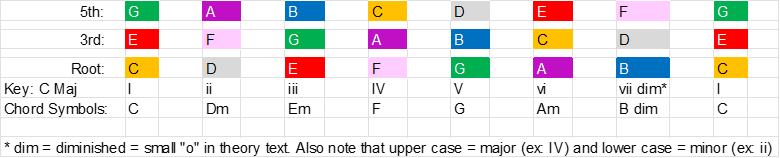
  • C major has no sharps or flats.
  • Notice the similarity in the pattern of triads between the keys: major, minor, minor, major, major, minor, and diminished.
  • This means that the relationships between the notes remain the same, but the actual notes in each harmony differ from F major.
Can Someone Explain Roman Numeral Analysis in Layman's Terms for Me - Triads Key of C - Tonic vs. Root in Music Theory - The C Major Scale (Including the C Major Chord Scale) - Whats the Secret of Practicing Arpeggios

Key of G Major

  • G major has one sharp: F#.
  • All the other notes are naturals.
  • Notice that the F# affects some triads, but not others.
Can Someone Explain Roman Numeral Analysis in Layman's Terms for Me - Triads Key of G - The G Major Scale (Including the G Major Chord Scale)

Key of D Major

  • D major has two sharps: F#, C#.
  • The Roman numeral analysis tells you which note of the scale a triad is built on.
  • Uppercase Roman numerals indicate major triads, and lowercase Roman numerals indicate minor triads.
What’s a Melody (and How to Write Strong Ones) - D Major Chord Scale

Key of A Major

  • A major has three sharps: F#, C#, G#.
  • The decimal numbers tell you how a harmony is constructed.
  • The chord gets its name from the root note, the third is three notes above the root, the fifth is five notes above the root, and the seventh is seven notes above the root.
How to Best Use Family Chords

Key of E Major

  • E major has four sharps: F#, C#, G#, D#. The sharp notes now outnumber the natural notes.
  • Chord symbols are used by chordal instruments such as the piano and guitar to create accompaniments.
  • A letter by itself indicates a major triad, a letter with a small “m” after it indicates a minor triad, and a decimal number 7 added after the letter means that an interval of a seventh has been added to the triad.

Click here to see all twenty-four major and minor keys.

How to Best Use Family Chords

For more information on chords and keys

How to Best Use Family Chords: How Is it Used in a Song?

Family chords are used in chord progressions within various keys.

  • What’s a chord progression?
  • It’s when you move from one triad to the next.
  • Below is a rock n’ roll progression.
  • If you watch the video, you can hear it being used in the verse of the song Earth Angel.
  • Earth Angel is in the key of Ab major. Solo using the Ab major scale over the progression.
Chord Progression (Including the 12 Bar Blues) - Triads in Ab Major
Video: Earth Angel

These books will help you become a better songwriter and player.

Changing Keys in Your Songwriting - pencil, eraser, and sheet music - Singing Shape Note Harmonic Minor Melodies - Learn the Elements of Songwriting Construction - Can Someone Explain Roman Numeral Analysis in Layman's Terms for Me - How Can I Learn the Basics of Music Theory - Song Structure, Musical Phrases, Musical Structures and Forms - What Exactly Do I Do with the Circle of Fifths - Do I Really Have to Learn Music Theory to Learn How to Play Piano - Why Do Minor Keys Sound Sad to Me - Color Code Key Signatures - Keyboard Accidentals - What is a Parallel Mode and How Does it Work - What Purpose Do Accidentals Serve in Reading Sheet Music - Reading Music (A Quick Guide to How to Read Music) - How Can I Learn the Basics of Music Theory - What Exactly Do I Do with the Circle of Fifths - An Easy How to Guide to Understanding Triads - 50 Essential Music Symbols Explained in Less Than 5 Minutes - What Exactly Do I Do with The Circle of Fifths - Circle of Fifths - How to Learn Music Theory with a Learning Disability - How to Effectively Use Music Theory to Transpose Music

Final Thoughts

Takeaway points:

  1. Family chords are harmonies that are all in the same key. In other words, they all have notes drawn from one scale, such as C major or G major.
  2. Family chords are also called diatonic harmony.
  3. If your triads are all in the same key (for example D major), this means that the D major scale will work over the chords in D major when soloing.

Have fun writing!

Glossary

memory and songwriting - young woman remembering - brainstorming your song titles - Learning Differences and Spatial Ability - after they can sight-read what’s left for musicians to learn - How Long Do You Take to Memorize a Piece of Piano Music - The Gifted Dyslexic and Insight Learning

Memory and Songwriting

Do you want your song to be catchy? If people can't remember your song, you’ve got a problem. Therefore, you need know how humans remember things. Read more to understand the connection between memory and songwriting. Estimated reading time 4 minutes.

Read More
Can I Learn Sight-Singing if I Haven't Learned an Instrument -Jazz Singer - Is There a Difference in Difficulty for Singing Specific Vowels - Do You Need Help Learning How to Harmonize - How Do I Switch from Singing Shaped Notes to Standard Notation - How to Figure Out Your Voice Type

Can I Learn Sight-Singing if I Haven’t Learned an Instrument?

Do you want to learn how to sight-sing? Have you ever wondered, “Can I learn sight-singing if I haven’t learned an instrument?” You’ve come to the right place! Read more to find out whether it’s possible to learn sight-singing without having learned an instrument first. Estimated reading time 2 minutes.

Read More


How to Set Up a Music Teacher’s Percussion Bag - Percussion Box

How to Set Up a Music Teacher’s Percussion Bag

Have you been thinking about keeping percussion instruments on hand for your music lessons? Do you want an idea of what should go into your bag? A percussion bag or box is useful for any music instructor. It can make the difference between happy, engaged students and pandemonium. Click “How to Set Up a Music Teacher’s Percussion Bag” for some tips to get you started. Estimated reading time 4 minutes.

Read More
What Precisely Is the Purpose of a Clef - Clef Cookies

What Precisely Is the Purpose of a Clef?

What precisely is the purpose of a clef? It’s the symbol to the left side of the staff that helps you know how to play the sheet music’s notes. The three most common are: treble, alto, and bass. Keep reading to learn what they are and how they work. Estimated reading time 2 minutes.

Read More