



Success Music Studio

What’s a Melody (and How to Write Strong Ones) - Woman with Headphones

What’s a Melody (and How to Write Strong Ones)

Facebook
Twitter

Estimated reading time 3 minutes

Table of Contents

Introduction

Do you want to learn how to write a melody? A melody is a series of notes that sound in rhythmic sequence. In a song, it’s the musical part that the lead vocalist sings. It’s the main focus of the music, because it’s what sells the song. Keep reading What’s a Melody (and How to Write Strong Ones) to learn what it is and how it works.

Singing Sixteenth Note Rhythmic Syllables - Girl Singing - Singing Shape Note Harmonic Minor Melodies - Can I Learn Singing on the Piano? - How to Unlock the Secret of Writing Dance Songs

What’s a Melody (and How to Write Strong Ones): The Scale and Chord Approach

How do you write a strong melody?

  • The first step is to write a lot of them.
  • Why? Because some of the melodies you write will be banal, others will be good, and a few will be really special.
  • The more you write, the more you’ll uncover the special ones.

There are a few ways you can start writing.

  1. The scale and chord approach
  2. The rhythm approach
  3. The intuitive approach

Start with scales and chords.

Mobile users: for best results reading the music, rotate your screen 90o to the right.

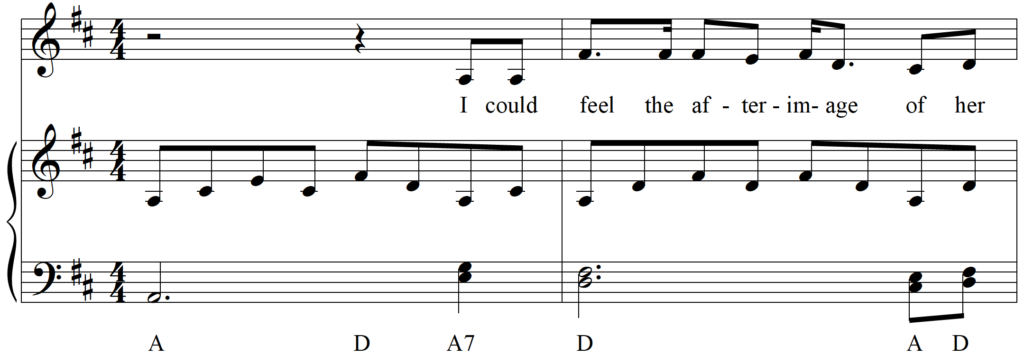
Do You Want Cool Chords for Your Song - Afterimage Arrangement 1 (line 1) - Cadence Meaning and Definition (Examples for Music and Language) - What’re the Basics of an Accompaniment in a Song?
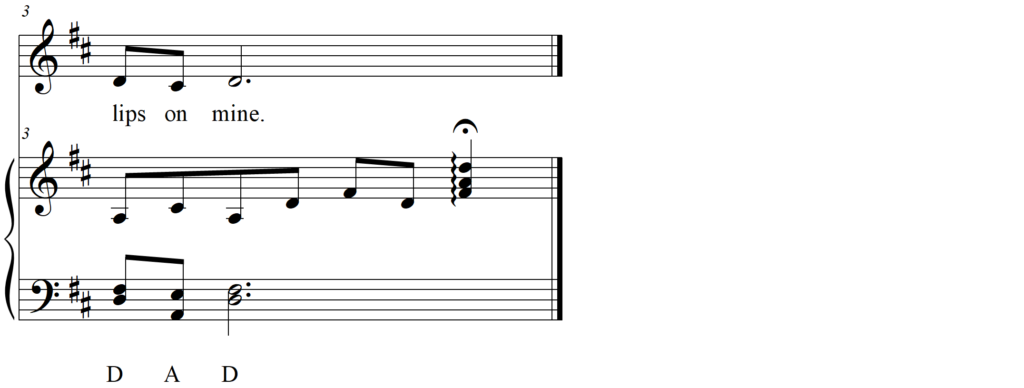
Do You Want Cool Chords for Your Song - Afterimage Arrangement 1 (line 2) - Cadence Meaning and Definition (Examples for Music and Language) - What’re the Basics of an Accompaniment in a Song?

Afterimage Soundtrack:

One idea starter is to noodle around in a key and see what you can come up with:

  • Many pop songs stay entirely within one key.
  • The example above is in D Major, meaning that all the notes come from this key.
  • The D major scale has these notes: D E F# G A B C# D.

The following chart shows you the notes for the triads in D major:

What’s a Melody (and How to Write Strong Ones) - D Major Chord Scale

If you look at the Afterimage example above, most of the notes in the melody are harmonic tones:

  • This means that the lead vocalist’s notes are the same as the notes in the chordal accompaniment.
  • In fact, 11 of the 12 notes in the melody above are harmonic tones.
  • The only non-harmonic tone is the E in measure two that lines up with the syllable “ter” in the word “afterimage”.
  • Not all melodies will be this stuffed with harmonic tones.
  • However, most will have more harmonic tones than non-harmonic tones.

How does this help you?

  • If you’re low on inspiration, you can begin by using non-chord tones from the scale to connect chord tones together.
  • You’ll do this in a music notation program, which will allow you to hear a preview of your song.
  • Keep messing around with your tune until you get something that sounds good.

Once again, create lots of melodies and set aside the best ones for later development.

For more information on notation software:

The 5 Best Free Music Notation Apps - Music Studio

What’s a Melody (and How to Write Strong Ones): The Rhythm Approach

Experimenting with rhythm is another good idea starter:

  1. You can take different rhythmic patterns (like the example at this link for creating guitar riffs) and mess around with them.
  2. Another thing you can do is use the rhythm of your lyrics as the basis of the rhythm for a melody.
  3. The final idea is you can use repetitive rhythmic patterns, called rhythmic motifs, to structure your tune.

For more information on how to use your lyrics to inspire melodic ideas:

For more information on rhythmic motifs:

Furthermore, you can put the scale and chord approach together with the rhythmic motifs approach to create full motifs.

How to Extract a Melody from Your Lyrics - vintage-typewriter-on-desk - The Narrator’s Point of View in Your Songwriting.jpg

What’s a Melody (and How to Write Strong Ones): Intuitive Approach

The intuitive approach is similar to the scale and chord approach in the sense that you start out with some chords:

  1. The idea is to sing over a chord progression.
  2. It can be any chords (even ones from your favorite pop songs) because you can’t copyright chord progressions. If you could, no one would be able to write certain styles again (e.g., blues, jazz, and doo wop).
  3. However, since an arrangement can be copyrighted, you need to make sure your rhythm is different so that you’re not just copying someone else’s song.
  4. Once you’re happy with your chords, record them. (If you don’t play an instrument, you can input the chords into your notation program.) Next, start singing over the chord track and record your vocals.
  5. Or you don’t even need a chord progression if a tune pops into your head when you read your lyrics.

Once again, create lots of melodies so that you can find the gems.

Final Thoughts

Takeaway points:

  1. What’s a melody? It’s the musical part that the lead vocalist sings.
  2. One way to start writing is to noodle around in a key and see what you come up with.
  3. Experimenting with rhythm is another good idea starter.
  4. With the intuitive approach, you can just begin singing and see what comes out.
  5. Once again, write tons of tunes so that you can discover the keepers.

Have fun writing!

Related Posts

© 2025 Geoffrey Keith

Glossary

Shatter the Perfectionism Chains in Music Lessons - Blue Abstract Sheet Music

Shatter the Perfectionism Chains in Music Lessons

Are you a music teacher? Do you have a student who struggles with obsessive perfectionism? While having a high standard is a good thing, obsessive perfectionism can be debilitating. Keep reading to learn how to shatter the perfectionism chains in music lessons. Estimated reading time 3 minutes.

Read More


Top 5 Best Songs for Professional Wedding Singers - Bride

Top 5 Best Songs for Professional Wedding Singers

Do you want to sing at weddings? Do you need help developing your repertoire? A wedding is a special time for a couple because it’s the beginning of building a life together. If you do your job right, you help build memories that will last for the rest of their lives. Click to learn the top 5 best songs for professional wedding singers and learn about the resources for learning even more songs. Estimated reading time 3 minutes.

Read More
How Easy Is It to Play Renaissance Lute?

Are you a guitarist who wants to try playing the lute? Do you want to know how difficult it is compared to guitar? The Renaissance lute is a pear-shaped instrument with a swept back headstock that harkens back to another age. Keep reading “How Easy Is It to Play Renaissance Lute?” to learn more. Estimated reading time 3 minutes.

Read More
How to Record Using a DAW (Digital Audio Workstation) - Recording Keyboards

How to Record Using a DAW (Digital Audio Workstation)

Do you want to know how to record using a digital audio workstation? When I was a teen, and recording my band, all we had was two mics, two mic stands, and a dinky little four-track tape recorder, which had severely limited audio quality. However, today’s modern DAW software can get you pro quality results without having to buy a whole recording studio. Click to learn how to record using a DAW (digital audio workstation). Estimated reading time 4 minutes.

Read More