




Success Music Studio

What’re the Basics of an Accompaniment in a Song - Keyboard Player

What’re the Basics of an Accompaniment in a Song?

Facebook
Twitter

Estimated reading time 3 minutes

Table of Contents

Introduction

Do you want to know what a song accompaniment is? Do you want to know the basics for writing them? An accompaniment is an arrangement for the backing instruments that support your song’s principal melody. Keep reading What’re the Basics of an Accompaniment in a Song? to learn more about what it is and how it works.

This article uses musical terms. For definitions, see the Glossary at the end of the post.

How to Read Basic Guitar Tab for Beginners - Guitarists

What’re the Basics of an Accompaniment in a Song #1: What Is an Accompaniment?

What’s an accompaniment? An accompanimental arrangement is primarily a combination of harmony, rhythm, and scales that are arranged for some combination of backing instruments.

Usually, in pop music, an accompaniment is provided by at least a chordal instrument such as piano or guitar:

  • Typically, they’ll be joined by bass guitar, keyboards, and drums.
  • It’s not unusual for these instruments to be further augmented by harmonica, horns, strings, or backing vocals.
  • Sometimes they can be even larger ensembles such as jazz bands or even symphony orchestras.

How an accompaniment sounds depends on the musical style:

  • Rock bands emphasize driving rhythms laid down by the rhythm section: guitar, bass, keyboards, and kit drums.
  • A jazz band can have complex horn arrangements.
  • While classical-styled arrangements can have intricate polyphony and multilayered orchestrations.

Keep reading to learn how it works.

Sing in Tune Like a Rock Star - rock band on stage.jpg

What’re the Basics of an Accompaniment in a Song #2: How Does the Harmony Work?

Harmony is the backbone of your arrangement. It supports and enhances your principal melody:

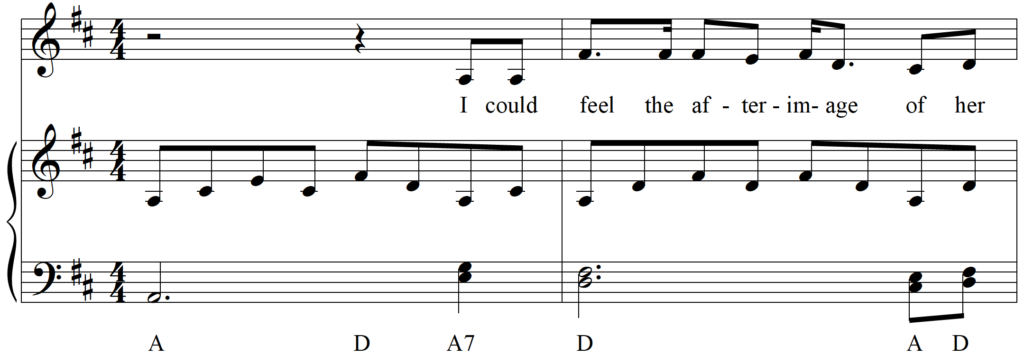
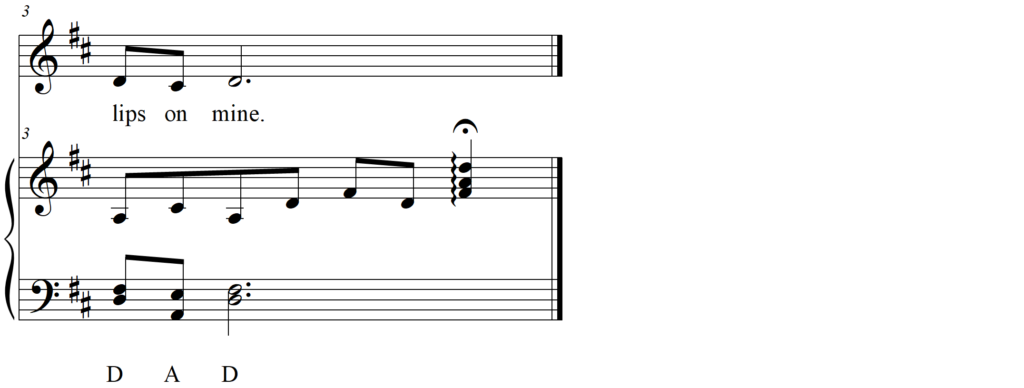
  • Notice that the vocal melody in the example below mostly consists of chord tones.
  • There are only occasional scale tones to connect the chord tones together.
  • Those connecting scale tones help give the line its melodic quality.

The supporting chords in the piano part below have these notes:

  • D Major Triad: D F# A
  • A Major Triad: A C# E
  • A7 Chord: A C# E G

The piano accompaniment below consists of arpeggios:

  • An arpeggio is a broken chord. This means that the chord tones are played one at a time instead of all at once like you’d find with block chords.
  • Arpeggios are good for lighter, softer music, while block chords are good for driving rhythms with lots of energy.
  • Ultimately, your goal is to create a fun arrangement that sounds cool.

For more information on harmony:

Mobile users: for best results reading the music, rotate your screen 90o to the right.

Do You Want Cool Chords for Your Song - Afterimage Arrangement 1 (line 1) - Cadence Meaning and Definition (Examples for Music and Language) - What’re the Basics of an Accompaniment in a Song?
Do You Want Cool Chords for Your Song - Afterimage Arrangement 1 (line 2) - Cadence Meaning and Definition (Examples for Music and Language) - What’re the Basics of an Accompaniment in a Song?

Soundtrack Piano Accompaniment Arrangement:

What’re the Basics of an Accompaniment in a Song #3: How Do You Arrange the Instruments?

Once you know what your harmonies are, you’ll need to figure out what instruments are going to play them:

  • At the very least, you must know instrument ranges and registers, because you need to know what notes an instrument will be able to play.
  • Also, you need to know what it sounds like in each part of its range.
  • Plus, it helps to learn something about the instruments. For example, you’ll need to understand that vocalists and wind instrumentalists need to breathe when performing.

The orchestration post (the first link below) does a deep dive into making musical arrangements.

For more information on how to create an arrangement:

Video: The Role of Each Instrument in a Pop Group

Final Thoughts

Takeaway points:

  • An accompaniment is primarily a combination of harmony, rhythm, and scales that are arranged for some combination of backing instruments that support the principal melody.
  • Harmony is the backbone of your arrangement. It supports and enhances your melody.
  • Once you know what your harmonies are, you’ll need to figure out what instruments are going to play them.

Have fun writing!

Related Posts

© 2025 Geoffrey Keith

Glossary

Hot Tube Amps Versus Cool Recording Studio Modelers - Marshall Amp

Hot Tube Amps Versus Cool Recording Studio Modelers

Have you been looking at gear and want to know whether tube amps or amp modelers are the better option for your guitar sound? Tube amps are old school and amp modelers are state of the art. However, each has its own advantages and disadvantages. Keep reading “Hot Tube Amps Versus Cool Recording Studio Modelers” to learn the benefits of each. Estimated reading time 3 minutes.

Read More
Learn How to Read Piano Notes (Free Resource) - Piano with Sheet Music

Learn How to Read Piano Notes (Free Resource)

Do you want to know how to read the notes in your piano music? Are you confused about why the right hand and left hand play different musical notes? Reading sheet music for piano is more difficult than for other instruments. Why? Because piano music uses two different clefs. Keep reading “Learn How to Read Piano Notes (Free Resource)” to learn how it works. Estimated reading time 2 minutes.

Read More

7 Songwriting Templates to Get Your Ideas Flowing - Acoustic Guitar with Capo

7 Songwriting Templates to Get Your Ideas Flowing

Are you stuck on how to begin writing your song? Have you been staring at a blank page and need help with structuring your song? You've come to the right place! Read on to learn more about 7 songwriting templates to get your ideas flowing. Estimated reading time 3 minutes.

Read More
How to Play Your $@&% Oboe in Tune - Oboe

How to Play Your $@&% Oboe in Tune

Do you need help with playing your oboe in tune? Mastering oboe intonation is one of the most challenging components of learning the instrument. However, once you’ve tweaked your intonation, it’ll make your instrument sound fantastic. Click to learn how to play your oboe in tune. Estimated reading time 4 minutes.

Read More