
Estimated reading time 3 minutes
Table of Contents
Simple Instructions for Pythagorean Tuning #1: The Pythagoras Angle
Do you need simple instructions for adjusting your synth to play Pythagorean tuning? The Pythagorean scale is based on the Pythagorean tuning ratios that are credited to (you guessed it) Pythagoras (same guy that invented the hypotenuse formula). However, it has since become popular with microtonal composers. Keep reading Simple Instructions for Pythagorean Tuning to learn the deep, dark secret of this scale.
This article uses musical terms. For definitions, see the Glossary at the end of the post.
Simple Instructions for Pythagorean Tuning #2: What Is It?
The New Harvard Dictionary of Music defines the scale as:
A diatonic scale characterized by pure fifths (3:2) … [The] scale can be derived by assuming a series of perfect fifths, beginning with F. If this series, F, c, g, d’, a’, e”, b”, is collapsed into a single octave, the Pythagorean scale is produced. (672-673)
The Greeks literally worshiped numbers in the sense that they thought the gods made everything, and since the gods were rational (as in ratios), everything should have an orderly, scientific explanation:
- Because of this, they searched for patterns in music, art, and nature, and of course, they found them.
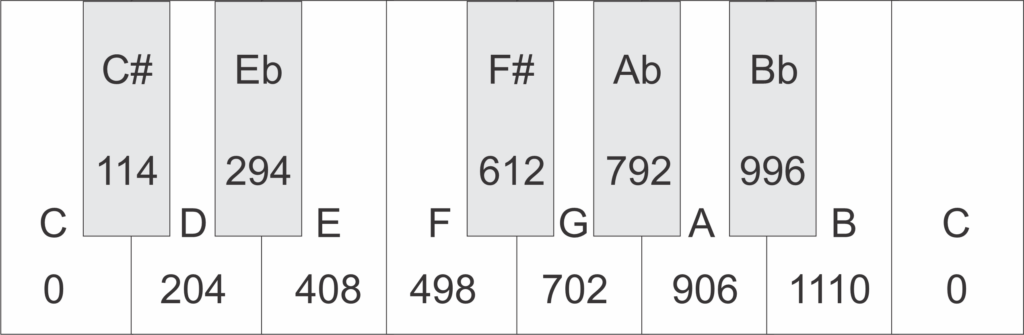
- However, there was a deep, dark secret about the 3/2 Pythagorean tuning ratio. If you stack twelve of them up (Ab 792, Eb 294, Bb 996, F 498, C 0, G 702, D 204, A 906, E 408, B 1110, F# 612, C# 114 – see the keyboard diagram below), the fifth between C# 114 and Ab 792 doesn’t make a 3/2 ratio.
- The Pythagoreans feared that this proved that the gods weren’t rational, so any member who revealed this secret was marked for death.
And it wasn’t just Pythagoras who viewed math, music, art, and nature this way. Stolba states:
Ptolemy was an astronomer and mathematician who, like Pythagoras and Plato, explained the universe as being bound together by mathematico-musical principals. (The Development of Western Music 13)
Keep reading to learn how the scale is constructed.
Simple Instructions for Pythagorean Tuning #3: How Do You Tune It?
Mobile users: for best results reading the example, rotate your screen 90o to the right.
How is the scale constructed?
- You use the Pythagorean tuning 3/2 frequency ratio to create a series of perfectly tuned fifths.
- To make things easier, instead of ratios, we’ll be using cents – with a perfect fifth of 702 cents. (See the glossary for a definition of cents.)
- Then, you’ll collect all those fifths into one twelve note scale.
To play the Pythagorean scale, you must have a microtonal keyboard:
- If you own a keyboard with global tuning, adjust your keys to the cent values from the above keyboard chart.
- They’ve been rounded to the closest cent, allowing synths with a 100 cent tuning range per keyboard key to play the Pythagorean scale.
- The keyboard chart centers around the C key instead of the F key.
Greek music wasn’t based on harmony, but rather on heterophony. Stobla asserts:
[Greek] instrumental accompaniment to a song was the duplication of the melodic line with occasional heterophony but without counterpoint or chordal accompaniment of the melody. (The Development of Western Music 10)
In other words, Heterophony is when two melodic lines are almost the same, but performers ornament them differently, creating slightly different melodies that they play together:
- This means that the Pythagorean scale is ideal for the Kithara’s melodic tuning but was never intended to be used harmonically.
- Some microtonal composers treat the Pythagorean scale like it’s an early form of just intonation. However, Greek music wasn’t created for playing just intonation chords.
- Nevertheless, this doesn’t mean it can’t be played harmonically.
- Unfortunately, the harsh Pythagorean major thirds don’t lend themselves to triads.
- So, you’ll need to build your harmonies based on fourths and fifths (like medieval counterpoint) rather than thirds and sixths.
Simple Instructions for Pythagorean Tuning #4: Final Thoughts
The takeaway points:
- The Pythagorean scale is based on the 3/2 Pythagorean tuning ratio.
- It’s ideal for heterophonic playing.
- However, it can be used for harmonies based on fourths and fifths.
Have fun playing!
Related Posts
- What Does Intonation Mean and Why Is It Essential in Music?
- How to Tune Your Incredibly Cool Microtonal Keyboard
- Intonation and Supplemented Equal Temperament
© 2025 Geoffrey Keith
Glossary
How to Tune C Wahine Like a Hawaiian
Do you like how Hawaiian music sounds? Do you feel frustrated that you can’t capture that sound yourself? Your tuning effects how the guitar sounds. Read more to learn how to tune C wahine like a Hawaiian. Estimated reading time 4 minutes.
Read MoreHow Do I Organize a Recital Concert?
Are you a music teacher? Are you organizing your first music recital? Whether you’re doing a classical recital, Christmas piano recital, a mini recital, or a chamber music recital, these musical recitals will all be organized basically the same way with just a few variations. Read more to answer the question, “How do I organize a recital concert?” Estimated reading time 4 minutes.
Read MoreHow to Play Musical Tempos from Adagio to Allegro
Do you want to know what the word tempo means? Do you need to understand how tempos work? Understanding how tempos work in music is a critical skill, because picking the right speed can breathe life into your music. Click to learn how to play musical tempos from adagio to allegro. Estimated reading time 3 minutes.
Read MoreWhy Do Just Intonation Keys Have Different Aural Characteristics?

Have you ever wondered why just intonation sounds different in different keys? This happens because the structure of just intonation diverges from equal temperament (the modern tuning standard), resulting in a different sound. Click to learn the answer to the question, “Why do just intonation keys have different aural characteristics?” Estimated reading time 4 minutes.
Read More