


Estimated reading time 3 minutes
Table of Contents
Introduction
Do you want a clear understanding of what the word resonate means in music? Music has an amazing capacity to affect our emotions. However, the word resonate can have both objective and subjective meanings when it comes to music. Keep reading What’s the Meaning of Resonate in the Context of Music? to learn both definitions.
This post uses technical and musical terms. For definitions, see the Glossary at the end of the article.
What's the Meaning of Resonate: Everything Vibrates
“What’s the meaning of resonate in the context of music?” It usually implies a sustained pitch created by a vibrating object such as a guitar string or a vibrating column of air in a brass or woodwind instrument.
In other words, to resonate is to vibrate and everything vibrates:
- From the membrane of a drumhead to the scream of a police siren to the sound of fingers tapping on a computer keyboard – everything vibrates.
- These vibrating bodies produce waves of sound that move through the air to your ears.
- Then, your ears turn the sound waves into neural impulses that the brain interprets as sound.
How do different instruments vibrate?
- Strings: Violins, violas, cellos, and bass viols transmit vibrations from the strings to the bridge to the soundboard to the air. Both the strings and the wooden sound broad affect the instrument’s timbre.
- Brass: Trumpets, horns, trombones, and tubas have vibrating columns of air that extend from the mouthpiece (where the lips vibrate against the mouthpiece) to just beyond the bell of the instrument. The player’s embouchure (the shape of their lips) will affect both the tuning and the tone color for this instrumental group.
- Woodwinds: Flutes, clarinets, oboes, and bassoons also have vibrating columns of air where the embouchure influences the sound. However, for both woodwinds and brass the bore of the tube (cylindrical vs conical) has an impact on the amount of warmth in the instrument’s tone.
- Percussion: Drums, mallet percussion, and ideophones encompass a wide and diverse group of instruments. The shape of the instrument and the type of materials used all affect how they vibrate, which affects the timbre (with many instruments possessing inharmonic spectrums).
What's the Meaning of Resonate: How Does It Affect the Tone Color?
“What’s the meaning of resonate in the context of music?” It means that the strings, wooden soundboards, and air columns can vibrate in complex patterns.
Harmonic overtones:
- When you strike a guitar string, it vibrates in wholes, halves, thirds, quarters, etc.
- These string divisions generate the fundamental frequency and a set of higher harmonic overtones.
- In other words, harmonics are high-pitched frequencies that vibrate along with the fundamental frequency. These play a role in shaping the instrument’s unique tone color.
Sympathetic vibration:
- Within the piano, the strings have different lengths and thicknesses, each of which determines the string’s pitch (i.e., it’s frequency) and timbre.
- Striking a piano key with the damper pedal down sets off a domino effect.
- Adjacent strings vibrate when sound waves with the same resonant frequency hit them.
- We call this effect sympathetic vibration.
- This helps to explain the piano pedal’s sound.
- The right pedal lifts the dampers allowing all the strings to vibrate.
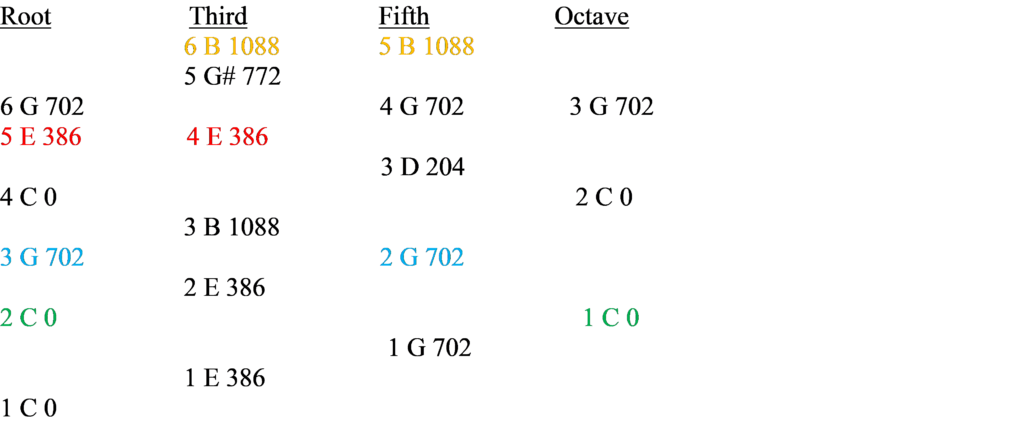
- When you play a key, it sets in motion all the strings containing harmonics at the same frequency as the note you played. This, in effect, amplifies any notes you play, because multiple notes will start ringing.
Mobile users: for best results reading the examples, tilt your screen 90o to the right.
For more detailed information on tone color:
What's the Meaning of Resonate: How Does it Affect Your Emotions?
“What’s the other meaning of resonate in the context of music?” The word can also have an emotional meaning as well.
- Some songs will “resonate” with you. That is, you form a strong emotional connection with some songs over others.
- It doesn’t matter whether it’s a soothing sonata or an exciting song, musical compositions tug at your heart strings.
- This makes sense, because composers deliberately try to craft music that will move their audiences’ emotions.
Final Thoughts on “What's the Meaning of Resonate in the Context of Music?”
Here’s a summary of What’s the Meaning of Resonate in the Context of Music?
- The term has two definitions that are relevant to music.
- It can be defined as a pitch created by a vibrating object.
- Or it can be defined as music that touches our deepest feelings.
Related Posts
- How Do Guitar Harmonics Work?
- Intonation and Supplemented Equal Temperament
- Basic Acoustics Music Pitch and Sound Frequencies
© 2024 Geoffrey Keith
Join me for in-person or online lessons today!
Glossary
Why Do Just Intonation Keys Have Different Aural Characteristics?
Have you ever wondered why just intonation sounds different in different keys? This happens because the structure of just intonation diverges from equal temperament (the modern tuning standard), resulting in a different sound. Click to learn the answer to the question, “Why do just intonation keys have different aural characteristics?” Estimated reading time 4 minutes.
Read MoreWhat Purpose Do Accidentals Serve in Reading Sheet Music?
“What purpose do accidentals serve in reading sheet music?” Sharps, flats, and naturals (collectively called accidentals) grew out of a problem that needed to be fixed in the mediaeval music notation. The music theorists of the time slapped their fix onto the preexisting notation system, and that fix is still with us to this day. However, having confused generations of budding musicians, the results of the fix leave a lot to be desired. Click to answer the question, “What purpose do accidentals serve in reading sheet music?” Estimated reading time 3 minutes.
Read MoreSound Like a Rock Star with Open G Tuning

Do you want to capture the sound of 70s rock guitar? Amp settings, effects, pickups, and strings all play a role in crafting your guitar sound. Nevertheless, the tuning you choose remains an important factor in your guitar sound that you might have overlooked. You will also learn the song “Brown Sugar.” Read more to learn how to sound like a rock star with open G tuning. Estimated reading time 3 minutes.
Read MoreWhat’s a Groove? (Including How to Write Hot Songs)
Do you need to know what a groove is? Do you want to learn how to write incredibly cool songs? The groove is the part of your song that makes you want to move to the beat. However, writing successful songs isn’t magic - it’s a skill that can be learned. Keep reading “What’s a Groove? (Including How to Write Hot Songs)” to learn how to write a killer groove. Estimated reading time 4 minutes.
Read More