
Success Music Studio

jumpstart the creativity in your songwriting - woman brainstorming song ideas

How to Jumpstart the Creativity in Your Songwriting

Facebook
Twitter

Estimated reading time 4 minutes

Table of Contents

Introduction

Have you ever had trouble coming up with songwriting ideas? A creative dry spell can be one of the worst things for a songwriter to have happen. Read more to learn how to jumpstart the creativity in your songwriting.

I remember my worst dry spell back in 1988. I didn’t have any trouble coming up with music, but I had hit a big wall with my lyric writing. No matter what I tried to do I could not come up with good topics to write about.  My next ten years were spent figuring out how to jumpstart inspiration.

One of the best pieces of advice I have ever heard of on the subject of jumpstarting musical ideas came from Jimmy Kachulis.  I saw Kachulis, a Berklee College of Music songwriting professor, at a Boston Songwriters Workshop event back in 1997. He suggested that when you get stuck you can write new material to hit songs to get the juices flowing.

This article uses musical terms. For definitions, see the Glossary at the end of the post.

music of words in songwriting, (i.e., the music of the words) impacts your songwriting, music of words into your songwriting - writing lyrics - jumpstart the creativity in your songwriting - Pronoun Definition & Meaning: Unlock Your Knowledge [Video]

Writing New Lyrics to a Hit Song to Jumpstart the Creativity in Your Songwriting

Your first exercise for jumpstarting the creativity in your songwriting, take a melody from a hit song and write new lyrics to it. Once you’ve come up with the lyric, dump the original melody and write a new melody of your own.

Writing lyrics to a hit melody can also be a great learning tool. It allows you to subconsciously absorb the rhythm, flow, and form of the song.

Conversely, you can write a new melody to preexisting lyrics. Then, write your own lyrics to the melody you’ve just created.  It gives you a place to start when you write to a preexisting song. That way you don’t come into the process totally cold.

In other words, it gets the ideas flowing. However, you won’t be stealing, because you’ll only use the material you’ve written.

Writing a New Melody to Preexisting Chords to Jumpstart the Creativity in Your Songwriting

Writing a Melody to the Chords from a Preexisting Song

You can also jumpstart the creativity in your songwriting by writing a new melody to the chords from another song. This works really well when you play the chords to a different rhythm. That way no one will know for certain what song you took the chords from.

However, when you write a new melody to another song’s chords, you don’t have to slavishly keep to the preexisting chord structure. Use the progressions to get the juices flowing, but don’t box yourself in. Follow where your ear tells you to go.

How to Pick the Chord Progression

When picking chord progressions to write over, pick ones from songs you love and that move you. Much of the power of the chord progression will often transfer to your melody. The chords will have a certain color to them regardless of what melody notes get sung over them.

Writing over new chords can also help you get out of any melodic ruts you may be in.  A chord progression will naturally limit the number of notes, because only three or four notes will work over each chord.

If you write over the same chords all the time, you’ll have a tendency to fall into melodic patterns. This explains why so many blues melodies sound similar to each other.

Writing over a new chord progression can help you breakout of stale melodic patterns. Writing over chords from a style you don’t usually write in can push the process even farther.

Similarly, if you write in verse/chorus form all of the time, try writing in AABA form every third or fourth song. Getting into ruts can lead to stale writing. Therefore, breaking out of ruts can help jumpstart the creativity in your songwriting.

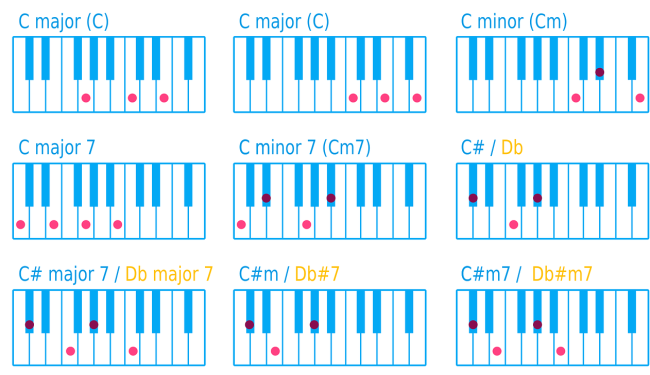
jumpstart the creativity in your songwriting - piano chords - Changing Keys in Your Songwriting - Need Advice for Teaching a First Year High School Jazz Pianist - An Easy How to Guide to Understanding Triads

Brainstorming Titles to Jumpstart the Creativity in Your Songwriting

What’s the third exercise for jumpstarting the creativity in your songwriting? You can free-associate ideas from existing song titles.

Go through CDs, song books, or search online, and brainstorm ideas for songs. If someone has written a song called “Cinema”, you might come up with a title like “At the Movies.”

Try to keep your title as original as possible so that it will not be confused with the title of any other song.  With this exercise you are just trying to get the juices going, not steal someone else’s title.

Only twenty titles out of a hundred will be worth developing. Therefore, brainstorm tons of titles against future need and keep them in a folder.

jumpstart the creativity in your songwriting - columbus ohio theatre - Noun Definition & Meaning (Noun Examples & Types of Nouns)

Conclusion

The last suggestion for jumpstarting the creativity in your songwriting is to keep a small notebook for lyric ideas. If you think of a title or a line, or if you hear someone say something witty, write it down for future use.

Hank Williams, Waylon Jennings, Ben E. King, and Eddie Snyder all used to keep notebooks. It can be one of the best ways to stave off creative slumps.

I hope you never have a dry period like I had in the late ’80s. If you use the strategies described above, it will go a long way toward letting you have a great songwriting experience. Have fun writing!

© 2021 Geoffrey Keith

Newsletter Signup

Join me for in-person or online lessons today!

Back to The Craft of Songwriting Category Blogs page

Back to the Successful Music Student Blogs page

Glossary

What Precisely Is the Purpose of Solfege - Headphones and Sheet Music

What Precisely Is the Purpose of Solfege?

“What precisely is the purpose of solfege?” Solfege has an important role in music education, allowing vocalists to develop sight singing skills. A solfege syllable acts as a mnemonic device to help you sight read sheet music. Read more to learn why they invented solfege and how the syllables work. Estimated reading time 2 minutes.

Read More
Art vs Commerce in Songwriting - Mozart

Art vs Commerce in Songwriting

Ever wonder if writing a hit song means you’re selling out? When pitching songs, do you worry about losing creative control? The question of art vs commerce has only been with us a relatively short amount of time. Read more to find out what changed. Estimated reading time 6 minutes.

Read More
12 Simile Examples That Aren’t Cliches (How to Write Them) - Writer with Notepad and Laptop

12 Simile Examples That Aren’t Cliches (How to Write Them)

Are you unsure about how similes work? Do all the similes you write seem trite? If you want your writing to move people, you need to make sure that you use original imagery that has power and presence. Read “12 Simile Examples That Aren’t Cliches (How to Write Them)” to find out how it works. Estimated reading time 3 minutes.

Read More


How to Teach Music Students with Dyscalculia - Numbers

How to Teach Music Students with Dyscalculia

Does your child or student have dyscalculia? Do you need help getting them to play rhythm accurately? Children with dyscalculia have struggles with math, and math and music have a lot in common. So, it makes sense that students with dyscalculia can have problems learning music. However, this post is stuffed with teaching tips that will help students learn. Keep reading “How to Teach Music Students with Dyscalculia” to learn multisensory strategies that will help kids of all abilities have fun playing and singing. Estimated reading time 4 minutes.

Read More