Success Music Studio

Explore Mozart’s Enchanting Music in Less Than Four Minutes

Facebook
Twitter

Estimated reading time 3 minutes

Table of Contents

Introduction

Do you want to know Mozart and his music but not take a ton of time? Mozart, along with Bach and Beethoven, is in an elite category of classical composers. If your average person on the street knowns any name in classical music, it’s probably one of those three. Keep reading to explore Mozart’s enchanting music in less than four minutes.

How to use the videos:

  1. Listen to 5 seconds of each piece.
  2. Usually this will be enough for you to tell if you want to listen to more.
  3. That way you can vet all the pieces in under a minute.

This article uses musical terms. For definitions, see the Glossary at the end of the post.

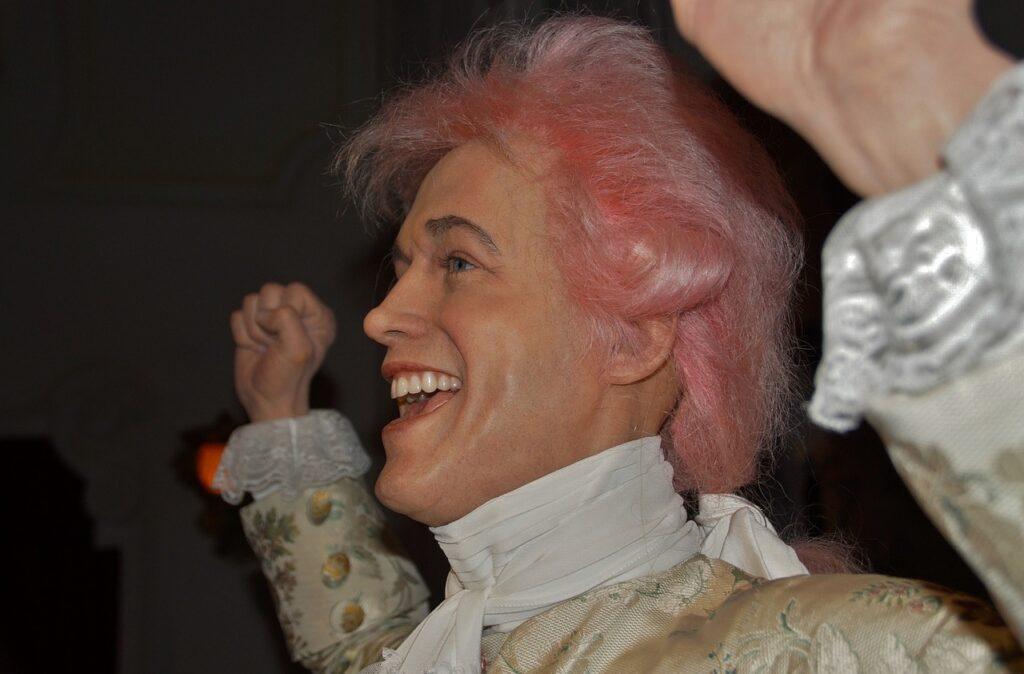
Perfect Pitch - Discover the Truth [Plus Absolute Pitch Test] - Mozart Busts - Explore Mozart's Enchanting Music in Less Than Four Minutes

Exploring Mozart's Music: Who Was He?

We’ll start the post Explore Mozart’s Enchanting Music in Less Than Four Minutes by quickly looking at who he was.

Mozart (1756 – 1791) wrote in every major musical genre of his time:

  • He composed over 600 works despite dying at the age of 35.
  • Saying that he was a prolific composer doesn’t capture the scope of what he achieved.
  • He wrote his first piano composition around 1762 or 1763 when he was about 11 years old.

Around this time, he toured Europe as a piano prodigy:

  • He and his sister Nannerl gave concerts in the afternoons and evenings.
  • Despite the intense performance schedule, he’d compose in the mornings and at night, sometimes working until daybreak.
  • Hence, he started writing music compulsively at a young age and never really stopped.
Requiem Meaning - Music, Memorial, and Mourning [Video] - Mozart Choral Music - Perfect Pitch: Discover the Truth [Plus Absolute Pitch Test] - Explore Mozart's Enchanting Music in Less Than Four Minutes - What Makes a Barbershop Quartet a Special A Cappella Group?

Exploring Mozart's Music: What Types of Music Did He Write?

Do you want to explore Mozart’s enchanting music in less than four minutes? Here’s a quick rundown of the genres he worked in.

Divertimenti and Serenades:

Serenades and divertimenti are light, fun pieces. Eine Kleine Nachtmusik is one of his catchiest melodies, making it a popular selection.

Popular Works Today:

  • Divertimento in D major, K. 136
  • Serenade in D major, K. 320
  • Eine Kleine Nachtmusik, K. 525
Video: Eine Kleine Nachtmusik, mvt 1

Piano:

Mozart’s menuets are some of the first pieces he composed as a boy. His first ever composition was the Menuet and Trio, K.1 (1e – 1f) listed below. Conversely, his piano sonatas (such as the Sonata in C major) display his brilliance and technical flare as a composer and performer.  

Popular Works Today:

  • Menuet and Trios, K.1 (1e -1f)
  • London Notebook, K. 15 (ll-pp)
  • Sonata in C major, K. 545
Video: Sonata in C Major, mvt 1

Symphonies:

He wrote forty-one symphonies, which are known for their memorable melodies and clean harmonies. In particular, he shows his mastery of the form in his last three symphonies.

Popular Works Today:

  • Symphony No. 25 in G minor, K. 183
  • Symphony No. 40 in G minor, K. 550
  • Jupiter Symphony No. 41 in C major, K. 551
Video: Symphony No. 41, mvt 1

Chamber Music:

Mozart must have loved writing for string quartets and quintets, because he featured them in his chamber music.

His six Haydn Quartets, K. 387–K. 421, are remarkable for their emotional depth and skill at polyphony. This reflects his early study of the counterpoint treatise Gradus Ad Parnassum. Generally, in his music all his melodies are singable, even the inner parts.

Popular Works Today:

  • Violin Sonata in B flat major, K. 454
  • String Quartet in G major, K. 387
  • Clarinet Quintet in A major, K. 581
Video: Clarinet Quintet, mvt 4

Choral Music:

His sacred music includes motets and masses. He started a requiem before he died, but Franz Xaver Süssmayr had to complete it.

Popular Works Today:

  • Missa in Honorem Sanctissimae Trinitatis (Mass in Honor of the Holy Trinity), K. 167
  • Ave Maria Corpus (Hail, True Body), K. 618
  • Requiem Mass in D minor, K. 626
Video: Requiem Mass - Lacrimosa

Concertos:

Mozart composed concertos for a variety of solo instruments. Piano Concerto No. 21 in C major and the Clarinet Concerto in A major show off his skills well.

Popular Works Today:

  • Flute Concerto No. 2 in D major, K. 314
  • Piano Concerto No. 21 in C major, K. 467
  • Clarinet Concerto in A Major, K. 622
Video: Piano Concerto No. 21, mvt 2

Operas:

His operas are acclaimed for their charming plots, beautiful arias, and elaborate arrangements. Die Zauberflöte was the first opera that was sung in a language other than Italian, while Don Giovanni is his most searched for work on Google.

Popular Works Today:

  • Le Nozze di Figaro (The Marriage of Figaro), K. 492
  • Don Giovanni, K. 527
  • Die Zauberflöte (The Magic Flute), K. 620
Video: Don Giovanni - Commendatore

Final Thoughts on “Explore Mozart's Enchanting Music in Less than Four Minutes”

Here’s a summary of Explore Mozart’s Enchanting Music in Less than Four Minutes:

  1. Mozart was a child prodigy who grew into a prolific musical genius.
  2. He wrote music in every major vocal and instrumental genre.
  3. His brilliance transcends time, giving us a wealth of flowing, virtuosic music that creates the illusion that it should be easy and effortless to play.

Now that you’ve explored Mozart’s enchanting music in less than four minutes, you can check out the videos and see which pieces you like best.

Have fun listening!

Related Posts

© 2024 Geoffrey Keith

Newsletter Signup

Join me for in-person or online lessons today!

Back to the All-Purpose Music Tips and Topics category blogs page

Back to the Successful Music Student Blogs page

The Flexibility in Supplemented Equal Temperament’s Theory - Guitarist and Keyboardists on Stage

Flexibility in Supplemented Equal Temperament’s Theory

Can Supplemented Equal Temperament help you coordinate your guitar and synth tunings so they sound good? A wide range of Supplemented Equal Temperament (SET) charts and preexisting EDOs (equal-division-of-the-octave tunings) can fit under the umbrella of SET. This gives you a lot of control over how you tune your guitars, ukuleles, banjos, and synths. This in turn will allow your whole ensemble to sound better in tune. Read more to learn about the flexibility in Supplemented Equal Temperament’s theory. Estimated reading time 5 minutes.

Read More
Simple Instructions for Pythagorean Tuning - Monochord

Simple Instructions for Pythagorean Tuning

Do you need simple instructions for adjusting your synth to play Pythagorean tuning? The Pythagorean scale is based on the Pythagorean tuning ratios that are credited to (you guessed it) Pythagoras (same guy that invented the hypotenuse formula). However, it has since become popular with microtonal composers. Keep reading “Simple Instructions for Pythagorean Tuning” to learn the deep, dark secret of this scale. Estimated reading time 3 minutes.

Read More

Whats the Secret of Practicing Arpeggios – Pianist

What’s the Secret of Practicing Arpeggios?

“What’s the secret of practicing arpeggios?” Arpeggios are both an important playing technique and a useful compositional device. They can add a flowing grace to your playing. Keep reading to learn more. Estimated reading time 3 minutes.

Read More
What’s the Basic Difference Between Drop D Vs Open D Tuning - Dobro Guitar

What’s the Basic Difference Between Drop D vs Open D Tuning?

“What’s the basic difference between Drop D vs Open D tuning?” Both are popular alternate guitar tunings. However, which string notes you alter, and how you play them once you’re done, will give them very different sounds. As a bonus, I’ve also added sections on Double Drop D and DADFAD tuning. Keep reading to learn what they are, and how you play them. Estimated reading time 3 minutes.

Read More