

Success Music Studio

Basic Arpeggios Explained in Less Than Three Minutes - Harp

Basic Arpeggios Explained in Less Than 3 Minutes

Facebook
Twitter

Estimated reading time 2 minutes

Table of Contents

Introduction

Are you clueless about arpeggios? An arpeggio, or broken chord, is a basic musical figuration that’s used in multiple musical genres and playing styles. It adds grace and elegance to your music, allowing you to achieve a lighter and more sophisticated sound. Keep reading Basic Arpeggios Explained in Less Than 3 Minutes to learn what they are and how they work.

This article uses musical terms. For definitions, see the Glossary at the end of the post.

Why Do Pianists Occasionally Play Their Hands at Different Times as They Perform - The 2022 Success Music Studio Student Showcase - Why Doesn’t My Hands-Separate Piano Practice Help with Hands-Together Playing

Basic Arpeggios Explained #1: What Is an Arpeggio?

Understanding how basic arpeggios work starts with understanding triads. The prefix Tri- means three, so a triad is a three-note chord.

The three notes of a triad are:

  • The root (for which the triad is named)
  • The third (three notes above the root)
  • The fifth (five notes above the root)

An arpeggio is a broken chord:

  • In other words, in a basic arpeggio the notes of a triad are played melodically, one after another, rather than all at the same time.
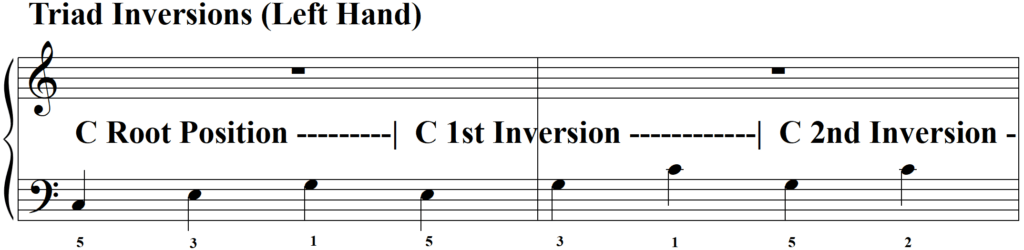
  • Therefore, if you play the notes of a C triad (C E G) one after another, you’ll have played a C major arpeggio.
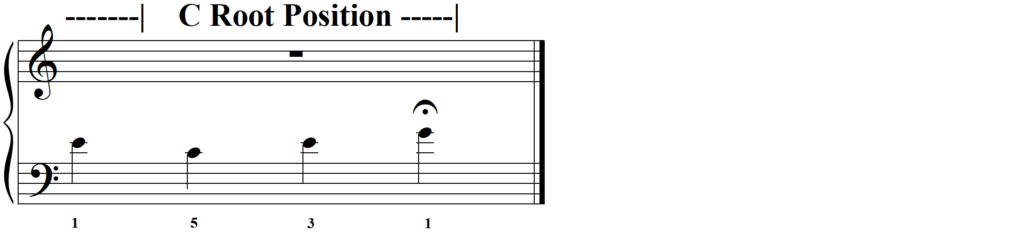
  • However, you can mix things up by inverting your arpeggios as shown in the example below.

Mobile users: for best results reading the music, rotate your screen 90o to the right.

Whats the Secret of Playing Arpeggios - Triad Inversions LH line 1
Whats the Secret of Playing Arpeggios - Triad Inversions LH line 2

Inversions:

Basic Arpeggios Explained #2: What Are Some Common Patterns?

The notes of a broken chord can be played in any order. However, these are some of the most common eighth-note broken-chord figurations used for the left hand on the piano:

  • Alberti Bass Pattern: C G E G C G E G
  • Ascending and Descending Pattern: C E G E C E G E
  • 3-4 Time Signature Pattern: C E G E G E or C E G E C E

Try out different note combinations and rhythmic patterns to make your broken chords and basslines even more interesting.

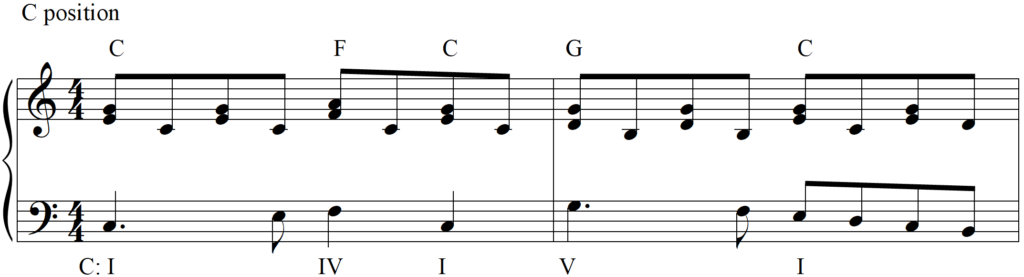
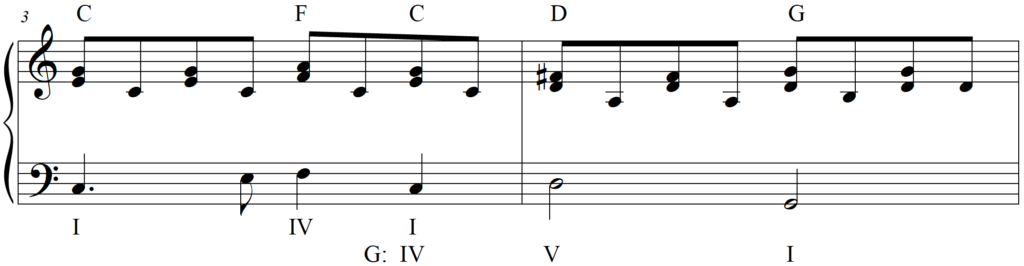
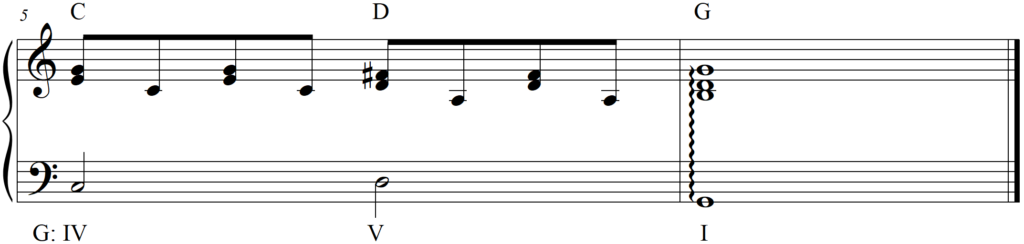
Here is a more complex pattern for the right hand with a left hand bassline:

Why Do Pianists Occasionally Play Their Hands at Different Times as They Perform - Changing Keys in Your Songwriting - Pivot Modulation line 1
Why Do Pianists Occasionally Play Their Hands at Different Times as They Perform - Changing Keys in Your Songwriting - Pivot Modulation line 2
Why Do Pianists Occasionally Play Their Hands at Different Times as They Perform - Changing Keys in Your Songwriting - Pivot Modulation line 3

Keyboard Arrangement:

Basic Arpeggios Explained #3: Understanding Triads and Keys

As you can see from the last example above, broken chords don’t have to be restricted to just the C major triad:

  • They can use the notes from any diatonic chord.
  • Diatonic what? Diatonic chords are the triads that have their notes come from only one scale.
  • For example, the triads in the key of C major only use the notes from the C major scale.

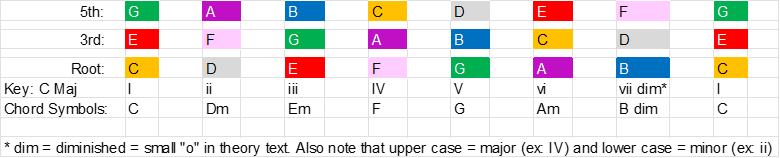
Therefore, arpeggios from the key of C major will be:

  • C Major: C E G
  • D Minor: D F A
  • E Minor: E G B
  • F Major: F A C
  • G Major: G B D
  • A Minor: A C E
  • B Diminished: B D F
Can Someone Explain Roman Numeral Analysis in Layman's Terms for Me - Triads Key of C - Tonic vs. Root in Music Theory - The C Major Scale (Including the C Major Chord Scale) - Whats the Secret of Practicing Arpeggios

In addition, you can see from the keyboard arrangement that you aren’t limited to only one key.

Can Someone Explain Roman Numeral Analysis in Layman's Terms for Me - Triads Key of G - The G Major Scale (Including the G Major Chord Scale)
Changing Keys in Your Songwriting - pencil, eraser, and sheet music - Singing Shape Note Harmonic Minor Melodies - Learn the Elements of Songwriting Construction - Can Someone Explain Roman Numeral Analysis in Layman's Terms for Me - How Can I Learn the Basics of Music Theory - Song Structure, Musical Phrases, Musical Structures and Forms - What Exactly Do I Do with the Circle of Fifths - Do I Really Have to Learn Music Theory to Learn How to Play Piano - Why Do Minor Keys Sound Sad to Me - Color Code Key Signatures - Keyboard Accidentals - What is a Parallel Mode and How Does it Work - What Purpose Do Accidentals Serve in Reading Sheet Music - Reading Music (A Quick Guide to How to Read Music) - How Can I Learn the Basics of Music Theory - What Exactly Do I Do with the Circle of Fifths - An Easy How to Guide to Understanding Triads - 50 Essential Music Symbols Explained in Less Than 5 Minutes - What Exactly Do I Do with The Circle of Fifths - Circle of Fifths - How to Learn Music Theory with a Learning Disability - How to Effectively Use Music Theory to Transpose Music

Final Thoughts

Takeaway points:

  1. Understanding basic arpeggios starts with understanding triads.
  2. Broken chords can be built from any triad of the diatonic scale.
  3. You can mix things up by inverting your broken chords and trying out different rhythms.

Have fun writing!

Related Posts

Glossary

How to Write Authentic Jesus Songs - Three Crosses

How to Write Authentic Jesus Songs

Do you love God and want to glorify His name? Do you need help learning how to write songs? Contemporary Christian Music (CCM) is a niche market that takes some specialized songwriting skills. Click to learn how to write authentic Jesus songs. Estimated reading time 3 minutes.

Read More


Chord Progression (Including the 12 Bar Blues) - Guitarist Playing Chords

Chord Progression (Including the 12 Bar Blues)

What’s a chord progression? It’s when you have a sequence of successive harmonies. In this post, we’ll look at common chord progressions, including rock n roll, the 12 bar blues, and jazz chord progressions. These can work as either piano chord progressions or guitar chord progressions. Read “Chord Progression (Including the 12 Bar Blues)” to learn the harmonic structure for these three styles of music. Estimated reading time 4 minutes.

Read More
Intonation and Supplemented Equal Temperament - Synth - On the Electric Keyboard Can You Play Dynamics - Why Do Just Intonation Keys Have Different Aural Characteristics

On the Electric Keyboard Can You Play Dynamics?

On the electric keyboard can you play dynamics? Well, that depends on the type of keyboard that you buy. In music, dynamics refers to the volume and intensity of sound, ranging from very soft (pp = pianissimo) to very loud (ff = fortissimo). Not all keyboards can play loud and soft through the keys though. Click to learn what you need to think about when buying an electronic keyboard. Estimated reading time 2 minutes.

Read More

What Exactly Does Onomatopoeia Mean in Writing

Do you want to know what in the world the odd sounding word onomatopoeia means? Do you need help learning how to write them? We’ll define the word and have examples from writing, songwriting, and poetry. Keep reading “What Exactly Does Onomatopoeia Mean in Writing” to learn what it is and how it’s used. Estimated reading time 2 minutes.

Read More