




Success Music Studio

How to Unlock Music Key Changes with Modulation - Sheet Music and a Pen

How to Unlock Music Key Changes with Modulation

Facebook
Twitter

Estimated reading time 3 minutes

Table of Contents

Introduction

Do you want to know what the word modulation means in music? Do you want to know how to make key changes in your songwriting? Modulation is when you use chromatic harmony to switch the tonal center of the music you’re writing. Doing this can make for dramatic, ear catching changes to the sound of your composition. Keep reading How to Unlock Music Key Changes with Modulation to learn what it is and how it works.

This article uses musical terms. For definitions, see the Glossary at the end of the post.

How Do I Write Good Songs Using Metaphors and Similes - Woman Writing Lyrics at a Table - 17 Songwriting Ideas to Get You Unstuck - Active Versus Passive Voice: How to Write Them

How to Unlock Music Key Changes with Modulation #1: What is Tritone Based Harmony?

Today we’ll discuss how you can use tritone based harmony to effectively modulate:

  • Tritones, otherwise known as diminished fifths or augmented fourths, are dissonant intervals that need a special resolution to sound good.
  • The notes either expand outward away from each other or inward toward each other by a half step: e.g., B-F to C-E or Cb-F to Bb-Gb. (Note: Cb = B.) This formulaic resolution helps smooth over the transition to a new tonal center.
  • It does this by instantly tonicizing the new key. Tonicizing is the process of reorienting a listener’s ear to a new tonal center.

All the harmonies shown in this post use the resolving tritone to chromatically reorient your ear to a new key.

For a discussion of basic triadic modulation:

Measuring a Song’s Success - Recording Sign - I'm Confused About These Stupid Vocal Ranges - How to Employ Effective Equalization on Your Song

How to Unlock Music Key Changes with Modulation #2: What Are Dominant Seventh Harmonies?

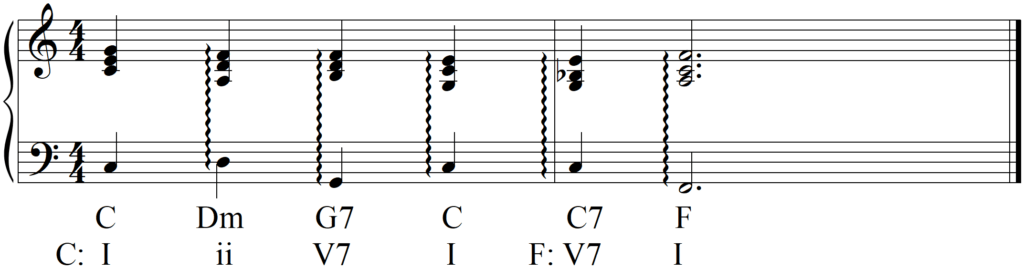
Dominant seventh (V7) harmonies strongly want to resolve to the I triad:

  • It’s called a dominant chord because it dominates the chord progression by pushing for a resolution to the I chord.
  • A resolution in music is when the piece progresses from a dissonant chord to a consonant chord.
  • You can use this effect to chromatically modulate from the current tonality to a new tonality.

For example:

Mobile users: for best results reading the music, rotate your screen 90o to the right.

How to Unlock Music Key Changes with Modulation - Dominant Seventh Chords

Dominant Seventh Modulation Soundtrack:

Can Someone Explain Roman Numeral Analysis in Layman's Terms for Me - Lego Roman - Tonic vs. Root in Music Theory - What’s the Deal with These i-VII-VI-V and iv-V-VII Chords and Stuff

How to Unlock Music Key Changes with Modulation #3: What Is a V7 of V Progression?

The chord progression in the previous section ended in a secondary dominant resolution:

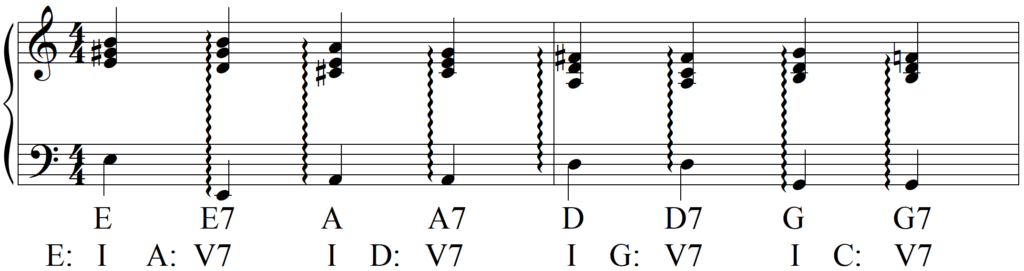
  • In other words, a dominant resolution is when you treat a triad as the I chord in the new key as you resolve from the V7 chord.
  • This is often done by chromatically turning the I triad from the old key into the V7 of the new key.
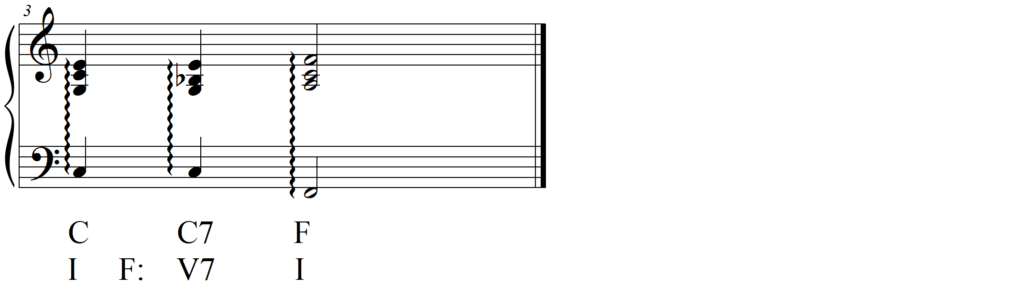
  • You can extend this by using chains of V7 harmonies to modulate through a sequence of keys making a series of V7of V progressions, so that the I triad in the old tonality acts as the V triad of the new tonality.

For example:

How to Unlock Music Key Changes with Modulation - V7 of V Chords line 1
How to Unlock Music Key Changes with Modulation - V7 of V Chords line 2

V7 of V Soundtrack:

How to Unlock Music Key Changes with Modulation #4: What Are Sub V7 Chords?

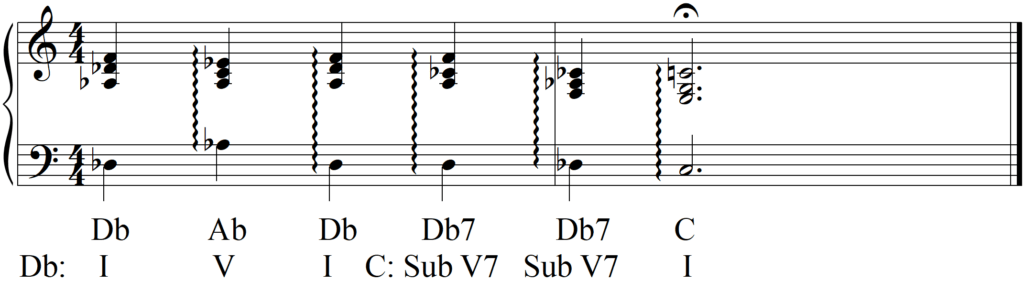
Any tritone will exist in two separate dominant seven chords, but with a different “spelling” for the notes. For example:

  • G7 = G B D F
  • Db7 = Db F Ab Cb

Both harmonies shown above share two notes: B/Cb and F. If you chromatically resolve the tritone in the opposite direction that usual, you can end up in a key a flattened fifth away:

How to Unlock Music Key Changes with Modulation - Sub V7 Chords

Sub V7 Soundtrack:

Augmented sixth chords function in a similar way to Sub V7 harmonies and thus will have a similar effect.

Final Thoughts

Takeaway points:

  • Modulation is when you use chromatic harmony to switch the tonal center of the music you’re writing.
  • All the harmonies shown in this post use the resolving tritone to chromatically reorient your ear to a new key.
  • It does this by using dominant harmony, including V7 of V and Sub V7 chords (the latter of which work similarly to augmented sixth chords).

…and with fully diminished seventh chords, you can do even more cool things, but that’s for another post.

Have fun writing!

Related Posts

© 2025 Geoffrey Keith

Glossary

Beethoven (Why Did He Keep Composing After Deafness) - Sheet Music - Singing Beethoven’s Beautiful Ode to Joy - Explore Beethoven’s Beautiful Music in Less Than Four Minutes - The Top 10 Best Iconic Classical Music Compositions

Why Did Beethoven Keep Composing After Suffering Deafness?

Do you want to know what motivated Ludwig van Beethoven to push through adversity to create some of the best and most influential classical music ever? By the time he turned fifty, he was considered by many to be the world's best living composer. His funeral was attended by 10,000 people. However, to achieve this level of fame he literally had to suffer for his art. That begs the question, why did Beethoven keep composing after suffering deafness? Keep reading to learn the answer to this and more. Estimated reading time 5 minutes.

Read More
Tune the Ukulele with a Free Online Tuner - Ukulele

Tune the Ukulele with a Free Online Tuner

Do you want to tune the ukulele with a free online tuner? If you’d like to get your ukulele into the standard ukulele tuning in equal temperament, don’t worry, I have what you need. However, did you know that the Hawaiians tune their instruments so that their ukes sound a lot better? Click to tune up the most common versions of the tuning. Estimated reading time 4 minutes.

Read More
Meantone Tuning (Simple Instructions) - Synthesizer

Meantone Tuning (Simple Instructions)

Do you need simple instructions for tuning a keyboard to meantone temperament? Meantone tuning is a temperament from Mozart’s time. It allows you to have an authentic sound when playing music from the classical period. Keeping reading “Meantone Tuning (Simple Instructions)” to learn how to get this sound. Estimated reading time 2 minutes.

Read More