
















Success Music Studio

What Exactly Do I Do with the Circle of Fifths - Spiral

What Exactly Do I Do with the Circle of Fifths?

Facebook
Twitter

Estimated reading time 3 minutes

Table of Contents

Introduction

“What exactly do I do with the circle of fifths?” The circle of fifths chart organizes musical keys and modes. Also, it helps you understand the relationships in music, making various tasks easier. Keep reading to learn more.

This post uses musical terms. For definitions, see the Glossary at the end of the article.

Changing Keys in Your Songwriting - pencil, eraser, and sheet music - Singing Shape Note Harmonic Minor Melodies - Learn the Elements of Songwriting Construction - Can Someone Explain Roman Numeral Analysis in Layman's Terms for Me - How Can I Learn the Basics of Music Theory - Song Structure, Musical Phrases, Musical Structures and Forms - What Exactly Do I Do with the Circle of Fifths - Do I Really Have to Learn Music Theory to Learn How to Play Piano - Why Do Minor Keys Sound Sad to Me - Color Code Key Signatures - Keyboard Accidentals - What is a Parallel Mode and How Does it Work - What Purpose Do Accidentals Serve in Reading Sheet Music - Reading Music (A Quick Guide to How to Read Music) - How Can I Learn the Basics of Music Theory - What Exactly Do I Do with the Circle of Fifths - An Easy How to Guide to Understanding Triads - 50 Essential Music Symbols Explained in Less Than 5 Minutes - What Exactly Do I Do with The Circle of Fifths - Circle of Fifths - How to Learn Music Theory with a Learning Disability - How to Effectively Use Music Theory to Transpose Music

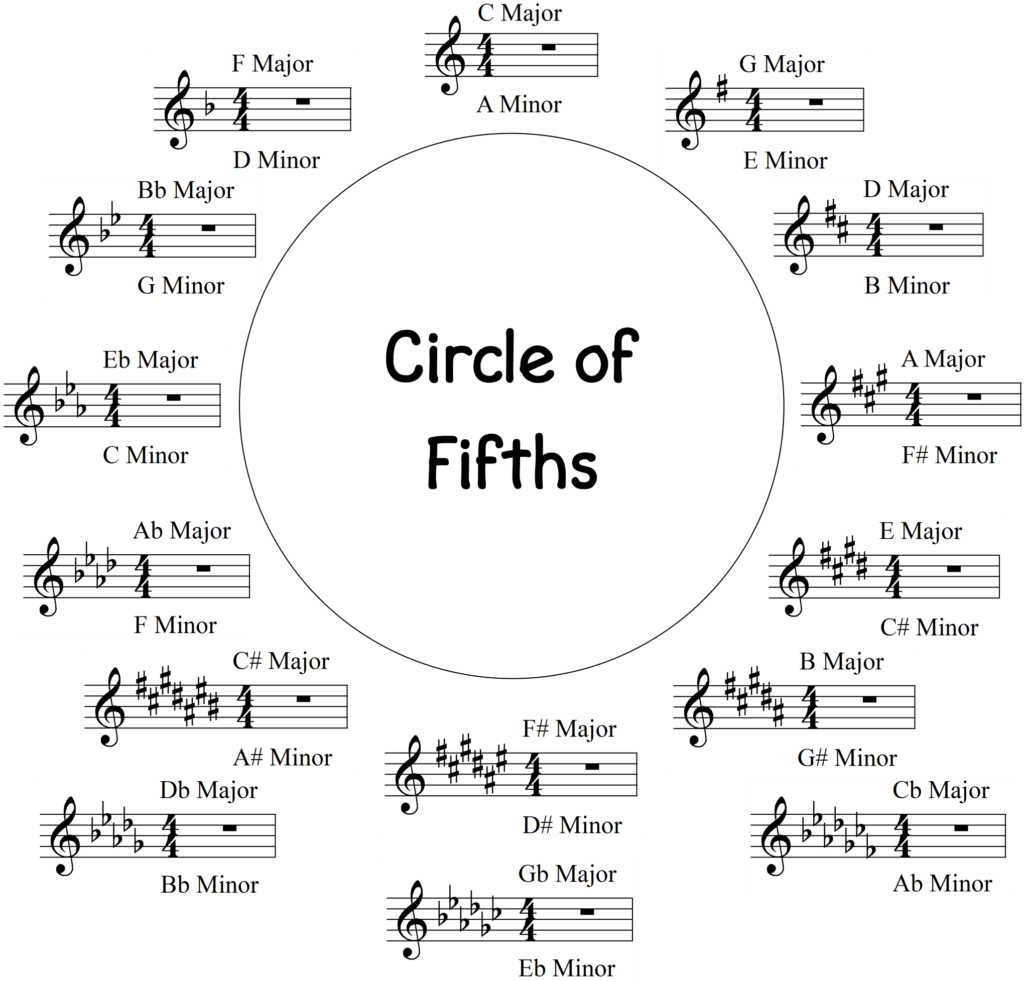
The Circle of Fifths: Let’s Take a Look at the Chart

Mobile users: for best results reading the examples, tilt your screen 90o to the right.

What Exactly Do I Do with The Circle of Fifths - Circle of Fifths - How to Learn Music Theory with a Learning Disability - How to Effectively Use Music Theory to Transpose Music

“What exactly do I do with the circle of fifths?” You use it to organize the twelve major and twelve minor keys:

  • When you move clockwise around the chart, you lose flats or gain sharps and vice versa.
  • In addition, closely related keys sit next to each other on the chart.
  • For example, C and G major have all the same notes except one (F#). Likewise, C and F major have all the same notes except one (Bb).

Thus, the chart is useful when you need to change keys (for more information, see section #4). Also, it’s useful for when you need to transpose a melody to fit the singing range of your voice.

Why are there two scale labels on each staff on the chart?

  • The major mode is above each staff and the minor mode is below.
  • When major and minor modes have the same notes, we call them relative modes.
  • However, each mode emphasizes different notes, making major and minor modes sound very different.

Therefore, the chart is useful when you need to change modes (for more information, see section #4).

What are enharmonic keys?

  • The C# and Db major scales, F# and Gb major scales, and B and Cb major scales are called enharmonic keys, because the scale pairs contain the same notes.
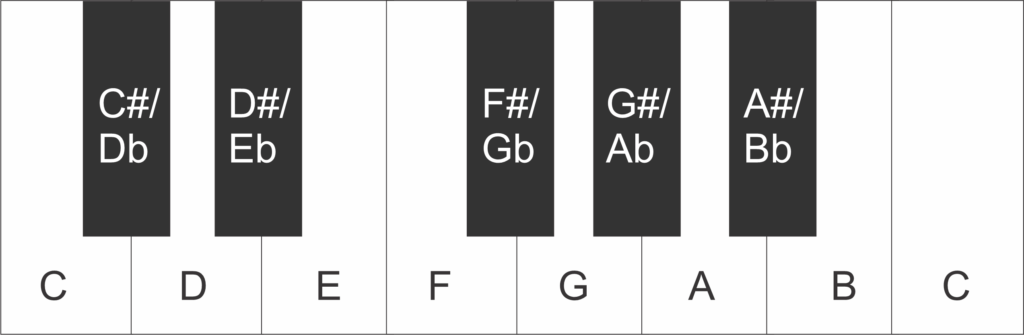
  • For example, the F# and Gb major scales have all the same notes on the keyboard, but one is “spelled” with sharps and the other with flats.
  • Try it! Take the notes from the F# and Gb major scales (see the scales in the next section) and play them on the keyboard.

In addition, enharmonic keys can have white key sharps and flats:

  • E# = F
  • B# = C
  • Fb = E
  • Cb = B
Do I Really Have to Learn Music Theory to Learn How to Play Piano - Why Do Minor Keys Sound Sad to Me - Color Code Key Signatures - Keyboard Accidentals - What is a Parallel Mode and How Does it Work - What Purpose Do Accidentals Serve in Reading Sheet Music - Reading Music (A Quick Guide to How to Read Music) - How Can I Learn the Basics of Music Theory - What Exactly Do I Do with the Circle of Fifths - An Easy How to Guide to Understanding Triads - 50 Essential Music Symbols Explained in Less Than 5 Minutes - What Exactly Do I Do with The Circle of Fifths - Circle of Fifths - How to Learn Music Theory with a Learning Disability - How to Effectively Use Music Theory to Transpose Music

To access an online keyboard: click here.

The Circle of Fifths: Now Let’s Look at How the Major Scales Can Be Organized Using the Chart

Why’s it called “the circle of fifths?”

  • Because the tonic notes of adjacent keys are five notes apart on the keyboard
  • The scales in this section are organized in the same order as the clockwise sequence on the circle of fifths chart.
  • For example, the tonic of G major is five notes away from the tonic of the key of D major.

Every time you move to a key with a tonic five notes away, you lose or gain either sharps or flats depending on the direction you move on the chart.

Why does this pattern happen?

  • The pattern of whole and half steps in the major scale’s construction makes this cyclical pattern of keys work.
  • The chart was created to take advantage of this effect.
  • For more information on scale construction, see section #4.
What Exactly Do I Do with The Circle of Fifths - C Major
What Exactly Do I Do with The Circle of Fifths - G Major
What Exactly Do I Do with The Circle of Fifths - D Major
What Exactly Do I Do with The Circle of Fifths - A Major
What Exactly Do I Do with The Circle of Fifths - E Major

B and Cb major are enharmonic keys:

What Exactly Do I Do with The Circle of Fifths - B Major
What Exactly Do I Do with The Circle of Fifths - Cb Major

F# and Gb major are enharmonic keys:

What Exactly Do I Do with The Circle of Fifths - F# Major
What Exactly Do I Do with The Circle of Fifths - Gb Major

C# and Db major are enharmonic keys:

What Exactly Do I Do with The Circle of Fifths - C# Major
What Exactly Do I Do with The Circle of Fifths - Db Major
What Exactly Do I Do with The Circle of Fifths - Ab Major
What Exactly Do I Do with The Circle of Fifths - Eb Major
What Exactly Do I Do with The Circle of Fifths - Bb Major
What Exactly Do I Do with The Circle of Fifths - F Major
What Exactly Do I Do with The Circle of Fifths - C Major
What is a Parallel Mode and How Does it Work - Sheet Music Keyboard - Is the Suzuki Music Methodology Bad for Learning Piano - How Can I Learn the Basics of Music Theory - What Exactly Is a Chord and What Does the Term Harmony Mean - What Exactly Do I Do with the Circle of Fifths

The Circle of Fifths: What’s the Practical Application?

This is the practical application section. However, the post would be too long if I went into detail here, so instead I’ve provided links that explain:

  1. How scales are constructed
  2. How modes work
  3. How chords work with the scales
  4. How to figure out the key and mode from the key signature
  5. How to change keys

These musical concepts, which are very closely related to the circle of fifths, will be explained by the following posts.

How Scales Are Constructed:

How Modes Work:

How Chords Work with the Scales:

How to Figure Out the Key and Mode from the Key Signature:

How to Change Keys:

Final Thoughts on “What Exactly Do I Do with the Circle of Fifths?”

Here’s a summary:

  • The circle of fifths chart organizes the twelve major and twelve minor keys, helping you to change keys or modes as well as to transpose music.
  • When major and minor keys all have the same notes, we call them relative keys.
  • The C# and Db, F# and Gb, and B and Cb major scales are the three enharmonic keys.

Related Posts

© 2024 Geoffrey Keith

Newsletter Signup

Join me for in-person or online lessons today!

Back to the All-Purpose Music Tips and Topics category blogs page

Back to the Successful Music Student Blogs page

Glossary

How to Transform a Poem into a Powerful Song - Pen, Paper, and Coffee

How to Transform a Poem into a Powerful Song

Do you want to know how to transform your poem into a song? Do you need help learning how to write a melody? Setting a poem to music is an incredibly cool way to take your poem to the next level. Keep reading “How to Transform a Poem into a Powerful Song” to learn how to set your text to music. Estimated reading time 3 minutes.

Read More

Singing Shape Note Solfege Mixolydian Melodies - Computer Mouse on Sheet Music -Do People with ADHD Have Difficulty Playing from Sheet Music?

Singing Shape Note Solfege Mixolydian Melodies

Do you want to sing blues, gospel, or even mediaeval melodies? Are you confused about how modes work? Modes have the exotic feel of world music and music from ancient times. "Singing Shape Note Solfege Mixolydian Melodies" helps you discover the sound of the modes. Estimated reading time 4 minutes.

Read More
Why Do Just Intonation Keys Have Different Aural Characteristics - Piano Tuner

Why Do Just Intonation Keys Have Different Aural Characteristics?

Have you ever wondered why just intonation sounds different in different keys? This happens because the structure of just intonation diverges from equal temperament (the modern tuning standard), resulting in a different sound. Click to learn the answer to the question, “Why do just intonation keys have different aural characteristics?” Estimated reading time 4 minutes.

Read More
The Gifted Dyslexic and Insight Learning - Notepad and Computer - What Exactly Is a Ballad and How Do You Write One?

The Gifted Dyslexic and Insight Learning (Part 4)

Have you ever wondered if you’re gifted and dyslexic? Or are you a parent of a child who’s gifted and dyslexic and want more information. Sometimes it can be difficult to recognize giftedness. Ronald Davis states, “This would commonly be recognized as daydreaming or simply not paying attention. The student is actually paying attention but has shifted to an imaginary world that is more interesting” (“The Gift of Learning” 38). How is this a sign of giftedness? Keep reading “The Gifted Dyslexic and Insight Learning” to learn about the last of our four dyslexic strengths. Estimated reading time 3 minutes.

Read More