
Success Music Studio

Why Do Minor Keys Sound Sad to Me - Sad Emoji - How to Write Beautiful Sad Songs

Why Do Minor Keys Sound Sad to Me?

Facebook
Twitter

Estimated reading time 3 minutes

Table of Contents

Introduction

Have you ever wondered, “Why do minor keys sound sad and major keys sound happy?” Has this phenomenon been hardwired into us, or does culture impact how we perceive scales? In fact, it’s a little bit of both. Read more to learn how this works.

This post uses some technical words. For descriptive links, see the Glossary below.

Why Do Minor Keys Sound Sad to Me- Ways Around the Difficulty of Playing the Piano Due to Short Fingers and Small Hands - piano fingers - How Can Legato Notes Be Played Staccato - Do My Hands' Sizes Affect Learning Performance on the Piano - Piano Major Scales (Basic Fingering Concepts)

Melody Impacts Why Minor Keys Sound Sad

Why do minor keys sound sad? Because of the melodic relationships. If you play the white keys on the keyboard from C to C, it’ll have a bright or happy sound. Conversely, if you play from A to A, it’ll have a dark or sad sound.

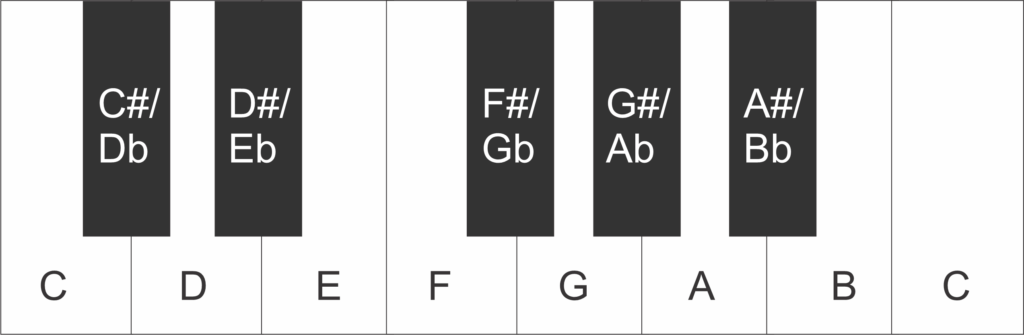
This happens because the pattern of whole (w) and half (h) steps changes between the minor and major scales. The C major scale has a pattern of w, w, h, w, w, w, h. You can see this on the keyboard diagram below.

The white keys all have black keys in between them – except for E & F and B & C. E & F and B & C are the half steps from the previous pattern.

In contrast, the A minor scale has a pattern of w, h, w, w, h, w, w. Because our ears hear in relative rather than absolute terms, the pattern shift completely changes the sound. Listen to the soundtracks to hear the difference.

Minor Key:

Relative Major Key:

Mobile users: for best results reading the examples, tilt your screen 90o to the right.

Do I Really Have to Learn Music Theory to Learn How to Play Piano - Why Do Minor Keys Sound Sad to Me - Color Code Key Signatures - Keyboard Accidentals - What is a Parallel Mode and How Does it Work - What Purpose Do Accidentals Serve in Reading Sheet Music - Reading Music (A Quick Guide to How to Read Music) - How Can I Learn the Basics of Music Theory - What Exactly Do I Do with the Circle of Fifths - An Easy How to Guide to Understanding Triads - 50 Essential Music Symbols Explained in Less Than 5 Minutes - What Exactly Do I Do with The Circle of Fifths - Circle of Fifths - How to Learn Music Theory with a Learning Disability - How to Effectively Use Music Theory to Transpose Music

Harmony Impacts Why Minor Keys Sound Sad

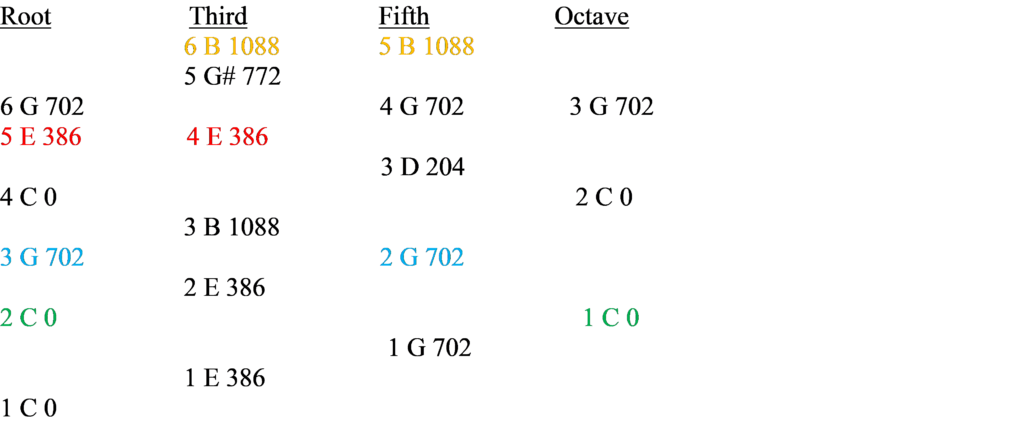
When you play notes together their harmonics interact. What are harmonics? Each note has a collection of pitches called harmonics that fuse together into one huge note called a complex tone. (See the chart below.)

When the critical bands between the harmonics in a chord overlap, it creates roughness. Suffice it to say that this creates the sense that some intervals and chords will be bright and others dark. You can hear this on the soundtracks below.

This partially explains why minor keys sound sad. For the rest of the explanation see the conclusion. For details on harmonics, fusion, critical bands, and the chart, read Harmony Is Tone Color.

I’ve provided the soundtracks to help illustrate the difference between minor and major sounds. However, the soundtracks have also been specially designed to help you sing in tune. If you’d like to see more Singing in Tune posts, click here for The Intonation Flight Simulator.

Minor Harmonies:

Relative Major Harmonies:

Why Do Minor Keys Sound Sad to Me -How Do Guitar Harmonics Work - Harmony is Tone Color - C Major Chord Chart - Learn the Secret Relationship of Timbre and Harmony - What's the Meaning of Resonate in the Context of Music - Can Somebody Explain Why Power Chords Sound Powerful?

Concluding Thoughts on Why Minor Keys Sound Sad

We’ve talked about why minor and major keys sound dark and bright, but why do minor keys sound sad and major keys sound happy? Your culture attaches meaning to the keys.

Not all cultures hear minor and major keys as sad and happy. In India, they have major scales that they consider to be sad, while they think some of the minor scales sound happy.

Because you grew up in (or were influenced by) Western society, you’ve learned to interpret the bright sounding major scale as happy. Likewise, you’ve absorbed through movies, MP3s, and the internet that the dark sounding minor scale should be sad.

However, when listening to non-western music, it’ll be better to think of the scales in terms of bright and dark.

Therefore, the fact that minor keys sound dark to us has been hardwired into our bodies. However, the emotional interpretation of the dark sounding key as being sad comes from Western culture.

Related Content:

© 2023 Geoffrey Keith

Newsletter Signup

Join me for in-person or online lessons today!

Back to the All-Purpose Music Tips and Topics category blogs page

Back to the Successful Music Student Blogs page

Glossary

color coded quarter note clapping - hands clapping - What Is the Basic Idea of Tempo in Music?

Color Coded Quarter Note Clapping

Do you have a hard time reading rhythm notation? (Or are you a teacher who has students that struggle with rhythm?) This remains a common issue with many musicians, but especially with LD, ADD, and special needs students. Read more to learn color coded quarter note clapping. Estimated reading time 4 minutes.

Read More
Whats a Good Alternative to a Metronome for Practice Sessions - Metronome - I’m Having a Hard Time Keeping a Steady Beat - Singing Rhythm - BPM (Using the Metronome to Get the Music Beat) - - How to Learn Music Theory with a Learning Disability

What’s a Good Alternative to a Metronome for Practice Sessions?

Teachers, do you have students who can’t use a metronome and can’t keep a steady beat? We all know how valuable metronome practice can be. However, it can be tricky for students to sync with a metronome, and many students flat out refuse to work with them. Click to answer the question, “What’s a good alternative to a metronome for practice sessions?” Estimated reading time 2 minutes.

Read More


sing in tune with synth settings - man singing while playing a synth - Can Somebody Explain Why Power Chords Sound Powerful?

Sing in Tune with Synth Settings

Does your choir have pitch issues? Retune your synth to make examples of good sounding chords. After years of hearing pianos tuned to equal temperament, many singers cannot sing harmony accurately. The piano is a bad model for how well-tuned chords should sound. Read more to learn how to sing in tune with synth settings! Estimated reading time 4 minutes.

Read More
What’s Pervasive Developmental Disorder and Its Impact on Music - Kids Exploring Percussion

What’s Pervasive Developmental Disorder and Its Impact on Music?

Do you need to know what pervasive developmental disorder is? Do you need advice on how to best teach your students? On one hand, PDD can affect how someone interacts with music. On the other hand, it can be a wonderful resource for boosting morale and generally enhancing your students’ lives. Click to answer the question, “What’s pervasive developmental disorder and its impact on music?” Estimated reading time 4 minutes.

Read More