Estimated reading time 4 minutes
Table of Contents
Why You Really Have to Learn Music Theory to Learn How to Play Piano
Do you want to give up on learning music theory? Does it seem pointless to you? Music theory can help with sight reading skills on the piano. It’ll be useful for improvisation and composition. It also helps with performance practice. If you still have an open mind, read Do I Really Have to Learn Music Theory to Learn How to Play Piano? to understand the ways it can help you to better play the instrument.
This post has links that define the musical terms, which you’ll find in the Glossary at the end of the article.
Do I Really Have to Learn Music Theory to Learn How to Play Piano: The Forest and the Trees Analogy
Mobile users: for best results reading the example, tilt your screen 90o to the right.
You might be asking yourself, “So, do I really have to learn music theory to learn how to play piano?”
The quick answer? No. Some people don’t get music theory, don’t want to know music theory, and sight read well enough that they don’t really need it anyway.
However, piano more than any other instrument can benefit from a music theory teaching approach. The keys all sit there before you. However, this means that musical patterns get lost for many pianists, and theory is all about patterns.
I like to use this analogy. On piano you can see the trees easier than the forest, but on guitar you can see the forest easier than the trees. The trees here represent the notes while the forest represents the patterns.
On guitar, you can easily move around using patterns. Once you’ve learned a moveable scale or chord shape, you can easily move it up and down the neck. However, doing this you’ll likely lose track of the notes.
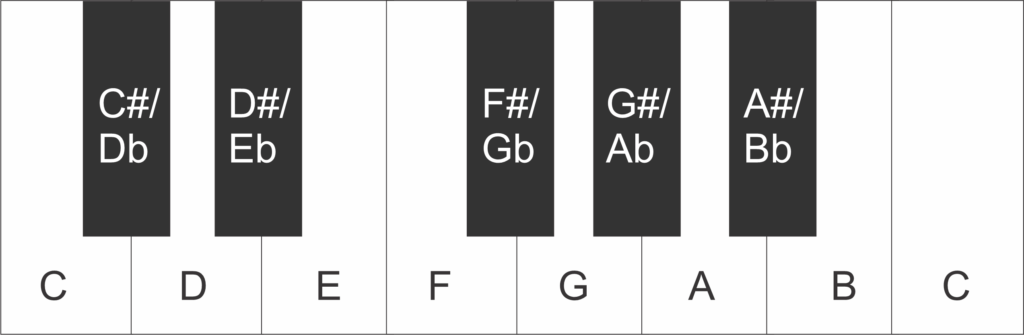
Conversely, on piano you’ll become hyperaware of the notes, but can lose the patterns. Every time you play a scale, chord, or arpeggio, you’ll need to know what notes you’ll be playing. But the layout of the keyboard, especially the missing black keys between E & F and B & C, obscures many of the patterns on the piano.
The patterns that music theory reveals will help you sight read, improvise, and compose better. This is really why you have to learn music theory to learn how to play piano. Because it will make you a better pianist.
Concluding Thoughts to “Do I Really Have to Learn Music Theory to Learn How to Play Piano?”
The New Harvard Dictionary of Music defines theory as, “The abstract principals embodied in music and the sounds of which it consists.
“With respect to Western music, theory has traditionally encompassed… pitch, duration, timbre… acoustics, tuning and temperament, intervals, consonance and dissonance, scales, modes, melody, harmony, counterpoint, rhythm, meter, form, and analysis” (844 – 845).
Now you might be asking, “Do I really have to learn all of that music theory to learn how to play piano?”
Once again, no. The aspects of theory most studied by pianists consists of just a few of these topics. I suggest that you start with notes, intervals, scales, chords, and rhythm, as these will be the most useful areas for you to learn. Most piano lesson books will work these into the teaching method.
Now, if you happen to be interested in how you tune instruments, especially alternate tunings for keyboard and guitar, check out the Intonation posts.
Have fun learning!
Related Content:
- How Does Your Brain Learn to Play the Piano with Two Hands?
- Ways Around the Difficulty of Playing the Piano Due to Short Fingers and Small Hands
- How to Overcome the Fear of Performing in Front of an Audience
- Why It’s So Hard for Someone with a Good Ear to Learn Sheet Music
- Why Do Minor Keys Sound Sad to Me?
- Why Do Pianists Occasionally Play Their Hands at Different Times as They Perform
- What Are the Small “>” Signs Above or Below the Notes?
- After They Can Sight-Read What’s Left for Musicians to Learn?
© 2023 Geoffrey Keith
Join me for in-person or online lessons today!
Back to the All-Purpose Music Tips and Topics category blogs page
Glossary
12 Best Taylor Swift Sheet Music Gift Ideas
Do you love Taylor Swift’s music? Are you looking for gift ideas for a Swifty? Taylor Swift has dominated the pop music scene for the last couple of decades, garnering both accolades and a ridiculous amount of commercial success. Keep reading to learn the 12 best Taylor Swift gift ideas. Estimated reading time 4 minutes.
Read MoreHow Do You Sing Eastern European Vocal Harmony in 2nds by Ear?

Have you ever wondered how Eastern European vocalists sing polyphony in parallel 2nds? Do you want to know how world music works? Understanding world music involves stepping outside your own perspective and seeing from the world musician’s point of view instead. Click to answer the question, “How do you sing Eastern European vocal harmony in 2nds by ear?” Estimated reading time 3 minutes.
Read MoreBest Music Program for Three-Year-Olds
As you may already know, Geoff from Success Music Studio is an expert in multisensory teaching, teaching piano to children as young as four-years-old. However, he has recently expanded to teaching three-year-olds a pre-instrumental music program that ultimately leads into piano lessons. Keep reading “Best Music Program for Three-Year-Olds” to learn more. Estimated reading time 2 minutes.
Read MoreWhat’re Critical Fine Motor Skills for Special Needs Music
Do you want to know what fine motor skills are and how they impact special needs music lessons? Fine motor skills are small, precise movements and therefore are a critical component of musical instrument lessons. Gross motor skills are also important in music. However, most instruments require a high level of finger precision, which is why in today’s post we’ll mostly focus on activities to develop finger dexterity. Keep reading “What’re Critical Fine Motor Skills for Special Needs Music” to learn how to increase finger dexterity in your special needs students. Estimated reading time 3 minutes.
Read More