

Success Music Studio

Why is Classical Music Interpreted Differently from Pop Music - Ludwig van Beethoven Bust - Beethoven (Why Did He Keep Composing After Deafness) - Singing Beethoven’s Beautiful Ode to Joy - Learn How to Play Beethoven’s Beautiful Fur Elise

Learn How to Play Beethoven’s Beautiful Fur Elise

Facebook
Pinterest
LinkedIn

Estimated reading time 5 minutes

Table of Contents

Introduction

Do you want to play Fur Elise? Do you need help with fingering? If you’re going to learn any classical piano piece, this is the one. It’s a crowd pleaser that’s a lot of fun to play. Keep reading to learn how to play Beethoven’s beautiful Fur Elise.

Do I Really Have to Learn Music Theory to Learn How to Play Piano - Understanding Prosody in Your Songwriting - piano - Learn How to Play Beethoven’s Beautiful Fur Elise

This post contains affiliate links, which means I may receive a small commission from purchases made through the links. I’ll only recommend products I use, use in lessons, or ones my students or colleagues have recommended.

Learn How to Play Beethoven’s Beautiful Fur Elise: Who Was Elise?

  • Fur Elise is one of the most popular pieces in the classical piano repertoire.
  • However, Fur Elise wasn’t published until 40 years after Beethoven’s death.
  • Nobody knows exactly who Fur Elise is dedicated to, though some people have suggested that it was Therese Malfatti – to whom he may have proposed.
Beethoven (Why Did He Keep Composing After Deafness) - Sheet Music - Singing Beethoven’s Beautiful Ode to Joy - Explore Beethoven’s Beautiful Music in Less Than Four Minutes - The Top 10 Best Iconic Classical Music Compositions

Learn How to Play Beethoven’s Beautiful Fur Elise: How Do I Play It?

Fur Elise is late intermediate playing difficulty.

  • This means that if you’re new to piano you should start with a beginner method book, such as Alfred’s Basic Adult All-in-One Course, Book 1. (See the next section for a link to the book.)
  • Have you been playing piano for several years? If yes, this post will explain the fingering for Fur Elise.

Beethoven’s Style

  • Beethoven was the first composer to take full advantage of the piano’s sonic qualities.
  • His legato playing was reportedly very smooth and flowing.
  • Likewise, Beethoven is the father of the modern pedaling technique. His student Czerny said that he employed it, “far more than he indicated in his works.”
  • Using both legato and pedaling, you should strive to play Fur Elise as smoothly as possible.

The Video and Score

  • You’ll use the video below to help you learn how to play Fur Elise. If you need to, click on the settings (gear) icon so you can slow down the video by adjusting the playback speed to 0.75 or 0.5.
  • I suggest you get a copy of the music so you can make notes about your fingerings in the score.
  • Also, it’ll help you know where I am in the score as I discuss the music. (See the next section for a link to the score.)

The Fingering

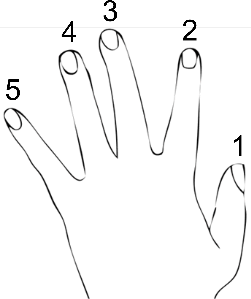
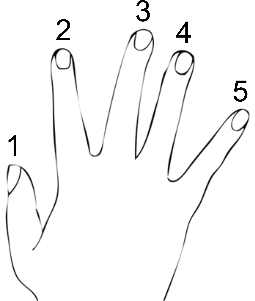
color coding fingers for music - LH piano hand icon with finger numbers
color coding fingers for music - RH piano hand icon with finger numbers

Hand Icon (churien.deviantart.com/art/hand-template-blank-272630198) by Unknown Author is licensed under CC BY (creativecommons.org/licenses/by/3.0). Modified by Geoffrey Keith.

Fingering is the core of good piano technique.

First, you’ll learn how to play the iconic main motif.

Section 1 (the pickup measure through measure 15)
The pickup measure through measure 9
  • The right hand (RH) plays the opening motif in A position. (Note: the video’s pianist sometimes has different fingering.)
  • The next four notes C E A B at the end of measure (m.) 2 (the second complete measure) are fingered 1 2 4 5 and E G# B C at the end of m. 3 is also 1 2 4 5.
  • At the end of m. 4, the 1 finger gets E and 5 gets the E octave, which puts you back into the main motive.
  • We get new material at the end of m. 7: E C B A, which is in A position with a stretch down to E.
  • In the left hand (LH), A E A in m. 2 gets 5 2 1 and E E G# gets 5 1 2 where 2 crosses over 1. The pedal will help you play this fingering smoothly.
  • You’ll repeat these LH patterns until m. 8. At the end of m. 9, the right hand is in A position.
Measures (mm.) 10 – 15
  • The right hand at the end of m. 10 is in B position with a stretch down to G, m. 11 is in A position with a stretch down to F, and m. 12 is in G position with a stretch down to E.
  • The left hand in mm. 10 – 13 uses the same fingering as mm. 1 – 8, but on the notes C G C (5 2 1), G G B (5 1 2), A E A (5 2 1) and E E E (5 1 2).
  • After the E triple octave in the left hand, RH and LH (notice the clef change) alternate E octaves using 1 and 5 fingers.
  • Next comes an odd fingering. Play D# and E but distribute them between LH (3 2) and RH (2 3).
  • There’s no reason to do this other than it looks cool.
Mm. 15 – 23
  • The end of m. 15 ushers in a reprise of mm. 1 – 9.
Section 2 (RH for mm. 24 – 37)
  • At the end of m. 24, RH is in F position with your 1 finger doing double duty on E and F.
  • In m. 25, you’ll have fingers 1 and 2 on the two grace notes and finger 4 on the C. While holding the C down, quickly switch to finger 1. This is called a 1-4 finger substitution, which transitions you into C position.
  • You’ll remain in C position until you play the Bb in m. 26 with finger 4, putting you into F position.
  • On the third note in m. 27 you’ll do a crossover so that 4 is on F, which puts you into C position.
  • You’ll be in G position in m. 28.
  • You have another 1-4 finger substitution on C in m. 20, which sets up D D# E with fingers 2 3 4 in m. 29.
  • The end of m. 30 is in B position.
  • Measure 32 starts with 2 on C. Your 5 finger will play all the Gs and your 1 finger covers all the other notes except for the D at the end, which gets 2. You’ll start m. 33 in F position with a stretch down to E on the first note. However, on the second E you’ll switch into C position – this fingering repeats in the next two measures.
  • You’ll play mm. 36 – 37 in C position.
Section 2 (LH for mm. 24 – 37)
  • The left hand in m. 24 starts with 5 2 1 on A E A. The second half of the measure is in F position.
  • Basically, you’ll remain in F position for mm. 25 – 30 with stretches both up and down.
  • Measure 31 transitions into G position with a stretch up to E and then up to F.
  • Notice the clef change in m. 32. Play the notes, located after the small treble clef, in C position.
  • You’ll change back to bass clef in m. 33, putting you in F position.
  • After the treble clef change in m. 34, you’ll be in C position. This is followed by F position after the bass clef change in m. 36.
  • You’ll finish m. 36 with 1 and 3 on the E and G#.
Section 3 (mm. 38 – 60)
  • Section 3 basically reprises section 1.
  • However, it’s a little different.
Section 4 (LH for mm. 61 – 83)
  • You’ll alternate between fingers 2 and 3, making it easier to play the repeated notes in mm. 61 – 65.
  • Use fingers 5 and 1 in m. 66. Then, 4 and 1 in m. 67, followed by 3 and 1 in m. 68.
  • After playing the harmonic octave in m. 69 with 5 and 1, you’ll go back to alternating fingers.
  • Play the E and G# in m. 78 with 3 and 1.
  • In m. 79 play the low A with 5 and the chord with fingers 5 3 1.
  • You’ll use the same fingering for the chords in mm. 80 – 82.
Section 4 (RH for mm. 62 – 69)
  • The diminished 7th chord in m. 62 gets fingers 1 2 3 4.
  • The d minor chord on beat 1 in m. 63 gets 1 2 5 on F A D respectively. The two harmonic thirds are played in B position as is the chord in m. 64 with 1 finger stretching down to the G#.
  • Play the A minor chord in m. 65 with 1 3 5.
  • Use 1 and 5 for each harmonic sixth in m. 66.
  • In m. 67, C F# A get fingers 1 3 5 respectively. The sixths in mm. 67 – 69, also use 1 and 5.
Section 4 (RH for mm. 70 – 83)
  • Measures 72 – 73 are in B position.
  • The sixths in m. 74 are played with 1 and 5.
  • The Bb chord on beat 1 in m. 75 gets 1 2 5 and the D minor chord on beat 3 gets 1 2 4. The G# diminished 7th chord in m. 76 gets 1 2 3, and the A minor chord in m. 77 gets 1 2 5.
  • Use 1 and 5 on the fifth in m. 78.
  • The arpeggio in m. 79 is played with 1 2 4 in both beats 1 and 2. In beat 3 you’ll play a descending scale in A position.
  • Measures 82 – 83 contain a descending chromatic scale. Use finger 3 on the black keys, and finger 1 on the white keys except for the notes F and C, which will get finger 2.
  • Measure 84 brings us back to the main motif.
Section 5 (mm. 84 – 105)
  • Section 5 reprises section 1 again.
  • Use 5 and 1 on the A harmonic octave in the left hand of the last measure.

Mobile users: for best results viewing the videos, rotate your screen 90o to the right.

Video: Beethoven’s Fur Elise

Learn How to Play Beethoven’s Beautiful Fur Elise: Sheet Music

Here’s the score for Fur Elsie.

  • I’ve also included a couple of other books of Beethoven’s compositions from the Masterworks series.
  • I really like the Masterworks series, because it clearly differentiates between what Beethoven wrote and the publisher’s additions.

The Books

If you’re new to piano, start with this book:

Note: This book doesn’t contain Fur Elise. However, you’ll play Fur Elise at the end of Alfred’s Basic Adult All-in-One Course level 3.

All the other scores include Fur Elise:

Video: Masterwork Classics

Final Thoughts

Takeaway points:

  • Fur Elise is one of the most popular piano pieces.
  • Good fingering strategies are critical for learning Fur Elise.
  • Legato and pedaling will make your playing super smooth.

Have fun playing!

Whats the Basic Difference Between Drop C and Drop D - Guitar Player

What’s the Basic Difference Between Drop C and Drop D?

Are you interested in guitar alternate tunings? Do you want to know the difference between Drop C and Drop D? In many ways Drop D and Drop C are very similar. However, there are a couple of important differences. Keep reading “What’s the Basic Difference Between Drop C and Drop D Tunings?” to learn what the differences are and how they impact your playing. Estimated reading time 3 minutes.

Read More

sight singing chromatic shape notes - carol singers decoration

Sight Singing Chromatic Shape Notes

Do you have basic sight singing down, but want more than seven notes? “Sight Singing Chromatic Shape Notes” shows you how to sing sharps. In the last shape note post, we sang the first half of the chorus from "You’re a Grand Old Flag." In this post, we will sing the second half of the chorus. However, we will need to learn how to sing sharp notes to do this. Read more to learn about sight singing chromatic shape notes. Estimated reading time 3 minutes.

Read More
How Many of You Want to Know How to Tune with Guitar Harmonics - Solid and Hollow Body Electric Guitars - What’s the Catch with G Guitar Tuning? (Open G Tuning) - What Are the Best Easy Guitar Chords for Beginners to Learn?

How Many of You Want to Know How to Tune with Guitar Harmonics?

How many of you want to know how to tune with guitar harmonics? Tuning using the 5th and 7th fret harmonics is the most common way to fine-tune standard tuning on the guitar. It yields better sounding chords than tuning using frets. However, it doesn’t restrict what you can use for open chord forms. Read more to learn how it works. Estimated reading time 3 minutes.

Read More