

Success Music Studio

What’s a Clef and How to Use It - G Clef

What’s a Clef and How to Use It?

Facebook
Pinterest
LinkedIn

Estimated reading time 3 minutes

Table of Contents

Introduction

Do you want to know what that funny looking thing is to the left side of the music staff? Do you need to know how they work when reading music? When a singer or instrumentalist sees a clef, it helps them find the notes on the staff. Therefore, it’s an essential symbol for interpreting the score. Keep reading What’s a Clef and How to Use It? to understand what it is and how it works.

This article uses musical terms. For definitions, see the Glossary at the end of the post.

What Does Dissonance Mean for Basic Seventh Chords - Sheet Music - How to Play Musical Tempos from Adagio to Allegro

This post contains affiliate links, which means I may receive a small commission from purchases made through the links. I’ll only recommend products I use, use in lessons, or ones my students or colleagues have recommended.

What’s a Clef and How to Use It: What’s a Clef?

Have you ever looked at a score and seen the odd-looking symbols to the left side of the staff lines?

  • These symbols are basically fancy letters. The three most important are the treble or G clef, the alto or C clef, and the F or bass clef.
  • They’re essential for reading the score.
  • But what precisely are they, and how do they work? To understand this, we first need to know what the staff is.

The staff consists of a collection of horizontal lines and spaces.

  • Guido d’Arezzo developed the staff around 1000 AD.
  • Originally, the staff had four lines and three spaces but quickly grew to the present size of five lines and four spaces.
  • The notes move from line to space and space to line up and down the staff, allowing singers to be able to learn a melody that they’ve never heard before.
Singing Shape Note Solfege Dorian Melodies - Chant Manuscript - Singing Shape Note Solfege Aeolian Melodies - Discover Early Music Via Beautiful Medieval Gregorian Chants

What’s a Clef and How to Use It: What Is Their Job?

How do you figure out which note goes where on the staff?

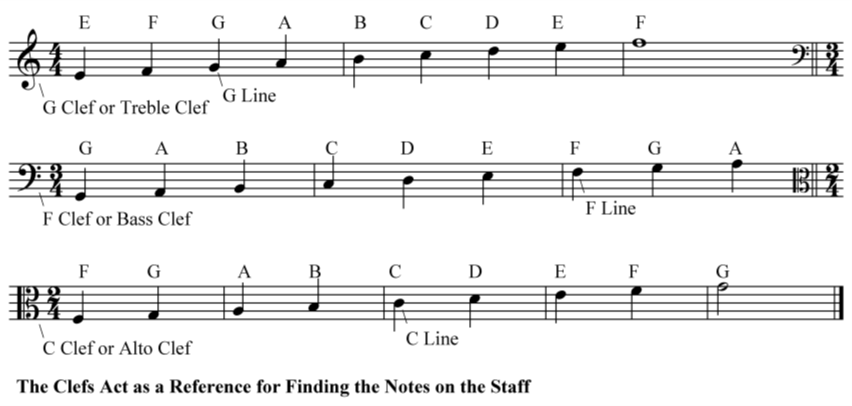
  • This is where these funny looking symbols come in. Their job is to create a reference point, so you know which letter name note is assigned to each line or space on the staff.
  • This is why they have letters in their names, like C, F, and G clef.
  • However, they also have names like treble, alto, and bass clef.

Why are there more than one?

  • Some clefs cover high notes, and others cover low notes.
  • There’s even a special one that hangs out around middle C that’s almost exclusively used by the viola.
  • More on these in the next section.
Do You Want Advice on Teaching a Music Student with ADHD - Violin and Sheet Music - What Are Some Signs of a Twice Exceptional (2E) Child - How Do I Organize a Recital Concert - Shatter the Perfectionism Chains in Music Lessons

What’s a Clef and How to Use It: The Introductions Please

Mobile users: for best results reading the music, rotate your screen 90o to the right.

Reading Music (A Quick Guide to How to Read Music) - Clefs - Making Sense of Why Treble and Bass Clef Are So Different - How to Color Code the Elusive Alto Clef - 50 Essential Music Symbols Explained in Less Than 5 Minutes - Basic Music Notation Explained in Less Than 4 Minutes

Treble Clef

  • The treble clef is also called the G clef, because it looks like a fancy cursive G. It locates the G line on the staff.
  • It’s called treble because it covers the high notes – treble means “high.”
  • This means that instruments like the violin, flute, trumpet, and guitar use the G clef.
  • Sopranos and altos use it when learning melodies.
  • Likewise, it’s used for the right hand on the piano.

Alto Clef

  • The alto or C clef covers the notes between the treble and bass. It locates middle C on the staff.
  • This perfectly fits the viola range.
  • However, it’s rarely used for other instruments.

Bass Clef

  • The F or bass clef covers the low notes – bass means “low”.
  • It’s derived from a stylized F and locates the F on the staff.
  • Instruments such as the cello, trombone, bassoon, and bass guitar use it.
  • Tenors and basses use it when learning melodies.
  • Likewise, it’s used for the left hand on the piano.
These reference books will help you better understand music notation.
How Can I Learn the Basics of Music Theory - Books on Music

Final Thoughts

Takeaway points:

  1. These funny looking symbols create a reference point, so you know which letter name note is assigned to each line or space on the staff.
  2. There are three main types: F, C, and G clef.
  3. Learning how they function will help you understand a fundamental symbol used in score reading.

Have fun learning music!

Glossary

The Top 10 Best Captivating Vivaldi Masterpieces - Violin

The Top 10 Best Captivating Vivaldi Masterpieces

Do you want to explore Antonio Vivaldi’s music? Vivaldi (1678 – 1741) is best known for his violin concertos. His music is celebrated for its infectious melodies combined with its impressive technical demands. Keep reading to learn about and listen to the top 10 best captivating Vivaldi masterpieces. Estimated reading time 3 minutes.

Read More


Simple Instructions for Pythagorean Tuning - Monochord

Simple Instructions for Pythagorean Tuning

Do you need simple instructions for adjusting your synth to play Pythagorean tuning? The Pythagorean scale is based on the Pythagorean tuning ratios that are credited to (you guessed it) Pythagoras (same guy that invented the hypotenuse formula). However, it has since become popular with microtonal composers. Keep reading “Simple Instructions for Pythagorean Tuning” to learn the deep, dark secret of this scale. Estimated reading time 3 minutes.

Read More
How to Play the Sad Sounding D Minor Chord - Hollow Body Electric Guitar

How to Play the Sad Sounding D Minor Chord

Do you want to know how to play the open D minor guitar chord? Do you want to know why it sounds sad? Minor chords have a sweet, haunting sound. Open D minor has medium difficulty, but with the right fingering strategies, it’s not that hard to play. Keep reading “How to Play the Sad Sounding D Minor Chord” to find out how to best play open D minor. Estimated reading time 3 minutes.

Read More