


Success Music Studio

How to Color Code Guitar Tab to Empower LD Achievement - Guitar Tab and Coffee Cup

How to Color Code Guitar Tab to Empower LD Achievement

Facebook
Twitter

Estimated reading time 3 minutes

Table of Contents

Why Color Code Guitar Tab for LD Achievement?

Does tab confuse you? Teachers: have you ever had a student who could not tell one string from another when reading tab? Tab creates a picture of the guitar neck. However, many ADHD, LD and autistic students become confused by tab despite its visual appearance. Read more to learn how to color code guitar tab. 

The Issue

LD students’ become dazzled by the shimmer created by the contrast of the black and white lines of the notation.

The Solution

Color coding the open strings helps reduce the confusion that students experience, assisting them to effectively read the score.

This post uses musical terms.  See the Glossary at the end of the article for definitions.

Mobile users: for best results reading the music, tilt your screen 90o to the right.

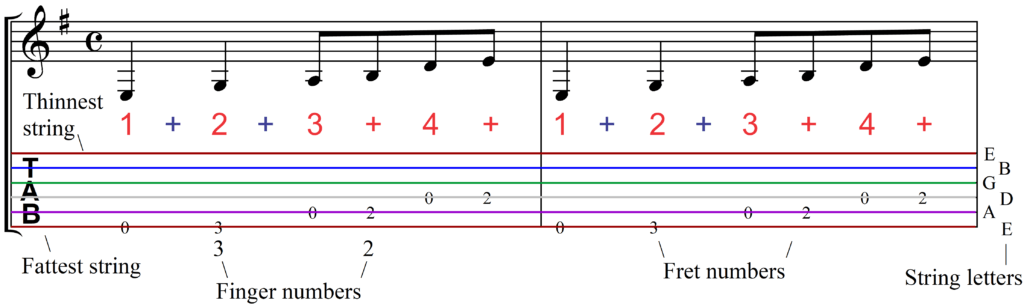
How To Color Code Guitar Tab To Empower LD Achievement - Guitar Tab - line 1 (2) - Reading Music (A Quick Guide to How to Read Music) - 50 Essential Music Symbols Explained in Less Than 5 Minutes
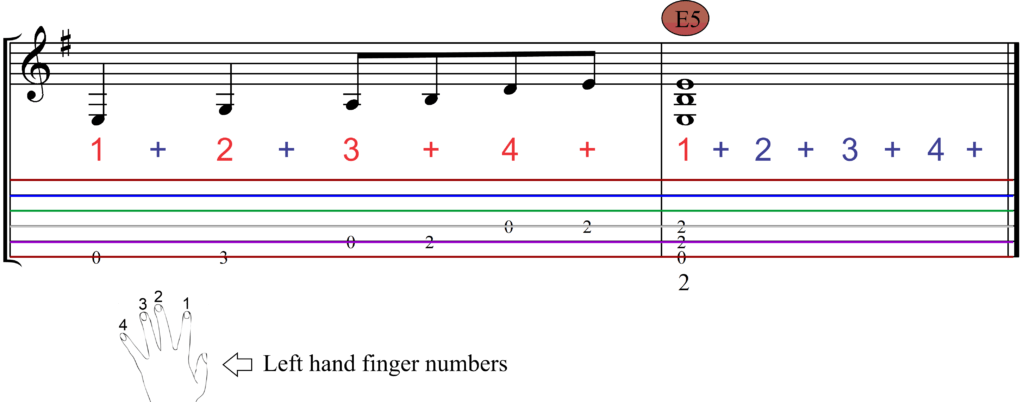
How To Color Code Guitar Tab To Empower LD Achievement - Guitar Tab - line 2 (5)

How Tab Works

In the example above, the horizontal tab lines represent the six strings of the guitar:

  • The line lowest on the TAB staff represents the fattest string.
  • Conversely, the line highest on the TAB staff represents the thinnest string. 
  • The thinnest string is also the highest sounding string.
  • This explains why the string closest to the floor on the guitar is the highest string represented on the TAB staff.
  • Namely, the string with the highest sounding note sits at the highest position on the TAB staff.

The numbers represent the frets:

  • The smaller the number the closer the fret is to the headstock of the guitar.
  • The bigger the number the closer the fret is to the bridge of the guitar.

For an explanation of the color coded counting numbers:

Video: How Effective is the Color Coding?

How to Color Code the Guitar Tab's Strings

Color code the guitar tab’s strings using the same note colors used in:

How to Color Code Notes for Successful LD & Special Needs Distance Learning

  • 1st (thinnest) string E = red
  • 2nd string B = blue
  • 3rd string G = green
  • 4th string D = gray
  • 5th string A = purple
  • 6th (thickest) string E = red

How to Color Code the Guitar Tab's Frets

I first encountered the idea of coloring the frets in Sarah Fard’s 2019 ABLE Assembly presentation. The ABLE Assembly is a special needs arts conference, and Fard’s presentation was in the block before my presentation at the conference.

  • It makes sense that LD students could get confused by notation represented by numbers and that color would help. Basically, Fard color codes the guitar tab’s three lowest frets. Click here to access the site that explains Fard’s methods.
  • Nevertheless, color coding the frets can take different forms.
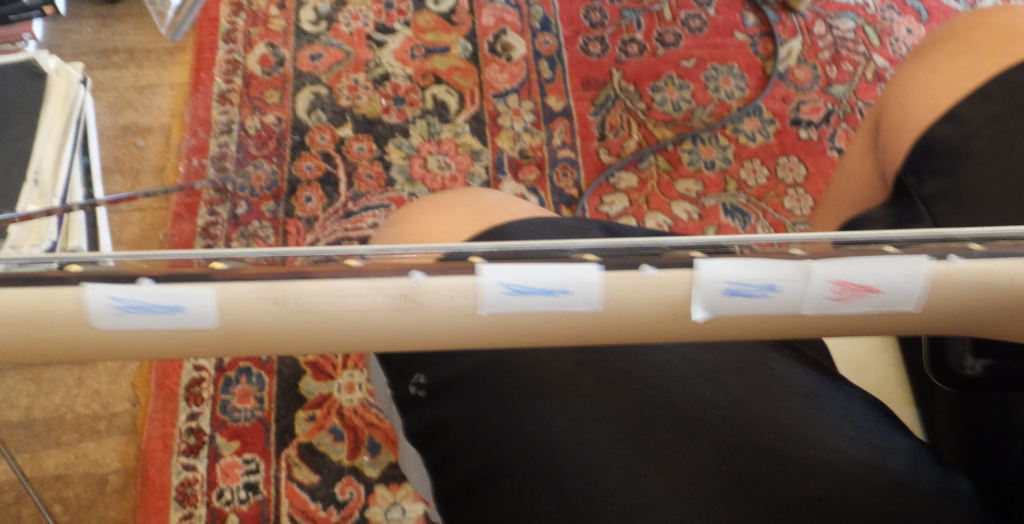
  • The student in the picture below struggled to play the main riff to the song Smoke on the Water. Mostly, the main riff plays doubles stops on frets five, eight, and ten on strings four and five.
  • Once in each cycle of the riff, the student plays fret eleven. At this point, my student would usually play the wrong fret even though I’d shown him the riff countless times.
  • My solution: I color coded the guitar tab’s easy frets (five, eight, and ten) all the same color: blue. The fret he struggled with, I colored red to make it stand out. It made the riff much easier for him to play.

Just for fun, I’ve included a Smoke on the Water video below.

How to Color Code Guitar Tab to Empower LD Achievement - Color Coded Fret Example - Amnesia, Alzheimer’s, Stroke, and Color Coding Music

Video: Learn the Smoke on the Water Riff

Final Thoughts to How to Color Code the Guitar Tab

Despite tab’s visual appearance, it can still confuse some students.

  • Multisensory teaching helps reduce the confusion that happens when ADD, LD, ASD, and special needs students read tablature.
  • That is, color coding guitar tab empowers them to achieve success.

© 2020 Geoffrey Keith 

Newsletter Signup

Join me for in-person or online lessons today!

Back to the Color Coding Blogs Page

Back to the Successful Music Student Blogs Page

Glossary

How Do I Switch from Minor Key Shaped Notes to Standard Notation -Sheet Music

How Do I Switch from Minor Key Shaped Notes to Standard Notation – Part 2

How do I switch from minor key shaped notes to standard notation?” Sight singing minor keys in standard notation can be challenging. Because it can be difficult to figure out if you’re in a major key or the relative minor. Read more to learn how to transition from shaped notes to standard notation for minor keys. Estimated reading time 3 minutes.

Read More


Singing Shape Note Solfege Mixolydian Melodies - Computer Mouse on Sheet Music -Do People with ADHD Have Difficulty Playing from Sheet Music?

Singing Shape Note Solfege Mixolydian Melodies

Do you want to sing blues, gospel, or even mediaeval melodies? Are you confused about how modes work? Modes have the exotic feel of world music and music from ancient times. "Singing Shape Note Solfege Mixolydian Melodies" helps you discover the sound of the modes. Estimated reading time 4 minutes.

Read More
What Is Your Definition of a Good Musician - Woman Playing Violin

What Is Your Definition of a Good Musician?

“What is your definition of a good musician?” Being a good musician means much more than just playing and singing. It’s also about how they affect those around them. Read more to find out what makes a good musician. Estimated reading time 3 minutes.

Read More

How to Extract a Melody from Your Lyrics - vintage-typewriter-on-desk - The Narrator’s Point of View in Your Songwriting.jpg

How to Extract a Melody from Your Lyrics

Do you have lyrics but need a melody? Starting with the text’s rhythm helps you create the melody you need. Read more to learn how to extract a melody from your lyrics. Estimated reading time 3 minutes.

Read More