
Success Music Studio

How to Read Piano Sheet Music for Beginners - Piano with Sheet Music and Roses

How to Read Piano Sheet Music for Beginners

Facebook
Twitter

Estimated reading time 5 minutes

Table of Contents

Introduction

Are you a beginner pianist and want to know how to read piano sheet music? Or are you a parent and want to figure out if your child is ready to play piano? This post covers the basics of how to read piano sheet music. In addition, it has links to practical examples so you can get an idea of what it’s like to play and read piano music. Keep reading How to Read Piano Sheet Music for Beginners to embark on your musical voyage.

Why Do Pianists Occasionally Play Their Hands at Different Times as They Perform - The 2022 Success Music Studio Student Showcase - Why Doesn’t My Hands-Separate Piano Practice Help with Hands-Together Playing

How to Read Piano Sheet Music for Beginners #1: Practical Examples

In this section, I have included links to practical examples that will get you or your child playing quickly:

  • Subsequent sections give quick explanations of basic score reading.
  • This means you can try the practical examples right away, or you can look through the sections on music notation first.
  • It’s your choice.

The link to the following post will give you a hands-on keyboard experience, so you can get the idea of what it’s like to play. I designed it specifically for kids, but anyone can try it, even adults.

Conversely, these posts help you to get an idea of what it’s like to interact with a musical score. I used color coding to help make it easy to read the sheet music, which is ideal for young kids and special need students, but once again, anyone can try it.

For a quick music notation guide in a list format:

On the Electric Keyboard Can You Play Dynamics - Sheet Music - On the Electric Keyboard Can You Play Dynamics - Music Rack - Help Me! How Do I Improve My Touch on Piano?

How to Read Piano Sheet Music for Beginners #2: The Grand Staff and Clef Mnemonics

Mobile users: for best results reading the examples, rotate your screen 90o to the right.

Do I Really Have to Learn Music Theory to Learn How to Play Piano - Why Do Minor Keys Sound Sad to Me - Color Code Key Signatures - Keyboard Accidentals - What is a Parallel Mode and How Does it Work - What Purpose Do Accidentals Serve in Reading Sheet Music - Reading Music (A Quick Guide to How to Read Music) - How Can I Learn the Basics of Music Theory - What Exactly Do I Do with the Circle of Fifths - An Easy How to Guide to Understanding Triads - 50 Essential Music Symbols Explained in Less Than 5 Minutes - What Exactly Do I Do with The Circle of Fifths - Circle of Fifths - How to Learn Music Theory with a Learning Disability - How to Effectively Use Music Theory to Transpose Music

To access an online keyboard: click here.

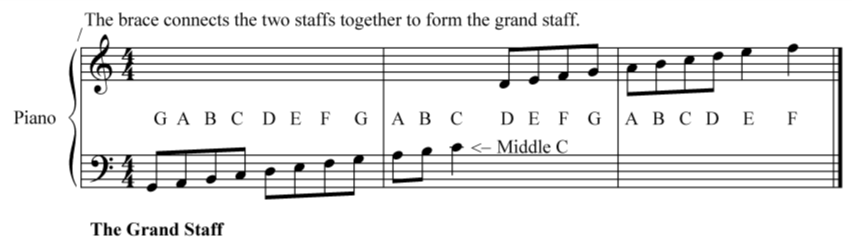
Piano is unusual because it uses two staves joined by middle C to make the grand staff:

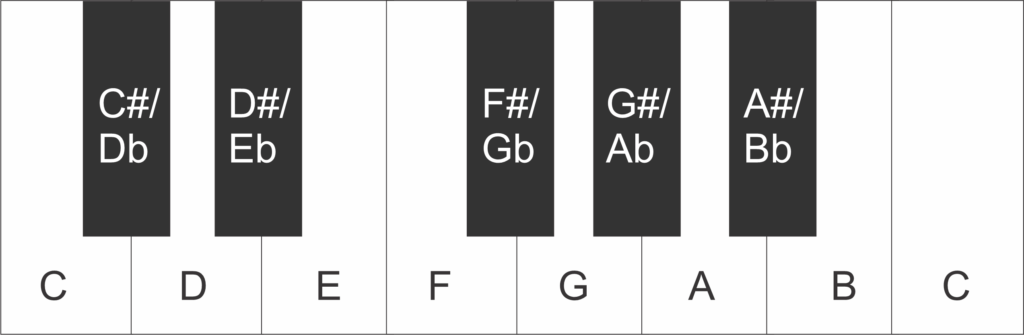
  • This creates, in essence, a large eleven-line staff. This explains why the notes (see the white keys on the keyboard above and the grand staff example below) on the treble staff are different from the bass staff.
  • When we start on the bottom line of the bass staff and progress through the notes up to the top line of the treble staff, you get the musical alphabet three times.
  • Instead of focusing on how the bass and treble staves are different, you need to focus on the continuum of notes across both staves.
Reading Music (A Quick Guide to How to Read Music) - Grand Staff - Making Sense of Why Treble and Bass Clef Are So Different - How to Color Code the Elusive Alto Clef - 50 Essential Music Symbols Explained in Less Than 5 Minutes - Basic Music Notation Explained in Less Than 4 Minutes

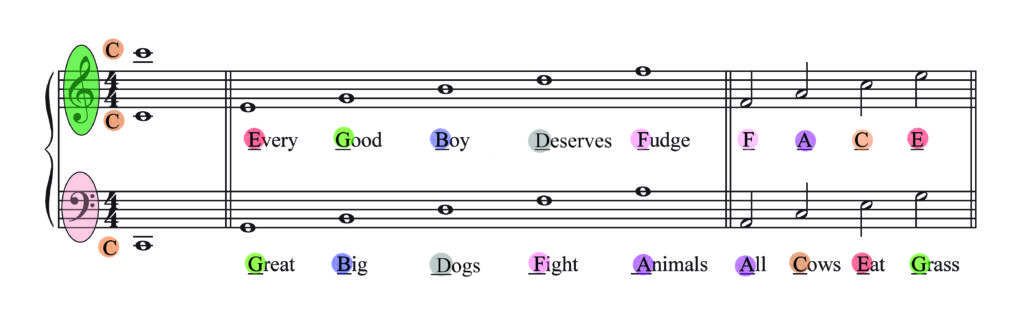
Usually, beginners will learn clef mnemonics to help them remember the note names:

  • Mnemonics are memory devices. Basically, they’re cute phrases like: Every Good Boy Deserves Fudge or F A C E. The first letter of each word indicates the notes on either the lines or spaces of the grand staff.
  • The right hand plays the trebles staff music, and the left hand plays the bass staff music.
  • Because of the continuum of the grand staff notes, we need separate mnemonics for the bass and treble staves. This is why the first and most important question you need to ask yourself is, “Which hand is playing?”
How to Graduate from the Color Coded Sheet Music - Part II - Grand Staff Clef Mnemonics - How to Graduate from the Color Coded Music Notation - Reading Music (A Quick Guide to How to Read Music) - Making Sense of Why Treble and Bass Clef Are So Different - 50 Essential Music Symbols Explained in Less Than 5 Minutes

If your child has trouble reading music, try color coding the notes:

How to Read Piano Sheet Music for Beginners #3: Hand Positions

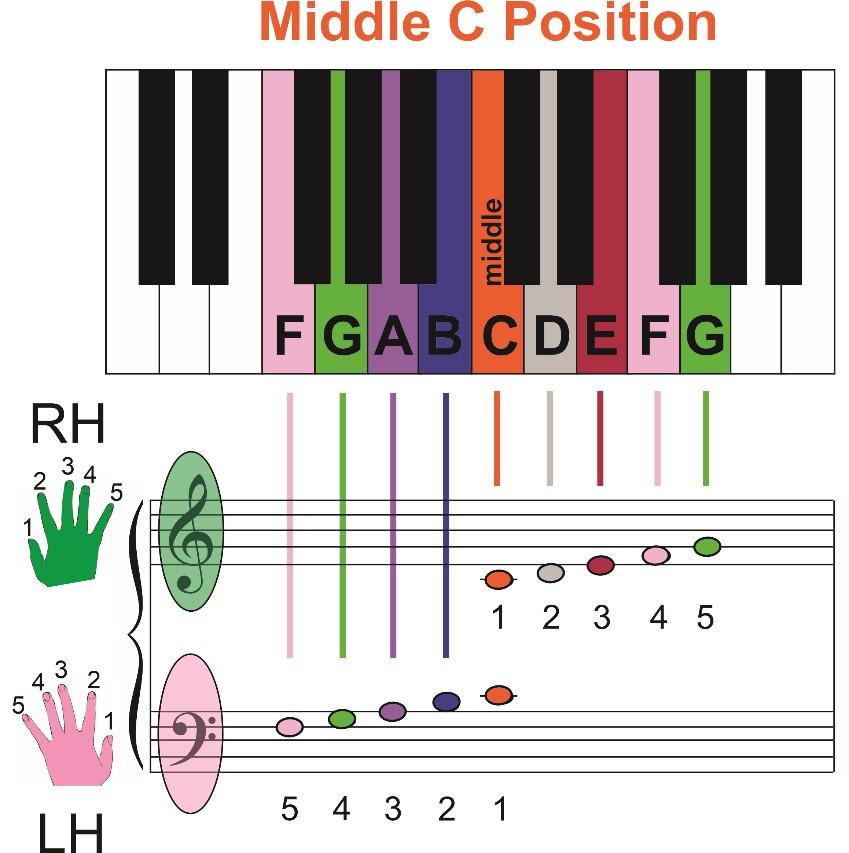
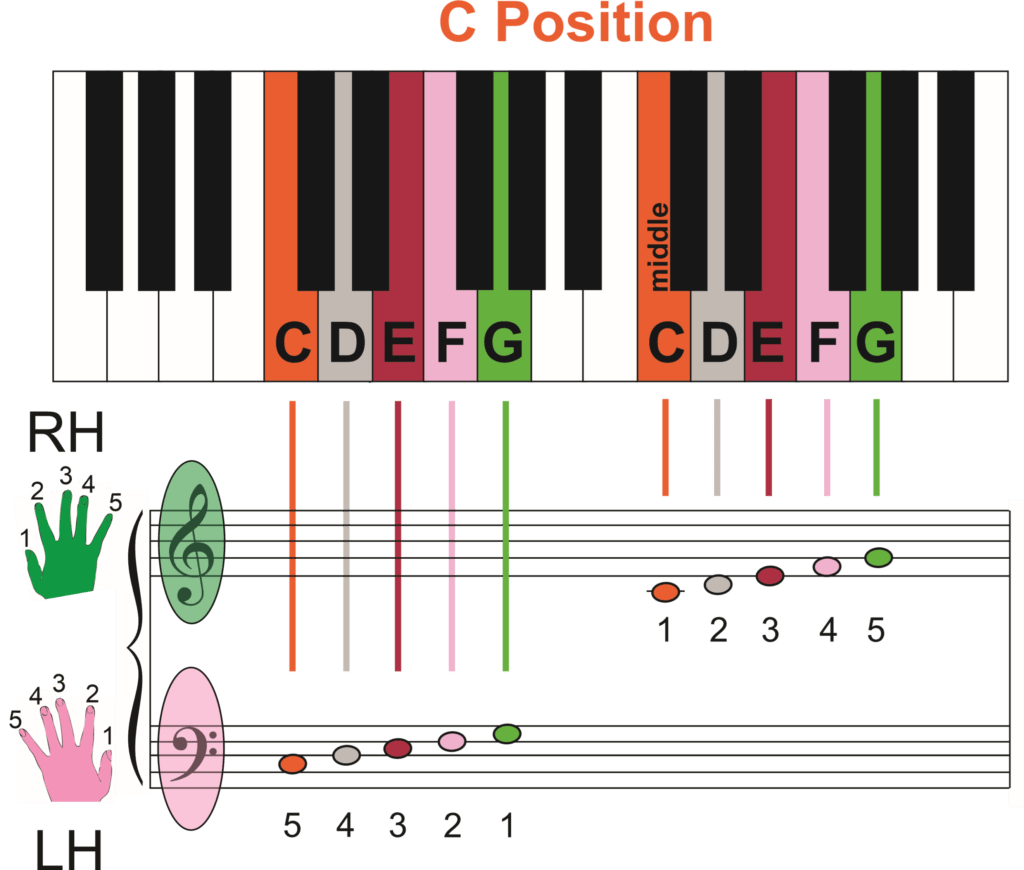
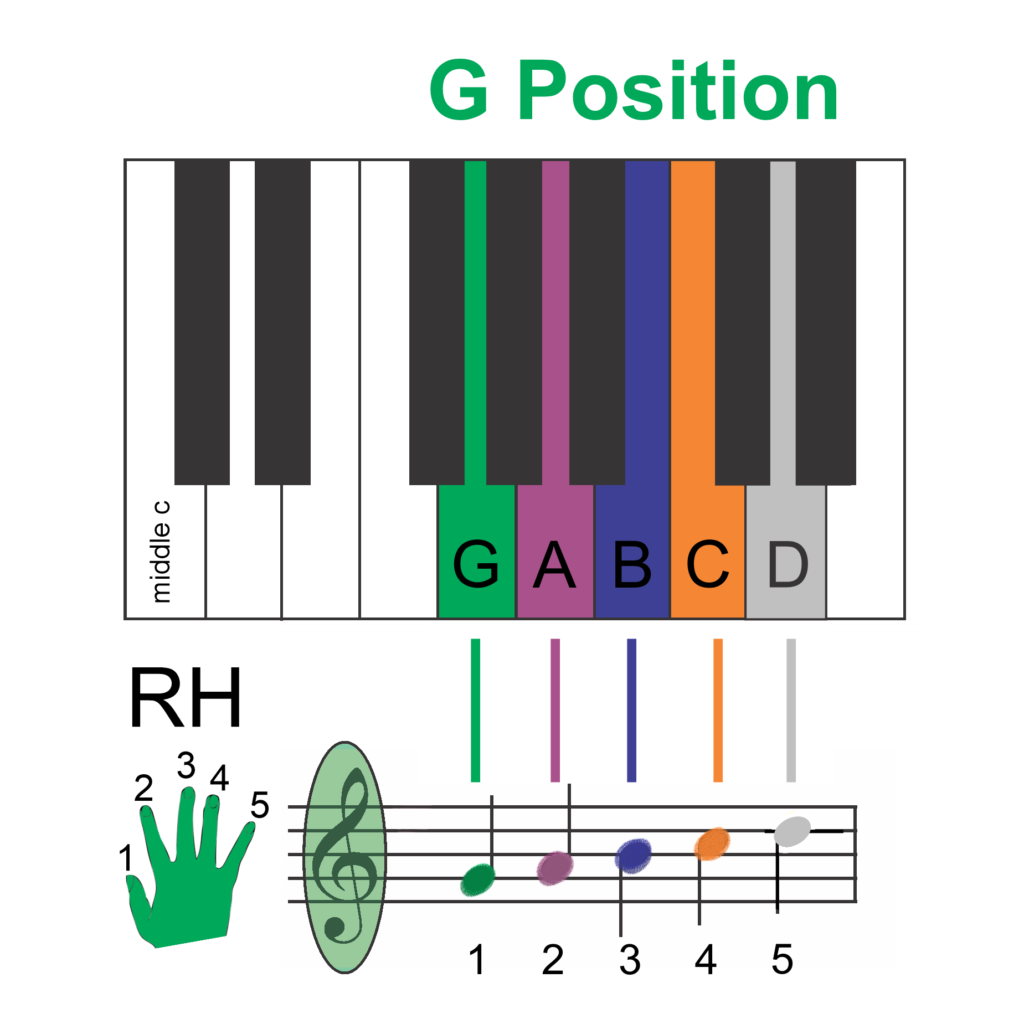
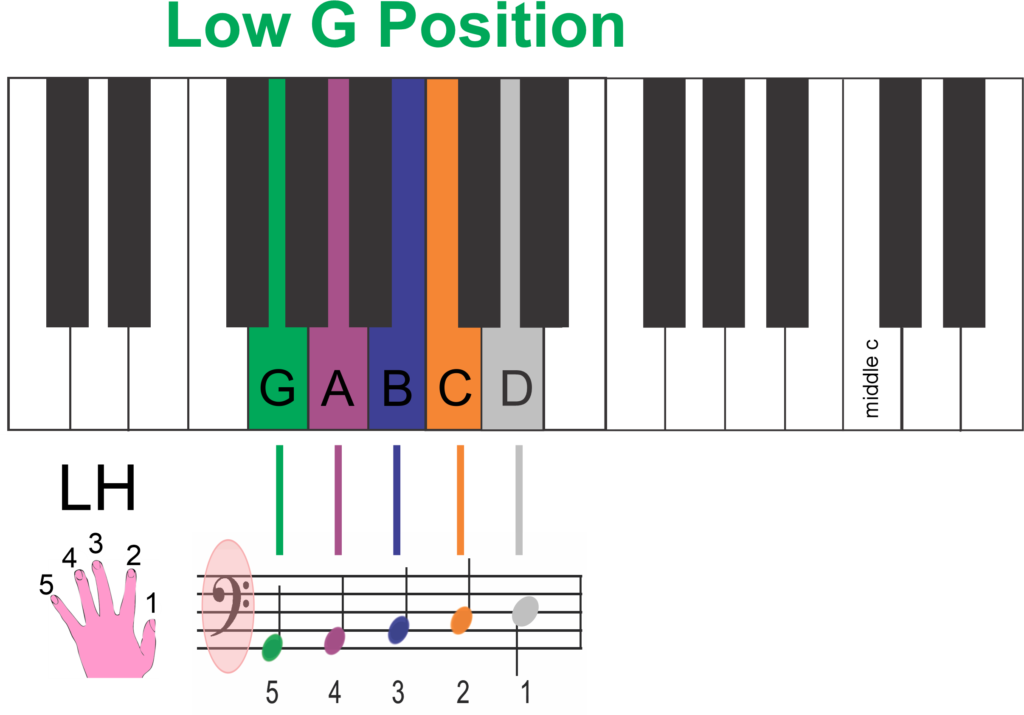
Once you know what note you’re playing, you need to know what finger to use:

  • Beginning piano does this using five finger hand positions where each finger gets a key.
  • Fingering is the biggest technical issue on keyboard instruments.
  • And hand positions are the heart and soul of keyboard technic.

For more information:

These are the three most used hand positions in beginner lesson books:

12 Easy Piano Songs for Young Beginners - Middle C Position - How to Play Piano (Kid’s Color Coded Piano Hand Placement)

Hand Icon (churien.deviantart.com/art/hand-template-blank-272630198) by Unknown Author is licensed under CC BY (creativecommons.org/licenses/by/3.0). Modified by Geoffrey Keith.

Playing the Piano with Color Coded Rhythm, Fingering, and Notes - C Position - Playing Piano with Color Coded Left Hand Notes and Rhythm - Piano Major Scales (Basic Fingering Concepts)
Playing the Piano with Color Coded Notes - G Position RH - Do You Want Advice on Teaching a Music Student with ADHD
Playing Piano with Color Coded Left Hand Notes - G Position LH

How to Read Piano Sheet Music for Beginners #4: Rhythm

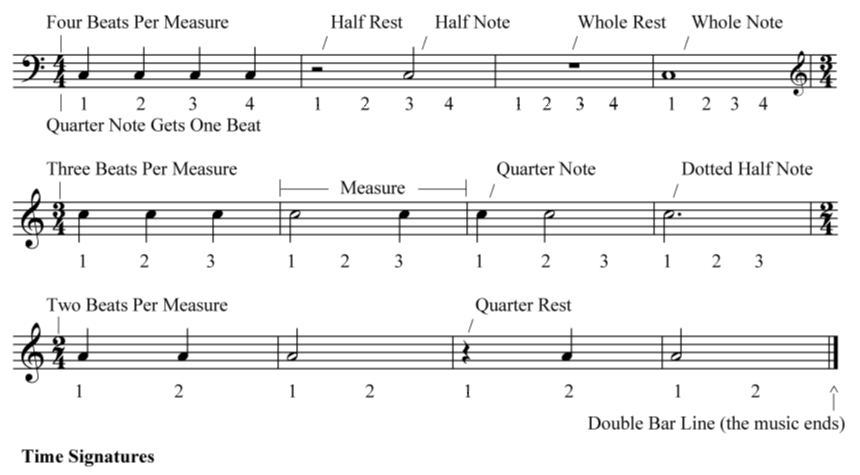
Rhythm is represented in the score by a series of shapes, each of which is held for a set amount of time:

  • The quarter note sounds for one beat.
  • The half note sounds for two beats.
  • The dotted half note sounds for three beats.
  • The whole note sounds for four beats.

Rests tell you to be silent for a set amount of time:

  • The quarter rest is silent for one beat.
  • The half rest is silent for two beats.
  • The whole rest is silent for the whole measure.
Reading Music (A Quick Guide to How to Read Music) - Time Signatures - 50 Essential Music Symbols Explained in Less Than 5 Minutes - Basic Music Notation Explained in Less Than 4 Minutes - A How to Guide to Learning Conducting with Musicality

Here are some practical examples of how rhythmic notation works, including audio tracks you can clap along with:

How to Read Piano Sheet Music for Beginners #5: Flats, Sharps, Naturals, and Key Signatures

Do I Really Have to Learn Music Theory to Learn How to Play Piano - Why Do Minor Keys Sound Sad to Me - Color Code Key Signatures - Keyboard Accidentals - What is a Parallel Mode and How Does it Work - What Purpose Do Accidentals Serve in Reading Sheet Music - Reading Music (A Quick Guide to How to Read Music) - How Can I Learn the Basics of Music Theory - What Exactly Do I Do with the Circle of Fifths - An Easy How to Guide to Understanding Triads - 50 Essential Music Symbols Explained in Less Than 5 Minutes - What Exactly Do I Do with The Circle of Fifths - Circle of Fifths - How to Learn Music Theory with a Learning Disability - How to Effectively Use Music Theory to Transpose Music

To access an online keyboard: click here.

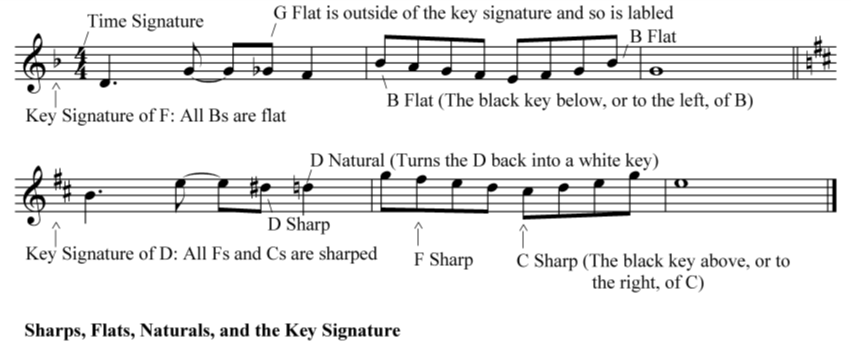
We’ve discussed how to play the white keys. So, how does the notation tell you to play the black keys?

  • A sharp sign before a note tells you to play the next black key to the right, and the flat tells you to play the next black key to the left.
  • A natural sign always tells you to play a white key.
  • The sharps or flats in the key signature tell you that the sharps or flats in question will apply for the whole song.
Reading Music (A Quick Guide to How to Read Music) - Sharps, Flats, Naturals, and Key Signatures - 50 Essential Music Symbols Explained in Less Than 5 Minutes

For more information:

How to Read Piano Sheet Music for Beginners #6: The Pedal

How to Color the Music Score to Successfully Focus Special Needs and LD Students on Features of the Sheet Music - example of applying highlighter to pedal and dyanimcs - What Purpose Do Accidentals Serve in Reading Sheet Music

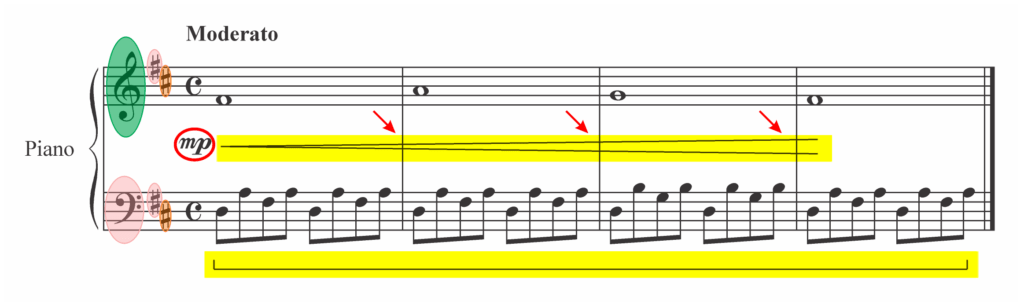
When you press the right pedal, it allows the keyboard’s notes to continue to sound even after you’ve lifted your fingers from the keys:

  • The pedal is one of the coolest things about keyboard instruments.
  • The modern pedal sign is a bracket (see the highlighted symbol below the bass staff in the example above).
  • The beginning of the bracket on the left tells you to press down the pedal with your foot, and the right side of the bracket tells you to lift your foot.

How to Read Piano Sheet Music for Beginners #7: Repeat Signs and Staccato and Legato

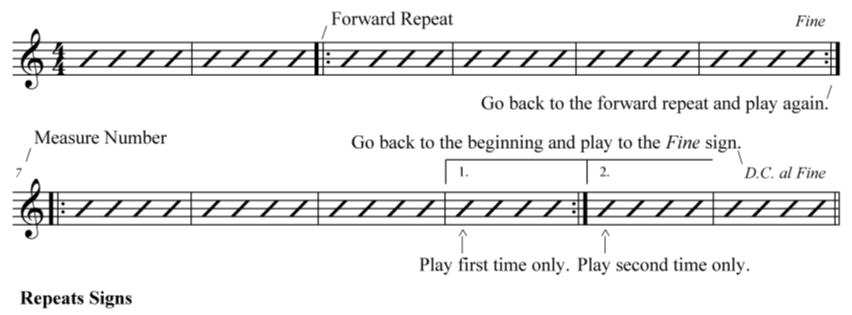
Signs of repetition tell you when to go back and play a section of music again:

Reading Music (A Quick Guide to How to Read Music) - Repeat Signs - 50 Essential Music Symbols Explained in Less Than 5 Minutes

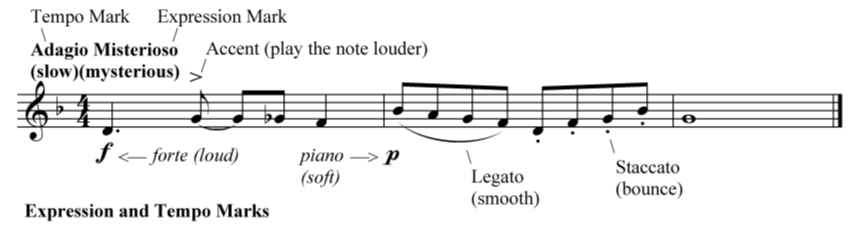
Dynamic signs (e.g., forte and piano) and articulations (e.g., staccato and legato) are symbols that tell you how to play more expressively:

Reading Music (A Quick Guide to How to Read Music) - Expression and Tempo Marks - 50 Essential Music Symbols Explained in Less Than 5 Minutes

Conclusion

Glossary

How to Effectively Use Music Theory to Transpose Music - Sheet Music

How to Effectively Use Music Theory to Transpose Music

Want to know what the word transpose means in music? Do you need to know how to change the key of a song? There are a bunch of reasons you might need to change the music’s key: 1) it’s the wrong range for your voice, 2) you need to make it fit your instrument’s range, 3) or you may play a transposing instrument (such as Bb trumpet) but need to read some music written at concert pitch. Keep reading “How to Effectively Use Music Theory to Transpose Music” to learn how to do it. Estimated reading time 4 minutes.

Read More

What’s the Key Difference Between Soprano and Mezzo Soprano?

“What’s the key difference between soprano and mezzo?” Though superficially these two voice types seem very similar. You only need to take a closer look to notice the key differences between singers like Celine Dion and Taylor Swift. Keep reading to learn how this affects singers like you. Estimated reading time 2 minutes.

Read More
How to Write Quartertone Music that Sounds Amazing - Keyboard Player

How to Write Quartertone Music that Sounds Amazing

Are you frustrated that you can’t make your quartertone music sound good? It’s notoriously hard to write music for this scale. Keep reading “How to Write Quartertone Music that Sounds Amazing” to learn how to make it work. Estimated reading time 4 minutes.

Read More
Song Structure, Musical Phrases, Musical Structures and Forms - Music Ipod

Song Structure, Musical Phrases, Musical Structures and Forms

Do you want to know how song structure, musical phrases, musical structures and forms work? Musical structures and forms in instrumental music works differently than popular song structure. However, motifs and musical phrases works pretty much the same in either type of writing. In this post, we’ll talk about all that plus the difference between motifs and leitmotifs. Read more to get music structure examples for both songwriting and instrumental music. Estimated reading time 5 minutes.

Read More