



Success Music Studio

Making Sense of Why Treble and Bass Clef Are So Different - Tenor, Treble, and Bass Clef

Making Sense of Why Treble and Bass Clef Are So Different

Facebook
Twitter

Estimated reading time 3 minutes

Table of Contents

Making Sense of Why Treble and Bass Clef Are So Different #1: The Big Pattern

“How do I make any sense of the treble and bass clefs? Why are they so different?” To answer this question, you need to understand the grand staff, the pattern of the clefs, and middle C. Keep reading Making Sense of Why Treble and Bass Clef Are So Different to learn how the clefs work.

This article uses music terms. For definitions, see the Glossary at the end of the post.

Amnesia, Alzheimer’s, Stroke, and Color Coding Music - Pianist - Shatter the Perfectionism Chains in Music Lessons - Making Sense of Why Treble and Bass Clef Are So Different

Making Sense of Why Treble and Bass Clef Are So Different #2: Introducing Treble, Alto, and Bass Clef

Mobile users: for best results reading the music, tilt your screen 90o to the right.

Reading Music (A Quick Guide to How to Read Music) - Clefs - Making Sense of Why Treble and Bass Clef Are So Different - How to Color Code the Elusive Alto Clef - 50 Essential Music Symbols Explained in Less Than 5 Minutes - Basic Music Notation Explained in Less Than 4 Minutes

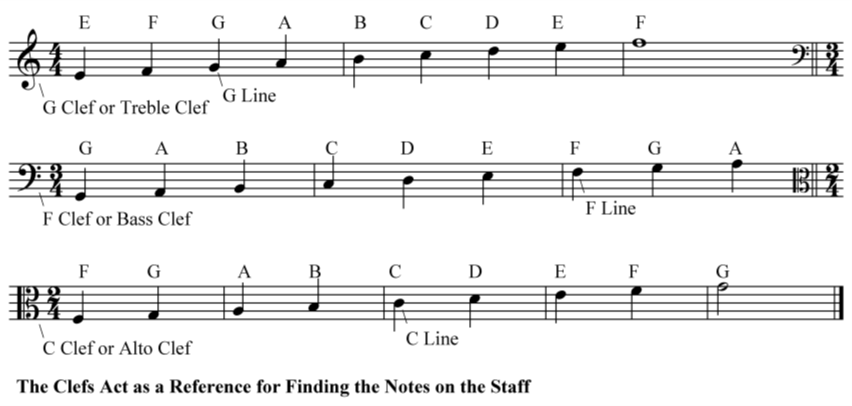
The funny looking symbols to the left side of the music staves above are called clefs. Their purpose is to give you a refence note for the treble clef, alto clef, and bass clef:

  • The treble clef points to the G above middle C.
  • The alto clef points to middle C.
  • The bass clef points to the F below middle C.

In addition, middle C on piano is used as a point of reference for the relative placement of the clefs.

Making Sense of Why Treble and Bass Clef Are So Different #3: The Trouble with Treble and Bass Staff Mnemonics

How to Graduate from the Color Coded Sheet Music - Part II - Grand Staff Clef Mnemonics - How to Graduate from the Color Coded Music Notation - Reading Music (A Quick Guide to How to Read Music) - Making Sense of Why Treble and Bass Clef Are So Different - 50 Essential Music Symbols Explained in Less Than 5 Minutes

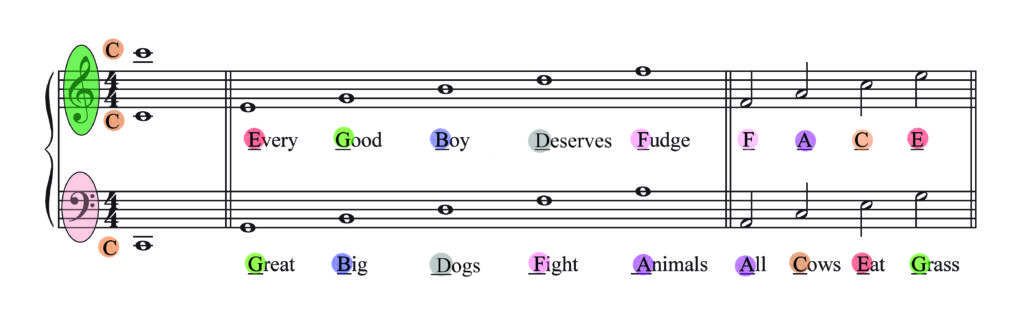
Most instrumentalists learn to read music using clef mnemonics:

  • Clef mnemonics use memorable phrases to help musicians remember the line and space notes on the treble and bass clef staves.
  • However, using the mnemonics for both treble and bass clef separately can obscure the pattern that unifies the clefs when they’re combined into the grand staff.
  • That means that many musicians can become confused when they learn that the notes are different on the two music staves. This will be especially true if they haven’t been given the big picture via the grand staff.

Making Sense of Why Treble and Bass Clef Are So Different #4: The Grand Staff Pattern Saves the Day

Reading Music (A Quick Guide to How to Read Music) - Grand Staff - Making Sense of Why Treble and Bass Clef Are So Different - How to Color Code the Elusive Alto Clef - 50 Essential Music Symbols Explained in Less Than 5 Minutes - Basic Music Notation Explained in Less Than 4 Minutes

Why do the treble and bass clefs have different positions for the notes on the staff? It helps if you understand the grand staff:

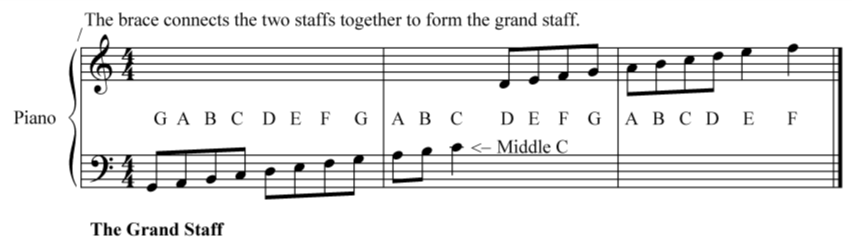
  • When you join the treble clef staff and the bass clef staff (plus the note middle C), you’ll have the grand staff. (Which is used for keyboard music.)
  • Think of the grand staff as a big eleven-line staff.
  • It consists of the five-line treble staff on top, and the five-line bass staff on the bottom, with the short ledger line note, middle C, stuck in between them.

Look at the pattern of the notes on the grand staff:

  • The bass clef staff starts with the bottom line-note: G. Then, it cycles through the musical alphabet going from line note to space note.
  • After you finish the notes on the bass staff, you get the inter-staff notes of B, middle C, and D.
  • Then, you end up on the bottom line-note for the treble clef staff: E.

The grand staff’s pattern makes the bottom line-notes different for the two music staves:

  • Likewise, the bottom space notes are A on the bass staff and F on the treble staff, and so on for the rest of the notes.
  • Thus, the eleven-line grand staff requires that the two music staves have different arrangements for the notes.
  • So, this also explains why the music staves must have different clef mnemonics.

Making Sense of Why Treble and Bass Clef Are So Different #5: Let’s See What’s Up with Middle C

By joining the treble and bass clef staves into one big staff, it explains middle C’s name:

  • Middle C isn’t the middle key of the piano, as many people assume. Instead, middle C is simply the middle note between the two music staves.
  • In fact, middle C on piano got its name before the piano received its full complement of 88 keys.
  • Middle C appears in the score only when needed.
Instrument - Picture of a Piano - Making Sense of Why Treble and Bass Clef Are So Different

Making Sense of Why Treble and Bass Clef Are So Different #6: Final Thoughts

Here’s a summary of Making Sense of Why Treble and Bass Clef Are So Different:

  1. The clefs give you a reference for the notes of the various staves. In addition, middle C is useful as a reference point for the relative positions of the music staves.
  2. Clef mnemonics, while helpful for learning the notes on the music staves, can obscure the relationship between the treble clef staff and the bass clef staff.
  3. The grand staff will help you see the relationship between the music staves.

Have fun reading music!

Related Posts

© 2024 Geoffrey Keith

Newsletter Signup

Join me for in-person or online lessons today!

Back to the All-Purpose Music Tips and Topics category blogs page

Back to the Successful Music Student Blogs page

Glossary

How to Play the Easy Beginner Guitar F Chord Without a Barre - Acoustic Guitar - What’s the Basic Difference Between Drop D vs Open D Tuning?

How to Play the Easy Beginner Guitar F Chord Without a Barre

Do you want to know how to play the easy beginner guitar F chord without a barre? Learning F on the guitar has long been a rite of passage for guitarists. Why? The barre makes it difficult to play, keeping many beginner guitarists from being able to play many otherwise simple songs. Keep reading to learn how to play the easy F chord on guitar. Estimated reading time 2 minutes.

Read More


How Do I Get the Music and Lyrics to Match Together – Musician Singing

How Do I Get the Music and Lyrics to Match Together in My Songwriting?

Frustrated that you can’t get the mood of your music and lyrics to match? Do you have problems getting the syllables of your lyrics to work with the music? If you answered, “yes,” you have problems with prosody in your songwriting. Read more to answer the question, “How do I get the music and lyrics to match together in my songwriting?” Estimated reading time 3 minutes.

Read More
Singing Lip Vowels - How to Overcome the Fear of Performing in Front of an Audience - Rock Concert - Anyone Can Learn to Sing, Including You - Stage Fear, How to Deal with Performance Anxiety - Singing Rhythm

How to Overcome the Fear of Performing in Front of an Audience

Do you feel terrified about playing for people? Do you want to know how to overcome the fear of performing in front of an audience? We know from psychology that our fears can be blown out of proportion through self-talk. However, a simple mental exercise can short circuit self-talk. Read more to find out how to defeat self-defeatism. Estimated reading time 2 minutes.

Read More
playing the piano with color coded notes - piano

Playing the Piano with Color Coded Notes

Do you have a hard time reading piano notes? (Or are you a teacher who has students that struggle with note reading?) Many pianists find note reading a challenge, but especially LD, ADD, and special needs musicians. Read more to learn about playing the piano with color coded notes. Estimated reading time 3 minutes.

Read More