







Success Music Studio

Playing Piano with Color Coded Left Hand Notes and Rhythm – Color Music

Playing Piano with Color Coded Left Hand Notes and Rhythm

Facebook
Twitter

Estimated reading time 2 minutes

Table of Contents

Introduction

Would you like to introduce your kid to piano? (Or are you a music teacher who has a student with learning difficulties?) Multisensory teaching methods will help! Read more to learn about playing piano with color coded left hand notes and rhythm.

Don’t have a piano? This virtual keyboard will help:

This article uses musical terms. For definitions, see the Glossary at the end of the post.

Playing Piano with Color Coded Left Hand Notes and Rhythm - Young Students - What Should I Look for in a “Piano Teacher Near Me”

Playing Piano with Color Coded Left Hand Notes and Rhythm: The Hand Position

Mobile users: for best results reading the music, tilt your screen 90o to the right.

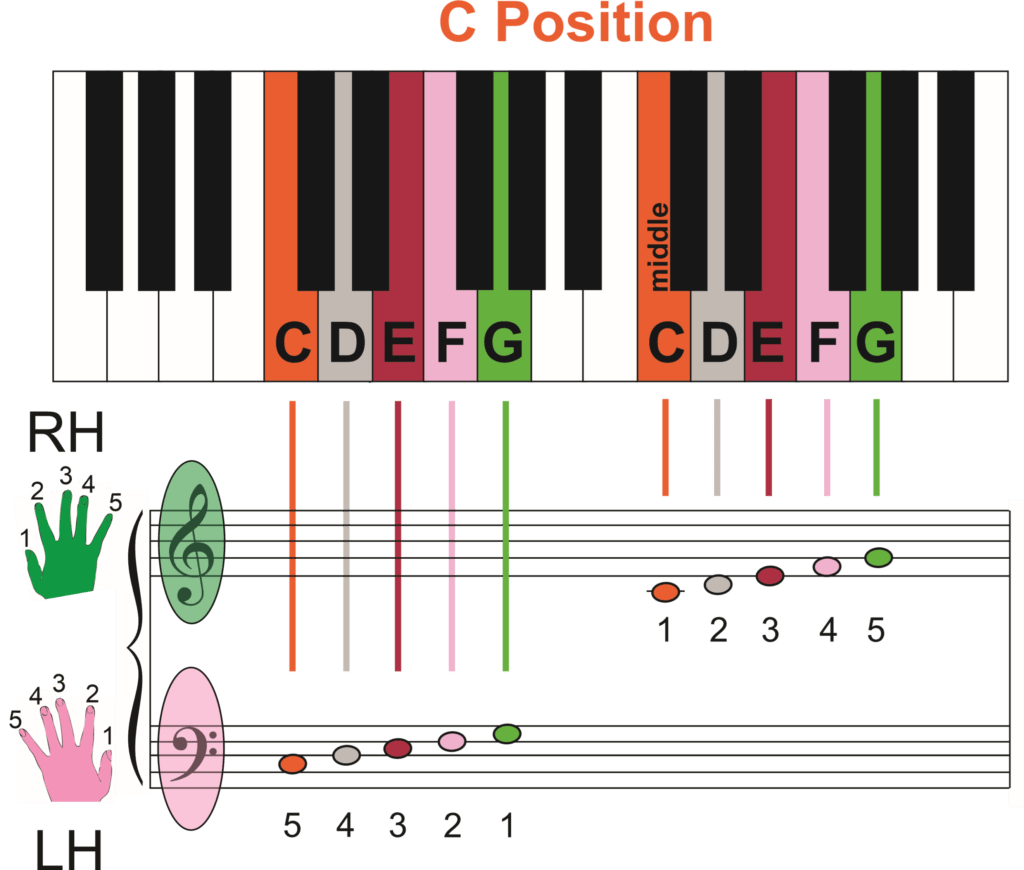
Playing the Piano with Color Coded Rhythm, Fingering, and Notes - C Position - Playing Piano with Color Coded Left Hand Notes and Rhythm - Piano Major Scales (Basic Fingering Concepts)

Hand Icon (churien.deviantart.com/art/hand-template-blank-272630198) by Churien is licensed under CC BY (creativecommons.org/licenses/by/3.0). Modified by Geoffrey Keith.

Before you can use your left hand to play piano with color coded notes and rhythm, it’ll be necessary to put your hand in the right place on the instrument.

The above diagram illustrates C position for both hands. However, we’ll be focusing on playing the notes on the left side of the diagram. Use your left hand with the following fingering:

  • First Finger: The thumb goes on the G (green) key
  • Second Finger: The pointer finger goes on the F (pink) key
  • Third Finger: The middle man goes on the E (red) key
  • Fourth Finger: The ring finger goes on the D (gray) key
  • Fifth Finger: The pinky goes on the C (orange) key

Students often become confused by the fingering. However, color coding the fingers will help:

Lightly Row and Playing Piano with Color Coded Left Hand Notes and Rhythm

Use your left hand to play the piano with the color coded notes and rhythm. Start with the notes and fingering:

  1. Play and say the notes, tracking from left to right on the page.
  2. Then, say the finger numbers (the black numbers) while playing.
  3. Make sure you keep a steady pulse as you play.

Next, count and clap the rhythm:

  • Red = clap
  • Blue = don’t clap
  • Brown = rest = opposite clap

For more info read:

I’ve created a soundtrack that demonstrates how the melody for Lightly Row will sound.

  • DO NOT listen to the track before playing the song.
  • Instead, listen to the soundtrack afterward to see if you played it accurately.

Once you have mastered Lightly Row, you can test yourself with the quiz provided below. Remember to play and say the notes.

Lightly Row Arrangement:

Playing Piano with Color Coded Left Hand Notes and Rhythm - Lightly Row - Color - line 1
Playing Piano with Color Coded Left Hand Notes and Rhythm - Lightly Row - Color - line 2
Playing Piano with Color Coded Left Hand Notes and Rhythm - Lightly Row - Color - line 3
Playing Piano with Color Coded Left Hand Notes and Rhythm - Lightly Row - Color - line 4

Playing Piano with Color Coded Left Hand Notes and Rhythm: Notes Quiz

Playing Piano with Color Coded Left Hand Notes and Rhythm - Quiz - line 1
Playing Piano with Color Coded Left Hand Notes and Rhythm - Quiz - line 2

Final Thoughts on Playing Piano with Color Coded Left Hand Notes and Rhythm

Many students find left hand sight reading more challenging. However, the more you use your left hand to play the piano with the color coded notes and rhythm, the better you’ll get at playing.

If you want to do more color coded reading, check out the other posts in the Playing Piano with Color Coding series:

Have fun playing!

© 2023 Geoffrey Keith

Newsletter Signup

Join me for in-person or online lessons today!

Back to the Color Coding category blogs page

Back to the Successful Music Student blogs page

Glossary

Why is Classical Music Interpreted Differently from Pop Music - Ludwig van Beethoven Bust - Beethoven (Why Did He Keep Composing After Deafness) - Singing Beethoven’s Beautiful Ode to Joy - Learn How to Play Beethoven’s Beautiful Fur Elise

Why is Classical Music Interpreted Differently from Pop Music? Part 3

“Why is classical music interpreted differently from pop music?” Interpretation has a very important role in performing classical music. This doesn’t mean that interpretation can’t be important in pop music. However, classical artists seem to be very aware of the process of how to interpret a piece of music. You can be too. Read more to learn how it works. Estimated reading time 2 minutes.

Read More
Why it's so hard for someone with a good ear to learn sheet music - music stand - How to Graduate from the Color Coded Music Notation - How Do Musicians Find Enough Time to Practice Their Instruments

Why It’s So Hard for Someone with a Good Ear to Learn Sheet Music

Do you want to learn how to read music, but just can’t? Are you a teacher that has students with good ears who struggle with reading? Having a good ear can be a two-edged sword. The student can pick up music quickly by ear. However, the same strength can create challenges for score reading. Read more to learn why it’s so hard for someone with a good ear to learn to read sheet music. Estimated reading time 3 minutes.

Read More


How to Write Music Using Consonance and Dissonance - Piano and Flute

How to Write Music Using Consonance and Dissonance

Do you want to know what consonance and dissonance are? Do you need to know how they work in music? If you want to write incredibly cool music, you need to understand how consonance and dissonance function in melodies and harmonies. Keep reading “How to Write Music Using Consonance and Dissonance” to learn what they are and how they work. Estimated reading time 3 minutes.

Read More

1 thought on “Playing Piano with Color Coded Left Hand Notes and Rhythm”

Comments are closed.