
Success Music Studio

Do My Hands Sizes Affect Learning Performance on the Piano - Hand Reaching for an Octave - How to Explain an Octave to an Absolute Beginner Musician

Do My Hands’ Sizes Affect Learning Performance on the Piano?

Facebook
Twitter

Estimated reading time 2 minutes

Table of Contents

Do My Hands' Sizes Really Affect Learning Performance on the Piano?

“Do my hands’ sizes affect learning performance on the piano?” Yes, your hand’s size can affect your ability to play certain techniques and perform some types of music. Read more to find out how your hand’s size can affect your ability to perform and what you can do about it.

This post uses musical terms. For definitions, see the Glossary at the end of the article.

Why Do Minor Keys Sound Sad to Me- Ways Around the Difficulty of Playing the Piano Due to Short Fingers and Small Hands - piano fingers - How Can Legato Notes Be Played Staccato - Do My Hands' Sizes Affect Learning Performance on the Piano - Piano Major Scales (Basic Fingering Concepts)

How My Hands' Sizes Affect Learning Performance on the Piano: Large Intervals

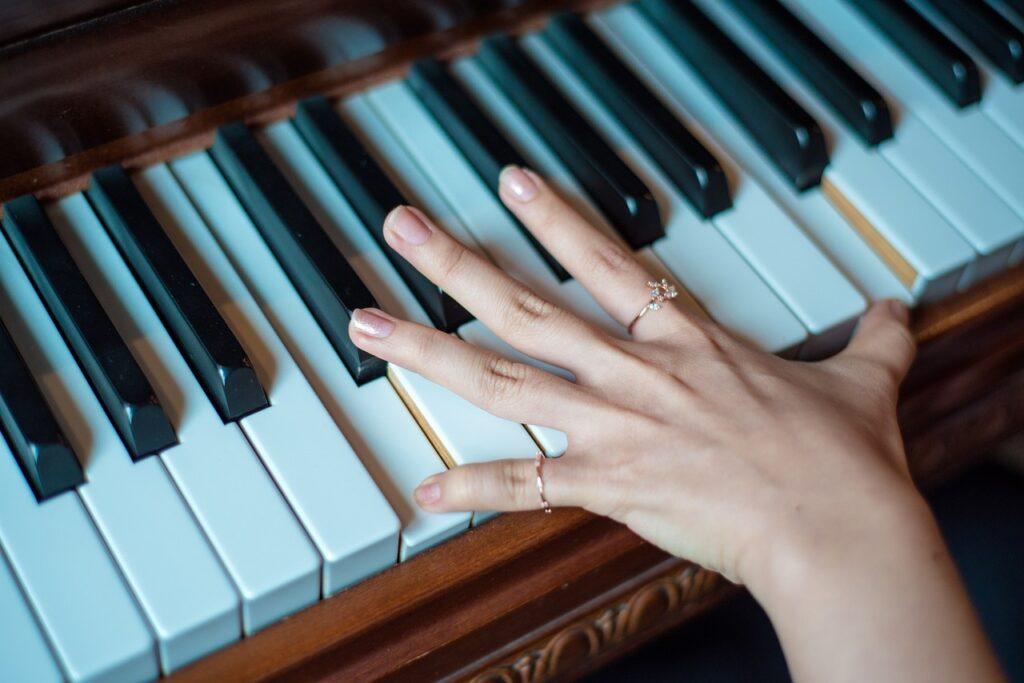
“Do my hands’ sizes affect learning performance on the piano?”  Yes, it impacts your ability to reach large intervals and challenging chords. Such as:

  1. Fast octaves can be challenging for anyone, which is one reason why many pianists consider fast octaves to be a virtuoso skill. Basically, octaves can only be fingered with the thumb (#1) and pinky (#5) fingers. Therefore, it should be no surprise that your hand’s size impacts your ability to play octaves quickly. If you have smaller hands, this may limit your ability to play elite level pieces.
  2. Also, hand size can impact your ability to reach larger intervals such as an interval of a tenth. An interval of a tenth spans ten white keys on the piano (thus the name). If you find octaves difficult, tenths will be out of the question. This will impact what types of music you can play. For example, Liszt (who wrote his music with his concerts in mind) had meat hooks for hands, so he used lots of tenths. This means that Liszt’s music will likely be out of your reach (literally) if you have small hands.
  3. Likewise, playing certain types of complex chords can require a big stretch. This might limit your ability to play the music of composers such as Rachmaninov or Joplin if you have a small hand span. And if you have tiny hands, even the interval of a sixth can be uncomfortable to reach. In that case, you’ll probably need the help of a good piano teacher to help you find workarounds.
Color Coding Musical Accents - writing well crafted songs - Picture of Sheet Music on a Piano - Do My Hands' Sizes Affect Learning Performance on the Piano - Teaching Music Teachers - Vintage Sheet Music - What Purpose Do Accidentals Serve in Reading Sheet Music - What Does it Mean for Me to Interpret a Piece of Music - Is Playing the Piano a Suitable Activity for Autistic People - How Long Do You Take to Memorize a Piece of Piano Music

How Do My Hands' Sizes Affect Learning Performance on the Piano and What Can I Do About It?

“Do my hands’ sizes affect learning performance on the piano?”  While small hand size can limit your ability to play large interval stretches, it doesn’t mean you can’t be a good pianist.

With solid technique and lots of practice you can become skilled at keyboard instruments. Having a good teacher helps too.  So, don’t let your hand span keep you from playing the instrument you love.

Having said that, what can you do if you have small hands but want to play the music of composers like Gershwin or Liszt? Read this next post for tips on how to roll chords and arrange piano music so it works for your hand size:

Related Posts

© 2023 Geoffrey Keith

Newsletter Signup

Join me for in-person or online lessons today!

Back to the All-Purpose Music Tips and Topics category blogs page

Back to the Successful Music Student Blogs page

Glossary

Harmony is Tone Color - Xylophone - Tips for Synthesizing an African Balafon Style Xylophone Sound

Tips for Synthesizing an African Balafon Style Xylophone Sound

Do you have a hard time recreating on the synth the xylophone sounds from your favorite world music? Do you want to know how to tune the African balafon? The tuning and tone color of an instrument are closely tied together. Keep reading to get info and tips for synthesizing an African balafon style xylophone sound. Estimated reading time 4 minutes.

Read More
Tune the Ukulele with a Free Online Tuner - Ukulele

Tune the Ukulele with a Free Online Tuner

Do you want to tune the ukulele with a free online tuner? If you’d like to get your ukulele into the standard ukulele tuning in equal temperament, don’t worry, I have what you need. However, did you know that the Hawaiians tune their instruments so that their ukes sound a lot better? Click to tune up the most common versions of the tuning. Estimated reading time 4 minutes.

Read More
How to Play the Easy Beginner Guitar F Chord Without a Barre - Acoustic Guitar - What’s the Basic Difference Between Drop D vs Open D Tuning?

How to Play the Easy Beginner Guitar F Chord Without a Barre

Do you want to know how to play the easy beginner guitar F chord without a barre? Learning F on the guitar has long been a rite of passage for guitarists. Why? The barre makes it difficult to play, keeping many beginner guitarists from being able to play many otherwise simple songs. Keep reading to learn how to play the easy F chord on guitar. Estimated reading time 2 minutes.

Read More
Do I Really Have to Learn Music Theory to Learn How to Play Piano - Understanding Prosody in Your Songwriting - piano - Learn How to Play Beethoven’s Beautiful Fur Elise

Do I Really Have to Learn Music Theory to Learn How to Play Piano?

Do you want to give up on learning music theory? Does it seem pointless to you? Music theory can help with sight reading skills on the piano. It’ll be useful for improvisation and composition. It even helps with performance practice. If you still have an open mind, read “Do I Really Have to Learn Music Theory to Learn How to Play Piano?” to understand the ways it can help you to better play the instrument. Estimated reading time 4 minutes.

Read More