Music
Music
Where Did the Word for Music Come From?
The Western term for music comes from the Greeks. The ancient Greeks thought that the arts were inspired by a collection of nine gods called the Muses.
This is understandable, because when a songwriter creates a song, it can feel as if it has come from an outside source. However, it has really come from the intuitive part of the songwriter’s brain.
The idea in mythology was that the Muses channeled creative ideas to singers and instrumental performers, and they in turn created their art.
On the other hand, some cultures lack an equivalent word for music. For instance, in some parts of the world the word for singing remains the same as the word for praying.
Music in the Non-Western World
For most of the world’s history, songs have been about more than just entertainment. It helped pull people together and bind them as a community. It would be hard to imagine a church service, sporting event, or school rally without songs.
Songs have often had important roles in life cycle events: births, deaths, seasonal songs, coming of age, work songs, and holidays.
Music in the Western World
Composers and songwriters sculpt sound into compositions. In Western culture, we usually view it as entertainment. This mostly likely results from the structure of free market societies, which always looks for ways to monetize products and services.
The Music Archive includes posts on different ways of learning to sing, play instruments, and compose. However, the list below focuses on songwriting posts.
Songwriting Posts on Melody and Harmony Composition:
See the posts below for full descriptions.
– Geoffrey Keith
© 2022 Geoffrey Keith
Back to the Successful Music Student Blogs page
Do you want to know how to read the notes in your piano music? Are you confused about why the right hand and left hand play different musical notes? Reading sheet music for piano is more difficult than for other instruments. Why? Because piano music uses two different clefs. Keep reading “Learn How to Read Piano Notes (Free Resource)” to learn how it works. Estimated reading time 2 minutes.
Learn How to Read Piano Notes (Free Resource) Read More »
Do you need to know what the word decibel (dB) means? Do you want a decibel chart so that you can know what noise levels are safe? Decibels are used in sound recording, radio, and live concert reinforcement. Keep reading “What Does Decibel Mean? (In Less than 3 Minutes)” to learn what it is and how it works. Estimated reading time 2 minutes.
What Does Decibel Mean? (In Less than 3 Minutes) Read More »
Do you want to know what lip syncing is? Do you want to know how to ethically do it? When it comes to both live performance and recordings, lips syncing is a controversial topic. There are some circumstances where it is brazenly dishonest, and others where it has become an industry standard. Keep reading “Why Do Some Singers Brazenly Lip Sync?” to learn more. Estimated reading time 2 minutes.
Why Do Some Singers Brazenly Lip Sync? Read More »
“What on earth exactly is vibrato?” It’s a pulsating sound that musicians use to make their music more engaging. Views on vibrato have varied through the centuries. However, currently it’s felt that it adds warmth to the notes, and by extension, it adds more emotion to your playing. Keep reading to learn what it is and how it works. Estimated reading time 3 minutes.
What on Earth Exactly Is Vibrato? Read More »
Do you want to know what the difference is between a trill and tremolo in music? The two terms sound alike, and superficially they have some things in common. However, they produce very different results. This is particularly true when you consider that tremolo picking on guitar and orchestral tremolo are two different things. Keep reading “What’s the Key Difference Between Trills and Tremolo” to learn how they’re similar and how they differ. Estimated reading time 3 minutes.
What’s the Key Difference Between Trills and Tremolo Read More »
Are you confused about what all the conductor’s hand gestures mean? Do you want to learn how to conduct a musical ensemble? Conducting isn’t just brandishing a stick. The conductor is the coach of an ensemble. Also, they interpret the musical score, making it so that each ensemble has its own unique sound. Keep reading “A How to Guide to Learning Conducting with Musicality” to learn what it is and how it works. Estimated reading time 4 minutes.
A How to Guide to Learning Conducting with Musicality Read More »
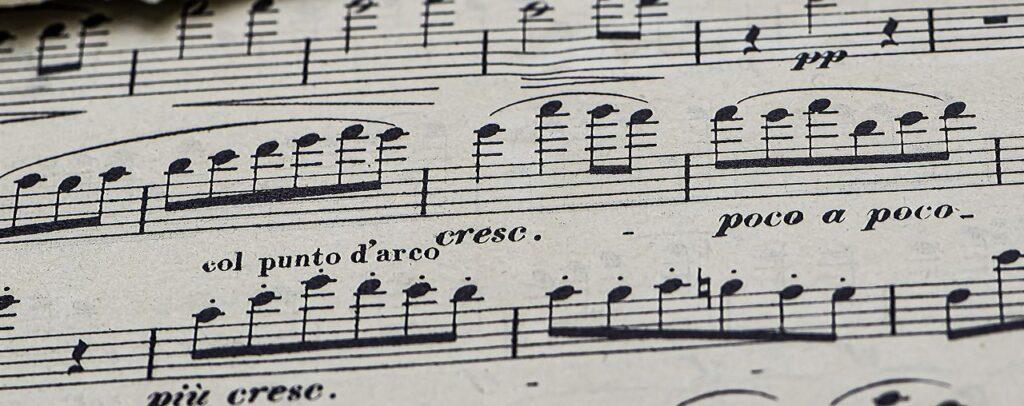
Do you want to know the meaning of the word crescendo? Do you want to know how to play crescendo and decrescendo? Dynamics (like crescendo and diminuendo) are an important part of musical expression and interpretation. Keep reading “What Is the Essential Meaning of Crescendo in Music” to learn what it is and how it works. Estimated reading time 3 minutes.
What Is the Essential Meaning of Crescendo in Music? Read More »
Do you need to be able to record your vocals? Do you want to have them sound professional? Good recording skills are an essential part of creating a high-quality sound. Moreover, it’s basically the same process for recording your voice for speech or for singing. Keep reading “How to Record Vocals for a Professional Sound” to learn how to get the best sound possible. Estimated reading time 5 minutes.
How to Record Vocals for a Professional Sound Read More »
Want to know what the word transpose means in music? Do you need to know how to change the key of a song? There are a bunch of reasons you might need to change the music’s key: 1) it’s the wrong range for your voice, 2) you need to make it fit your instrument’s range, 3) or you may play a transposing instrument (such as Bb trumpet) but need to read some music written at concert pitch. Keep reading “How to Effectively Use Music Theory to Transpose Music” to learn how to do it. Estimated reading time 4 minutes.
How to Effectively Use Music Theory to Transpose Music Read More »
Do you want to learn how to write a melody? A melody is a series of notes that sound in rhythmic sequence. In a song, it’s the musical part that the lead vocalist sings. It’s the main focus of the music, because it’s what sells the song. Keep reading “What’s a Melody (and How to Write Strong Ones)” to learn what it is and how it works. Estimated reading time 3 minutes.
What’s a Melody (and How to Write Strong Ones) Read More »