




Success Music Studio

How to Write Music Using Consonance and Dissonance - Piano and Flute

How to Write Music Using Consonance and Dissonance

Facebook
Twitter

Estimated reading time 3 minutes

Table of Contents

Introduction

Do you want to know what consonance and dissonance are? Do you need to know how they work in music? If you want to write incredibly cool music, you need to understand how consonance and dissonance function in melodies and harmonies. Keep reading How to Write Music Using Consonance and Dissonance to learn what they are and how they work.

This article uses musical terms. For definitions, see the Glossary at the end of the post.

Changing Keys in Your Songwriting - pencil, eraser, and sheet music - Singing Shape Note Harmonic Minor Melodies - Learn the Elements of Songwriting Construction - Can Someone Explain Roman Numeral Analysis in Layman's Terms for Me - How Can I Learn the Basics of Music Theory - Song Structure, Musical Phrases, Musical Structures and Forms - What Exactly Do I Do with the Circle of Fifths - Do I Really Have to Learn Music Theory to Learn How to Play Piano - Why Do Minor Keys Sound Sad to Me - Color Code Key Signatures - Keyboard Accidentals - What is a Parallel Mode and How Does it Work - What Purpose Do Accidentals Serve in Reading Sheet Music - Reading Music (A Quick Guide to How to Read Music) - How Can I Learn the Basics of Music Theory - What Exactly Do I Do with the Circle of Fifths - An Easy How to Guide to Understanding Triads - 50 Essential Music Symbols Explained in Less Than 5 Minutes - What Exactly Do I Do with The Circle of Fifths - Circle of Fifths - How to Learn Music Theory with a Learning Disability - How to Effectively Use Music Theory to Transpose Music

How to Write Music Using Consonance and Dissonance: What Are They in Music?

What are consonance and dissonance? The New Harvard Dictionary of Music states:

The perceived stability or instability of a complex of two or more sounds. (197)

When two notes are dissonant, they have a roughness that is unpleasant to listen to:

  • This roughness makes them unstable, because your ear wants to move on from the unpleasant sound.
  • When you move from a dissonant (bad sounding) to a consonant (good sounding) interval, it’s called a resolution.
  • Consonance is stable, because your ear likes hearing pleasant sounding intervals.

The back and forth of consonance and dissonance in Western music gives the music forward motion.

Do I Really Have to Learn Music Theory to Learn How to Play Piano - Learn the Elements of Songwriting Construction - Songwriter at a Computer - after they can sight-read what’s left for musicians to learn - What is a Parallel Mode and How Does it Work - How Can I Learn the Basics of Music Theory - The Top 5 Best Drake Sheet Music Gift Ideas

How to Write Music Using Consonance and Dissonance: How it Functions in Melodies

Dissonance happens in melodies when scale tones (a.k.a. non-harmonic tones), conflict with the notes in your harmony, which then resolves to a consonance.

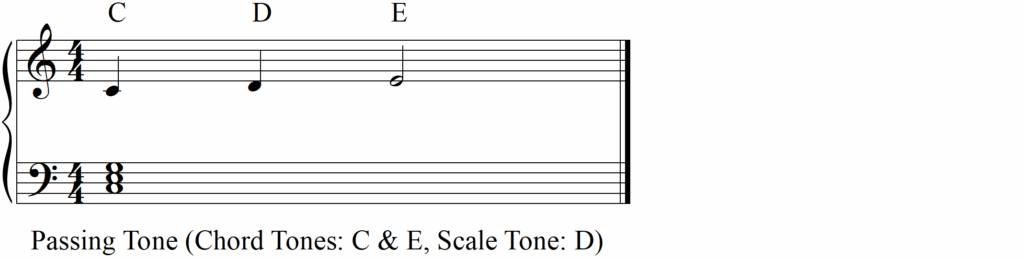
  • Passing Tone: This is the simplest non-harmonic tone as the scale note passes between chord notes. If you listen closely, you can hear extra tension as the D note (the non-harmonic tone) plays.
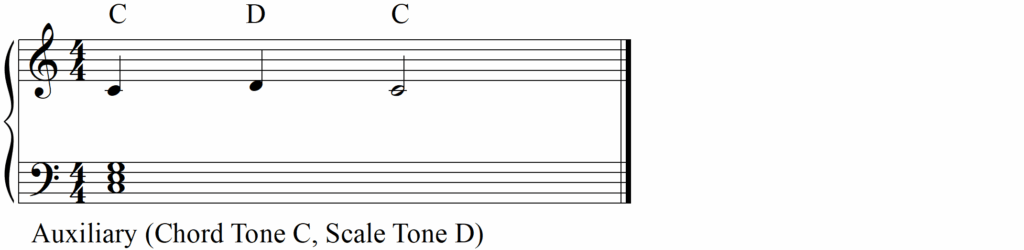
  • Auxiliary: It starts on a chord note, then goes up or down by a step and back again.
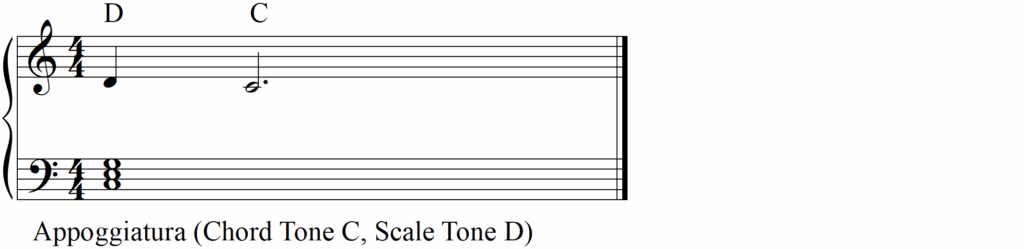
  • Appoggiatura: Unlike the last two, this one has the non-harmonic tone land on the beat then resolve to the chord tone. Having the scale tone on the beat really makes the roughness pop out of the texture.

Melodic skips

  • Cambiata: This melodic ornament starts on the chord tone, then skips to a non-harmonic tone (either up or down). Finally, it resolves by step in the opposite direction to a chord tone.
  • Echappe: An echappee steps into the dissonance then skips into the resolution. You could think of it as being the opposite of the cambiata.

Pulling in notes from other chords.

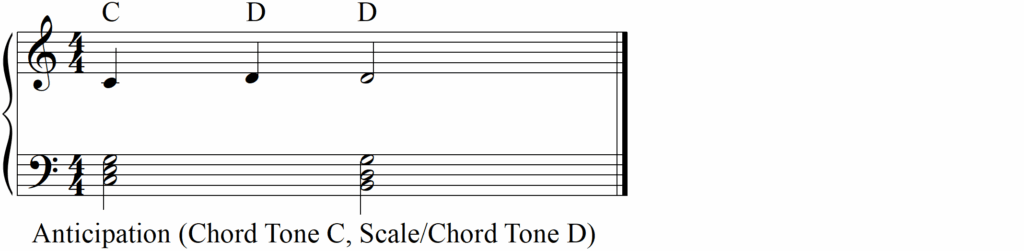
  • Anticipation: The non-harmonic tone played over the first chord is the same as the chord tone in the next harmony.
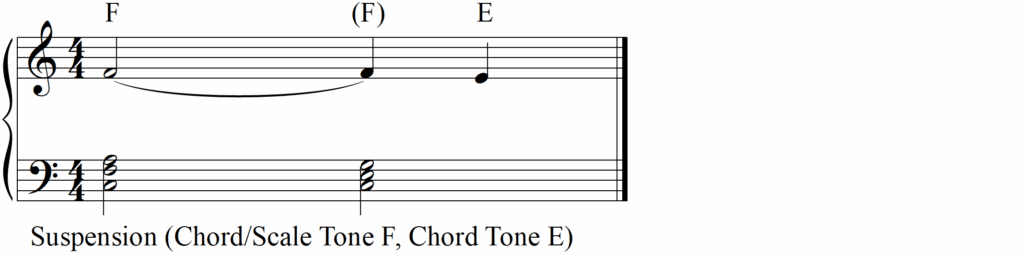
  • Suspension: A suspension is the opposite of an anticipation. A note from the first chord is held over into the next chord, turning that note into a non-harmonic tone.

See the examples below for each type of non-harmonic tone.

  • I deliberately made the soundtracks slow, so you can hear the roughness.
  • To minimize the roughness, increase the speed when using melodic ornaments.
  • Doing this will generally make your melodies less dissonant.

Just be sure not to make your melodies too fast!

Mobile users: for best results reading the music, rotate your screen 90o to the right.

How to Write Music Using Consonance and Dissonance - Passing Tone
How to Write Music Using Consonance and Dissonance - Auxiliary Tone
How to Write Music Using Consonance and Dissonance - Appoggiatura

How to Write Music Using Consonance and Dissonance: How it Functions in Harmony

Harmonic consonance and dissonance happen when notes sound simultaneously.

  • This means that you need to have at least two notes, such as you find with harmonic intervals.
  • However, triads have three notes, and seventh chords have four unique notes per chord.
  • Jazz chords can have even more than that.

One of the most common uses of harmonic consonance and dissonance is the resolving tritone.

  • You can see in the first example the tense tritone resolving to the calm major third.
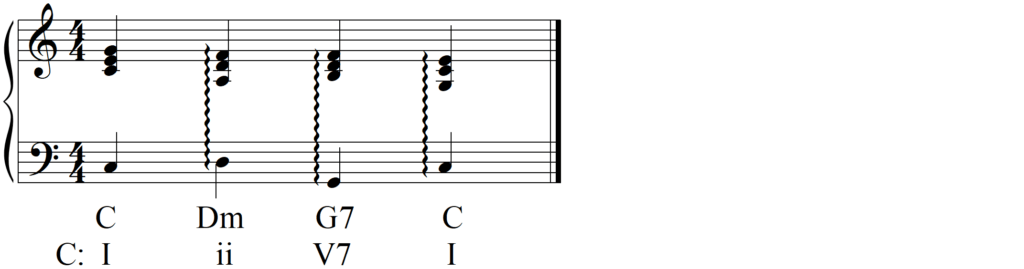
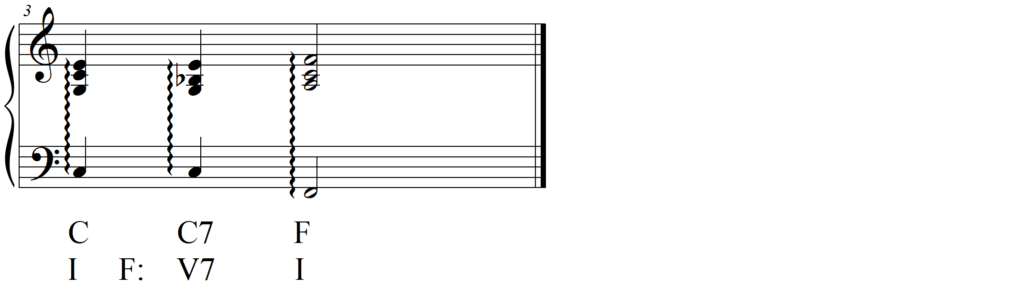
  • The next example has a V7 to I resolution. In other words, the tritone within the V7 chord resolves when you move to the I triad.
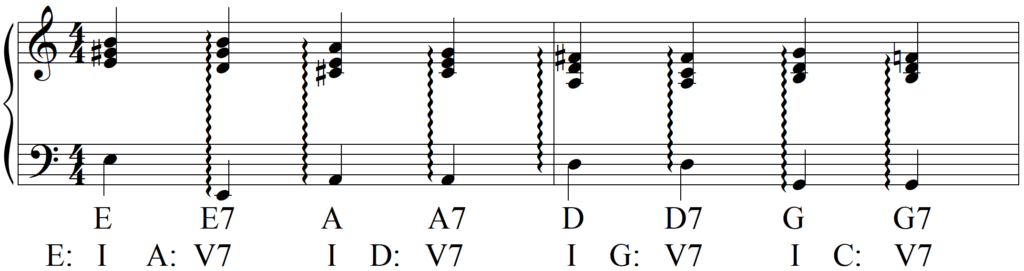
  • In addition, resolutions help you change keys.
  • The third example below shows how you can use chains of V7 chords to quickly move through six different keys.
  • The final example below has a diminished seventh chord, which contains two tritones. It demonstrates the different ways this very tense chord can be effectively resolved.

For more information on Roman numeral analysis:

What Does Dissonance Mean for Basic Seventh Chords - Resolving Tritone
What Does Dissonance Mean for Basic Seventh Chords - C Major V7 I
How to Unlock Music Key Changes with Modulation - V7 of V Chords line 1
How to Unlock Music Key Changes with Modulation - V7 of V Chords line 2
Why Do Crazy Chromatic Notes and Chords Work - Resolving C Dim7 line 1
Why Do Crazy Chromatic Notes and Chords Work - Resolving C Dim7 line 2

Final Thoughts

Takeaway points:

  1. Dissonant intervals sound bad, and consonant intervals sound good.
  2. Moving from a dissonant to a consonant interval is called a resolution.
  3. Dissonance happens in melodies when scale tones (a.k.a. non-harmonic tones), conflict with the notes in your harmony, which then resolves to a consonance.

Have fun writing!

Related Posts

© 2025 Geoffrey Keith

Glossary

Explore Bach’s Epic Orchestral Music in Less Than Four Minutes - Pipe Organ

Explore Bach’s Epic Orchestral Music in Less Than Four Minutes

Would you like to explore Johann Sebastian Bach’s instrumental music but don’t have a lot of time to spend doing it? Bach is one of the most celebrated composers in classical music. He’s best known for writing delightfully complex polyphonic music. Keep reading to explore Bach’s epic orchestral music in less than four minutes. Estimated reading time 3 minutes.

Read More

Top 5 Best Songs for Professional Wedding Singers - Bride

Top 5 Best Songs for Professional Wedding Singers

Do you want to sing at weddings? Do you need help developing your repertoire? A wedding is a special time for a couple because it’s the beginning of building a life together. If you do your job right, you help build memories that will last for the rest of their lives. Click to learn the top 5 best songs for professional wedding singers and learn about the resources for learning even more songs. Estimated reading time 3 minutes.

Read More

How to Choose the Best Guitar Case for You - Woman with Gig Bag

How to Choose the Best Guitar Case for You

Did you just buy a guitar, but it didn’t come with anything to carry it in? Do you need some advice on what type of case to buy? A guitar case makes it easier to carry your instrument, and it also protects your guitar as you transport it. Click to learn how to choose the best guitar case for you. Estimated reading time 3 minutes.

Read More