


Success Music Studio

A Quick Guide to How to Play the Bass - Fender Bass

A Quick Guide to How to Play the Bass

Facebook
Twitter

Estimated reading time 4 minutes

Table of Contents

Introduction

Want to learn how to play bass? In today’s post we’ll talk about some basic skills. Also, we’ll break down more advanced skills (including additional resources) by musical style. Keep reading A Quick Guide to How to Play the Bass to learn more about this fun instrument.

This article uses musical terms. For definitions, see the Glossary at the end of the post.

How to Read Basic Guitar Tab for Beginners - Guitarists

A Quick Guide to How to Play the Bass: Fundamental Skills

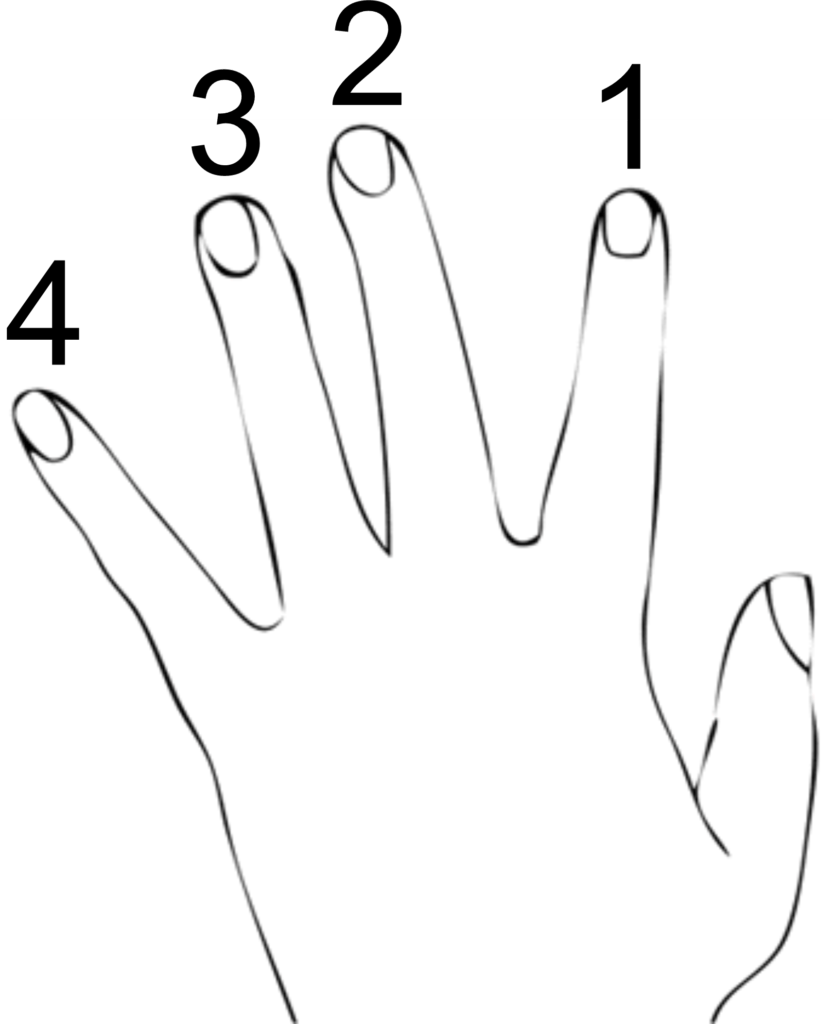
How to Play the Easy Beginner Guitar F Chord Without a Barre - Easy G Chord - Hand Icon LH (guitar) - What Are the Best Easy Guitar Chords for Beginners to Learn?

Hand Icon (churien.deviantart.com/art/hand-template-blank-272630198) by Unknown Author is licensed under CC BY (creativecommons.org/licenses/by/3.0). Modified by Geoffrey Keith.

Left hand fingering rules.

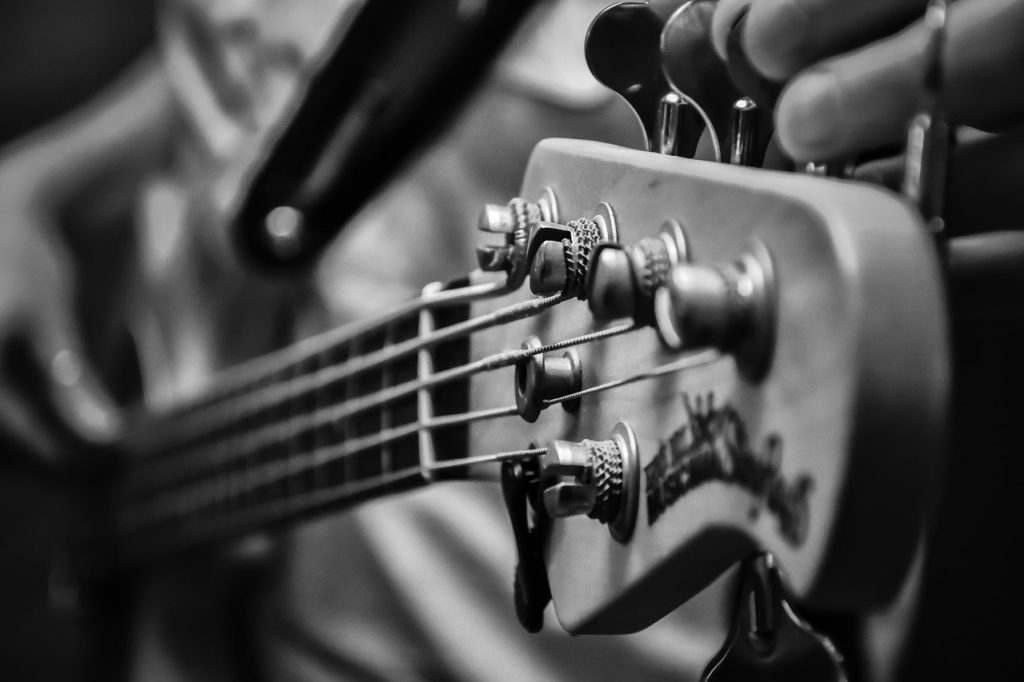
  • When you fret notes, you need to have your thumb behind the neck supporting your other four fingers (see the picture at the top of the post).
  • However, don’t let your thumb creep up toward the top of the neck.
  • Also, your thumb should be centered between your pointer (#1) and ring (#3) fingers.

Your right hand should play with the power stroke.

  • You need to pluck with your pointer and middle fingers so that they follow through, stopping to rest on the next higher string.
  • This will add projection to your tone.
  • Do this by alternately plucking with your pointer and middle fingers while your thumb rests on the pickup.

Slap bass

  • Want to play slap bass style? You need to hit the string with the first joint of your right-hand thumb about 12 frets above the note you’re playing (e.g., hold the note at fret two and slap around fret 14).
  • This creates the slap tone by hitting the artificial harmonic halfway between the bridge and your fretted note.
  • Experiment with shifting around your thumb until you get a resonant slap tone.

A Quick Guide to How to Play the Bass: Know Your Neck

Good bassists know where all the notes are on the neck.

  • The open strings are E A D G (from fattest to thinnest).
  • Once you have learned the open strings, learn the natural notes.
  • After you’ve learned the natural notes, learn the sharps and flats.

I’ve included a downloadable PDF that will teach you all the notes on the neck.

  • First, you need to know how to read tab.
  • If you don’t know how, see the next section.
  • After learning the natural notes, learn the sharps and flats.
  • Any sharp is one fret higher (toward the bass’s body) and any flat is one fret lower (toward the head) from the natural note.
  • For example, A is on the 1st string 2nd fret. Therefore, A sharp (A#) will be one fret higher (1st string 3rd fret) and A flat (Ab) will be one fret lower (1st string 1st fret).
PDF

It can’t be stressed enough that progress results from regular practice.

Tuning - Picture of Tuning an Electric Bass

A Quick Guide to How to Play the Bass: Pop and Rock

Unlike concert band, you won’t be reading musical notation.

  • Instead, the guitarist in your band will give you the chords for a song and say, “make it up” or “learn it from tab.”
  • In rock, it’s more important to learn styles rather than musical notation. (Having said that, it’s still good to learn how to read music.)
  • Rhythmically, you should play along with your drummer’s bass drum part.
Bass style book

To use this book, you’ll need to know how to read tab.

  • The following post is for guitar.
  • However, the only real difference is that the bass has four strings, and the guitar has six strings.
  • Otherwise, tab works the same for both instruments.
Tab post

You’ll also need to know scales.

Scales help you improvise, but how do you actually do it?

  • The Improv concepts link below will teach you how to improvise.
  • It teaches from the piano perspective, but the ideas translate well to other instruments.
  • Once you’ve got the concept, go to YouTube and try improvising over your favorite songs.

Improv concepts

Video: How to Play Rock Bass

A Quick Guide to How to Play the Bass: Concert Band

In concert band, you’ll need to read musical notation. These posts will give you the basics.

However, you’ll need a good method book that focuses on how to read bass music.

Also, you should try to find a good teacher to help you master your instrument.

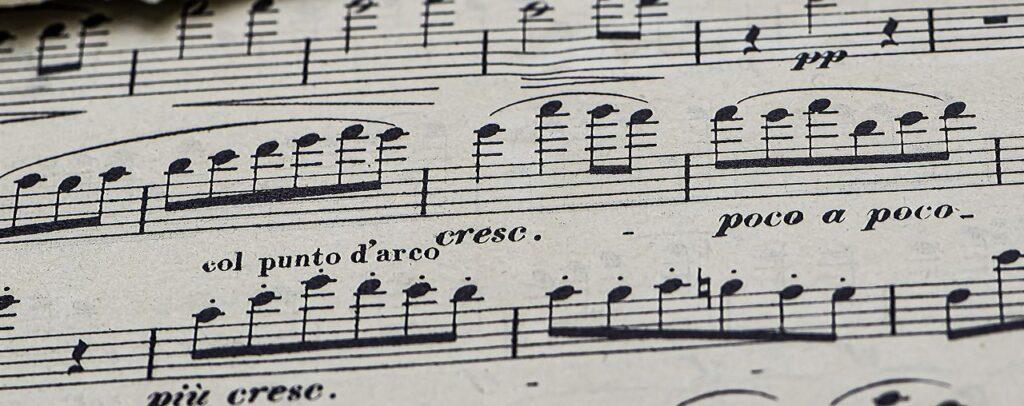
What Is the Essential Meaning of Crescendo in Music - Sheet Music 2

A Quick Guide to How to Play the Bass: Jazz Walking Bass

Like concert band, you’ll need to read musical notation. You’ll also need to create walking bass lines:

  1. Play the walking bass line using a steady quarter note rhythm, though you can throw in an occasional eighth note.
  2. The notes move in stepwise motion, though you can throw in an occasional skip.
  3. Repeated notes should be avoided when performing walking bass lines.
  4. Chord tones are played on the first and third beats, and scale tones are played on the second and fourth beats.
  5. Scale tones are played from the scale that the piece is in, so that if the piece is in the key of F major, the scale tones will be pulled from the F major scale.
  6. However, if the piece later modulates to the key of Bb major, the scale tones will be pulled from the Bb
  7. If a harmony has chord tones from outside the key, but the chord is not part of a full modulation, play beats one and three using the notes from the chord rather than from the key.

When playing walking bass lines, you need to have a thorough understanding of scales and chords.

Scales:

Video: How to Play a Walking Bass Line

Final Thoughts

Takeaway points:

  1. You should try to find a good music teacher to help you master your instrument.
  2. It can’t be stressed enough that progress results from regular practice.
  3. Rhythmically, you should play along with your drummer’s bass drum part.
  4. If you want to have full freedom improvising over chord changes you need to have a thorough understanding of scales and chords.
  5. However, it’s still important to learn how to read tab and musical notation.

Have fun playing!

Related Posts

© 2025 Geoffrey Keith

Glossary

Help Me! How Do I Improve My Touch on Piano?

Help Me! How Do I Improve My Touch on Piano? Part 4

Do you want to be better at piano touch? Do you need help learning how to interpret a piece of music? The term piano touch covers the different ways you strike the key to get certain effects. Carl Seashore, in Piano Touch, states, “The pianist has at his direct control only two of four factors in music: namely intensity and time” (360). Read more to answer the question, “How do I improve my touch on piano?” Estimated reading time 2 minutes.

Read More

What’s the Key Difference Between Soprano and Mezzo Soprano?

“What’s the key difference between soprano and mezzo?” Though superficially these two voice types seem very similar. You only need to take a closer look to notice the key differences between singers like Celine Dion and Taylor Swift. Keep reading to learn how this affects singers like you. Estimated reading time 2 minutes.

Read More

Exploring the Music Themes and Leitmotifs of Star Wars - Legos

Exploring the Music Themes and Leitmotifs of Star Wars

Do you love the “Star Wars” soundtrack and want to understand it better? Are you a budding composer and want to understand leitmotifs and how to write them? It doesn’t matter if you’re a composer or just a fan, exploring the music themes and leitmotifs of “Star Wars” will be a rewarding experience. Read more to understand themes and leitmotifs, and to get indexed lists of each theme and where it occurs within the film. Estimated reading time 5 minutes.

Read More
How to Best Memorize Music - Sheet Music With Hearts

How to Best Memorize Your Music

Do you need to memorize your music? Do you want help understanding the different ways to effectively memorize pieces? Not everyone thinks the same way, so the trick is to learn the best way for *you* to memorize your music. Click to learn how to best memorize your music. Estimated reading time 4 minutes.

Read More