



Success Music Studio

What Is the Essential Meaning of Crescendo in Music - Sheet Music 2

What Is the Essential Meaning of Crescendo in Music?

Facebook
Twitter

Estimated reading time 3 minutes

Table of Contents

Introduction

Do you want to know the meaning of the word crescendo? Do you want to know how to play crescendo and decrescendo? Dynamics (like crescendo and diminuendo) are an important part of musical expression and interpretation. Keep reading What Is the Essential Meaning of Crescendo in Music? to learn what it is and how it works.

How Easy (or Difficult) Is it to Play Accordion - Piano Accordion

What Is the Essential Meaning of Crescendo in Music: What Does it Mean?

What is the essential meaning of the word crescendo?

  • The literal meaning of the Italian word is growing.
  • Thus, it’s not a climax, but rather the process of building toward a climax.
  • Therefore, in music it means that the sound grows progressively louder until it peaks.
Explore Handel's Captivating Music in Less Than Four Minutes - Harpsichord Trio - Explore Bach’s Epic Orchestral Music in Less Than Four Minutes

What Is the Essential Meaning of Crescendo in Music: How Does it Work?

How does crescendo appear in a score?

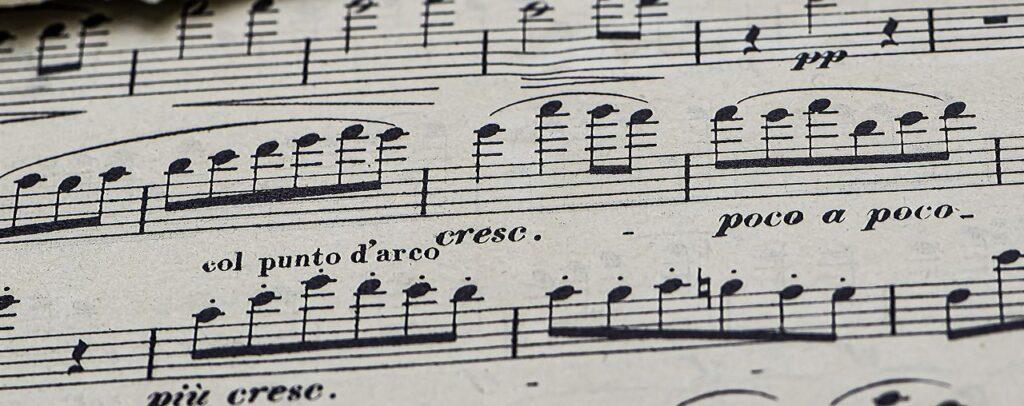
  • It can be indicated by a graphic symbol, or the word crescendo, or by the abbreviation cresc. (see the example below).
  • Notice that the graphic symbol looks like it’s getting bigger as you go from left to right on the page.
  • Thus, the graphic symbol represents the sound getting bigger, i.e., louder. (Decrescendo, being the opposite, looks like it’s getting smaller.)

Mobile users: for best results reading the score examples, rotate your screen 90o to the right.

What Is the Essential Meaning of Crescendo in Music - Crescendo line 1
What Is the Essential Meaning of Crescendo in Music - Crescendo line 2

The trick to crescendo (and by extension decrescendo – a.k.a. diminuendo) is to not get loud either too quickly or too slowly:

  • In the first case, you’ll peak too soon. In the latter case, you’ll peak too late.
  • To perform crescendo effectively, you should map out where in the score you need to get louder.
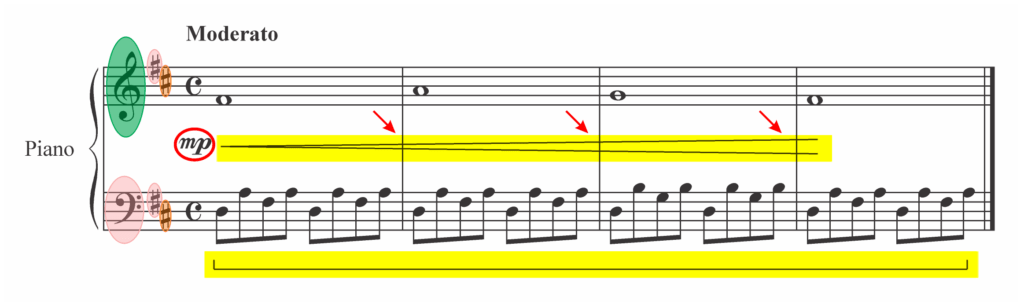
  • In the example below, the first measure is the quietest, you get a little louder in the second measure, louder still in the third measure, then peak in the fourth measure.
How to Color the Music Score to Successfully Focus Special Needs and LD Students on Features of the Sheet Music - example of applying highlighter to pedal and dyanimcs - What Purpose Do Accidentals Serve in Reading Sheet Music

Decrescendo is the opposite of crescendo.

  • To diminish means to get smaller, so the sound gets smaller, which makes sense of decrescendo’s other name: diminuendo.
  • Diminuendo can be indicated in the score by the graphic symbol, by the word diminuendo, or the abbreviation dim.
  • Humans can only hear about six levels of dynamics.
  • Therefore, the length of the crescendo or diminuendo in part determines how quicky you get louder or quieter.
  • In the example above, you’ll get louder at each measure (marked by the red arrows).
  • However, in the example below you’ll get progressively louder with each of the first five notes. Then, the following four notes become progressively quieter with each successive note.
  • Moreover, you’ll be quietest at the Cs and loudest at the G, which is the climax point in the phrase.
What Is the Essential Meaning of Crescendo in Music - Crescendo and Decrescendo

What Is the Essential Meaning of Crescendo in Music: Why Is it Important?

Dynamics in general, and crescendo and decrescendo in particular, are important because they create contrast between sections, especially when you repeat verbatim a section of the score:

  • If you play everything the same way, it becomes deadly boring. You don’t want to bore your audience, or they’ll just go off and watch YouTube videos.
  • Not only do dynamics make your playing less boring, but they can also heighten a performance’s emotional impact.
  • Dynamics can make your instrument shout, whisper, or sigh, mimicking those and a host of other emotions.

The following video shows how this works in a symphony orchestra.

Video: Dynamics

Final Thoughts

Takeaway points:

  1. While the essential meaning of crescendo in music is an increase in volume (with decrescendo being the opposite), dynamics collectively can be a whole lot more.
  2. They lend variety to the different sections in a score, helping to make your playing more engaging.
  3. Also, they add emotion and expressiveness to your performance.

Have fun playing!

Related Posts

© 2025 Geoffrey Keith

Understanding Basic Diction in Modern Singing - Girl Singing and Playing Guitar

Understanding Basic Diction in Modern Singing

Do you want to know what diction in singing is? In any vocal style, diction is central to a good performance, at least if you want your audience to understand you. However, if you’re not careful, you can overdo it and make your performance sound stiff and artificial. Keep reading “Understanding Basic Diction in Modern Singing” to learn what it is and how it works. Estimated reading time 3 minutes.

Read More
How to Use Kinesthetic Learning in Music Lessons - Music Students

How to Use Kinesthetic Learning in Music Lessons

Do you need to know what kinesthetic learning is? Do you want to be able to integrate it into your music lessons? Kinesthetic learning uses physical activity to improve the learning experience. When done right, it’ll make your lessons more fun, engaging, and effective. Click to learn how to use kinesthetic learning in music lessons. Estimated reading time 3 minutes.

Read More
How Easy (or Difficult) Is it to Play Accordion - Piano Accordion

How Easy (or Difficult) Is it to Play Accordion?

Do you want to know how easy it is to play accordion? The accordion is a versatile instrument that’s a dominant force in folk and ethnic music around the world. However, the playing difficulty depends on which type of instrument you’re talking about. Keep reading “How Easy (or Difficult) Is it to Play Accordion?” to learn more. Estimated reading time 3 minutes.

Read More