Success Music Studio

What’s Pervasive Developmental Disorder and Its Impact on Music - Kids Exploring Percussion

What’s Pervasive Developmental Disorder and Its Impact on Music?

Facebook
Pinterest
LinkedIn

Estimated reading time 4 minutes

Table of Contents

Introduction

Do you need to know what pervasive developmental disorder is? Do you need advice on how to best teach your students? On one hand, PDD can affect how someone interacts with music. On the other hand, it can be a wonderful resource for boosting morale and generally enhancing your students’ lives. Keep reading to answer the question, “What’s pervasive developmental disorder and its impact on music?”

playing the piano with color coded notes - girl playing piano - 12 Easy Piano Songs (Including Twinkle Twinkle Little Star) - How to Play Piano (Kid’s Color Coded Piano Hand Placement) - What Is the Precise Meaning of Scaffolding in Teaching - How to Teach Music Students with Dyscalculia - What’s Pervasive Developmental Disorder and Its Impact on Music?

This post contains affiliate links, which means I may receive a small commission from purchases made through the links. I’ll only recommend products I use, use in lessons, or ones my students or colleagues have recommended.

What’s Pervasive Developmental Disorder and Its Impact on Music: What Is It?

What is PDD?

Pervasive developmental disorder (PDD) is used to categorize a group of behavioral characteristics for individuals who have troubles with communicating, socializing, and display socially problematic behaviors.

PDD is a general term and not in itself a diagnosis.

Under the umbrella of PDD is:

  • Autism
  • Aspergers syndrome
  • Pervasive developmental disorder not otherwise specified (PDD-NOS)
  • Childhood disintegrative disorder (CDD)
  • Rett syndrome

In the early 2000s, PDD and PDD-NOS were commonly used. However, the first four diagnoses on the list above now have been moved under the umbrella of autism spectrum disorder (ASD).

Even though PDD isn’t a specific diagnosis, PDD-NOS is.

  • PDD-NOS is sometimes used as a placeholder diagnosis when a child is very young.
  • Since most very young children have limited language skills, it can make it difficult to assess if a child falls on the autistic spectrum (ASD) or if there is something else going on.
  • Children with PDD-NOS can range from non-verbal up to very good language skills.

Therefore, the child’s level of communication will determine whether music therapy or adapted music lessons will be a better fit.

The following post will give you information that will help you decide whether music therapy or music lessons are appropriate for your PDD-NOS child.

Prodigy Meaning (Examples of Special Talent in Music) [Video] - Children Playing Music - Sing the Charming Song London Bridge Is Falling Down

What’s Pervasive Developmental Disorder and Its Impact on Music: Adapted Music Lessons

What are adapted music lessons?

Adapted music lessons use an adapted score to help students master reading on their instruments.

If the student has good communication skills, vocal or instrumental lessons will usually be a good fit.

  • With many students, they’ll learn similarly to typical learner students.
  • However, they’ll often need help navigating the social aspects of the lessons.
  • Also, there can be issues with dichotomous thinking, where everything is black and white with no in between. If you run into problems with this, ask your student, “Is there a middle ground here?”

Other students will struggle with learning to read the score.

  • This can vary from mild to extreme, because each student is different.
  • This is why you shouldn’t get too attached to labels.
  • They make a good starting place, but ultimately, you need to learn your student’s strengths and struggles.

The following links contain information on how to use multisensory strategies to help your students learn their instruments.

This post shows you how to “scaffold” the multisensory techniques.

How Do Musicians Find Enough Time to Practice Their Instruments - Musicians Practicing Outside

What’s Pervasive Developmental Disorder and Its Impact on Music: Music Therapy

What is music therapy?

  • It entails sessions with a board-certified therapist, focusing on using music for non-musical goals.
  • Therefore, songs might be used to work on language skills or for learning specific tasks such as how to put on clothing.
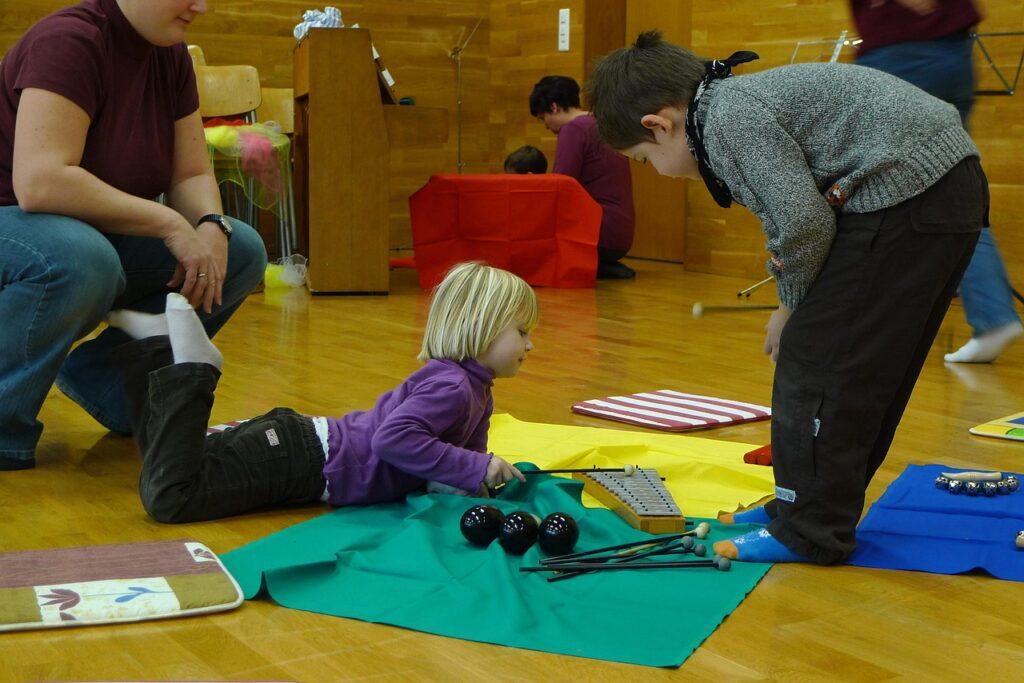
  • Playing instruments, such as drums and other percussion instruments, can be used to work on gross and fine motor skills.
  • Also, songs can be used for stress management, or to deal with trauma.

Kids with PDD can have issues with noticing social cues, navigating social interactions, and appropriately expressing themselves.

  • Thus, the sessions may focus on learning language skills.
  • Or it can center on social skills and emotional regulation.
  • For example, the therapist might use games that help develop listening skills or that work on taking turns.

Also, the sessions can be used for self-expression.

  • Difficulties with social interactions can create a tremendous amount of stress. Learning to sing or play an instrument can be a much-needed outlet.
  • In addition, ensemble activities can help foster a sense of belonging and community.
  • It’s also a lot of fun.

Here Are Some Effective Music Therapy Resources

Can I Become a Music Teacher if I Have Special Needs - Teacher Teaching Young Guitar Student - What’s the Best Lesson You’ve Had with Your Music Teacher? - What Is the Precise Meaning of Scaffolding in Teaching - Meet Special Needs Music Expert Geoff Keith at Lexsepta 2025 - What’s Pervasive Developmental Disorder and Its Impact on Music?

Final Thoughts

Takeaway points:

  1. Pervasive developmental disorder is used to categorize a group of behavioral characteristics for individuals who have troubles with communicating, socializing, and display socially problematic behaviors.
  2. Adapted music lessons use an adapted score to help students master reading on their instruments.
  3. Music therapy entails sessions with a board-certified therapist, focusing on using music for non-musical goals.

Have fun teaching!

Best Practices: How to Play a Guitar A Chord

Do you need help learning open A? There’s more than one way to finger the chord. So, we’ll talk about how the context makes a difference and best practices for each fingering. Click to learn how to play a guitar A chord. Estimated reading time 3 minutes.

Read More
The Gifted Dyslexic and Insight Learning - Notepad and Computer - What Exactly Is a Ballad and How Do You Write One?

The Gifted Dyslexic and Insight Learning (Part 4)

Have you ever wondered if you’re gifted and dyslexic? Or are you a parent of a child who’s gifted and dyslexic and want more information. Sometimes it can be difficult to recognize giftedness. Ronald Davis states, “This would commonly be recognized as daydreaming or simply not paying attention. The student is actually paying attention but has shifted to an imaginary world that is more interesting” (“The Gift of Learning” 38). How is this a sign of giftedness? Keep reading “The Gifted Dyslexic and Insight Learning” to learn about the last of our four dyslexic strengths. Estimated reading time 3 minutes.

Read More
How Do I Write Good Songs Using Metaphors and Similes - Woman Working on Computer - Does ADD and ADHD Make People More Creative

How Do I Write Good Songs Using Metaphors and Similes?

Do you want to write better songs using vivid imagery? Do you need to learn about figurative imagery? Figurative imagery expands your pallet of description beyond just literal imagery. Metaphors and similes are important literary tropes that help you to do just that. Read more to learn the answer to the question, “How do I write good songs using metaphors and similes?” Estimated reading time 2 minutes.

Read More
Where Do I Start if I Want to Be Able to Sing A Cappella - Women Singing

Where Do I Start if I Want to Be Able to Sing A Cappella?

Do you want to be able to sing with an a cappella group while having both great tone and tuning? An a cappella group is an ensemble that performs without instrumental accompaniment. This allows your group to lock in the harmonies, which helps achieve the distinctive vocal blend you find in this style. How do you do this? Through ear training and physical skills instruction. Keep reading “Where Do I Start if I Want to Be Able to Sing A Cappella?” to learn the essential skills you’ll need. Estimated reading time 4 minutes.

Read More