

Success Music Studio

What’s Autism Spectrum Disorder and Its Impact on Music - Sheet Music and Yellow Flower

What’s Autism Spectrum Disorder and Its Impact on Music?

Facebook
Pinterest
LinkedIn

Estimated reading time 5 minutes

Table of Contents

Introduction

Are you a music teacher with a student with autism spectrum disorder (ASD)? Do you need advice on teaching your student? For people with autism spectrum disorder, music can be comforting after a hard day interacting with people, allowing an outlet for pent up emotions. However, does ASD have an impact on playing music? Keep reading What’s Autism Spectrum Disorder and Its Impact on Music? to find out.

Do I Really Have to Learn Music Theory to Learn How to Play Piano - Understanding Prosody in Your Songwriting - piano - Learn How to Play Beethoven’s Beautiful Fur Elise

This post contains affiliate links, which means I may receive a small commission from purchases made through the links. All the links to music books in this post are lesson books that I use every week to teach special needs students.

What’s Autism Spectrum Disorder and Its Impact on Music: What Is ASD?

What is autism spectrum disorder?

  • The key word here is spectrum, which Merriam-Webster defines as, “a continuous sequence or range.”
  • In the past, the medical community thought that a person with autism was like rain man.
  • In the early 1990s, this began to change, so it’s now acknowledged that there’s a great range of skills and behaviors associated with people on the spectrum, thus the term autism spectrum disorder.
  • For example, a person with classic autism can display limited expressive language as well as have developmental delays.
  • Whereas a person with Asperger’s syndrome can have very good language and cognitive skills but still have difficulty with social interactions.

Since there’s such a wide range of ASD abilities, the trick is to be able to accommodate students with a variety of lesson tracks.

  • In past posts, I’ve talked about using multisensory strategies for kids with autism spectrum disorder.
  • However, in this post we’ll talk about how you’d place your student in a lesson book.
  • Some students will need multisensory techniques applied to adapted scores, while other students (e.g., kids with high functioning Autism) will need little score adaptation.

This means that you’ll need to assess an ASD student’s strengths vs challenges and then pick an appropriate lesson book to put the student into.

  • Putting students into the right lesson materials is critical for their success.
  • If the material is too challenging, students get frustrated and quit.
  • If the material is not challenging enough, they get bored and quit.

So, how do you figure out what books to use?

  • If a student has had lessons before, have the parents bring the old lesson books in so you can see what the student has done.
  • If the books look good, you can continue to teach out of them. If not, put the student in your preferred method books.
  • If the student is new, I use this question during the lesson sign-up process, “What is your child’s level of communication as compared to a typical learner?”
  • Then, based on the answer to this question, you place your new student in a lesson book based on the student’s communication ability level rather than chronological age. In other words, if the answer is “five years old” you put the student in a book appropriate for a five-year-old even if the student is seven years old. 
  • This gets you started – you can fine tune the lesson pace as you get to know the student.

Since I teach piano and guitar, I’ll walk you through the books for these two instruments. For the first time in a post, I’ll be getting into the details of when in the lesson books you should graduate a student from the color coding.

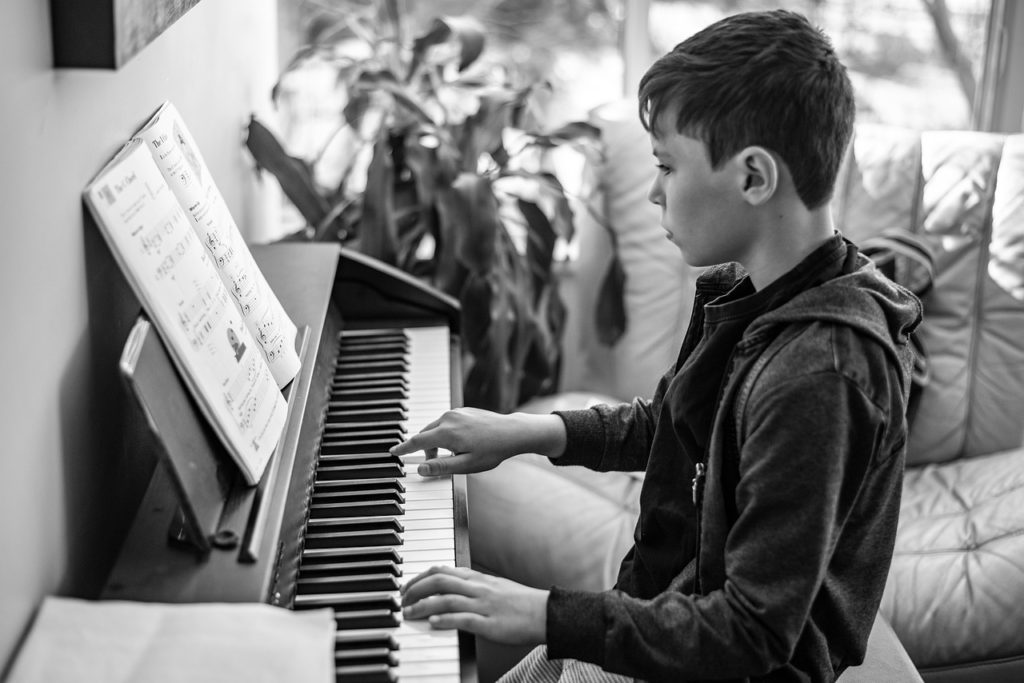
Autism - a boy playing the piano - How to Graduate from the Color Coded Music Notation

What’s Autism Spectrum Disorder and Its Impact on Music: Piano

I can teach out of almost any lesson series, and there are some good ones out there:

However, my go-to lesson books are from Alfred:

  • Why? Because they have a variety of different lesson tracks that run concurrently with each other.
  • This means that if you need to adjust the pace up or down for your student, you can do it with these books.
  • They all cover the same material, but the books for younger students do it over a longer span of time.

These lesson tracks will work for virtually any student, whether the student has ASD, ADHD, learning disabilities, or is a typical learner.

Very Young Beginner

  • With stories, plushies, and color coding, Music for Little Mozarts is ideal for young students.
  • This means it’s also good for ASD students with developmental delays.
  • Just make sure that your students are not so old that the books are seen as being “baby-ish.”

There are four levels in this series, then it graduates to prep course level C.

Starting Ages: 4-6 (for a typical learner)

Video: Music for Little Mozarts

Not all kids with ASD have trouble learning music. However, if your student struggles with reading, these posts will help:

Young Beginner

Alfred Prep Course levels A and B roughly cover the same material as the Music for Little Mozarts series, but at a faster pace. If you use color coding, start using contour lines to graduate from the colors around prep course level E.

Starting Ages: 5-7 (typical learner)

Beginner

  • Afred lesson levels 1A, 1B, and 2 cover the same material as prep course A-F.
  • If you use color coding, start using contour lines to graduate your student from the color coding starting in level 2.
  • You do the rest of the steps for graduating from the colors in level 3.

For more information:

Starting Ages: 8-10 (typical learner)

Older Beginner

  • This book covers the same material as level 1A and 1B, but at a faster pace than the younger kids’ series.
  • Also, there is a complete level 2 & 3.
  • However, I use the individual level 2 and 3 books, because they give the student a better feeling of forward progress.

Starting Ages: 10-12 (typical learner)

Teens and Adults

  • Unlike the other books, there isn’t much overlap in these books with the kids’ series.
  • I use this series with all my adults, and most of my teens.
  • Though I sometimes put tweens and younger teens in the kids’ version of complete level 1.

Starting Ages: Teens and Adults

Advanced Piano

These are some of the books that my advanced ASD students are in. As you can see, the range of ability that kids on the spectrum display (from Music for Little Mozarts to Gershwin) is quite wide, which is why you need to customize your curriculum for each student.

I really like Alfred’s Masterworks series, because it makes a clear distinction between what the composer wrote (black typeface) and what the editors put in (gray typeface).

  • This means that you can know exactly what the original score was like.
  • The only downside is that the gray typeface can be harder to read.
  • If you have a student with vision issues, make sure you have an extra bright light you can shine on the score.
Video: Masterworks Series

Masterworks Classics:

Fun Books as a Companion to the Lesson Books

If you have young students who complain that they want to play songs they know, the Faber supplementary books are great.

They come in seven levels:

  • PreTime
  • PlayTime
  • ShowTime
  • ChordTime
  • FunTime
  • BigTime
  • AdvanceTime

And various styles:

  • Disney
  • Popular
  • Classics
  • Favorites
  • Hymns
  • Kid’s Songs
  • Rock ‘n Roll
  • Jazz & Blues
  • Christmas

They roughly equate with the Alfred levels, so you can use them as graded fun books.

  • These books are also good for regulating the pace of your ASD students.
  • You’ll add more songs if your student needs to go slower.
  • You’ll take out songs if your student needs to go faster.

Examples:

What’s Autism Spectrum Disorder and Its Impact on Music: Guitar

Most kids aren’t ready for guitar lessons until they reach age five.

  • Having said that, guitar is easier to graduate from the color coding than piano.
  • It only has one clef, so students generally graduate from the color coding much earlier than they do on piano.
  • Normally, guitarists graduate in six months to a couple of years from the beginning of lessons.

For more information on color coding:

Young Beginner

The FJH Young Beginner Guitar Method series teaches the notes and chords in separate books. After level 3, I put my students in Alfred’s level 2:

FJH Starting Ages: 5-7 (typical learner)

Beginner

Unlike the FJH books, Alfred’s Kid’s Guitar Course Complete has the chords and note reading incorporated into the same book.

  • In fact, it starts with the chords before the note reading.
  • The “compete” book below incorporates levels 1 and 2, and (despite its name) there is a third level after this one.
  • After level 3, your student will go into Alfred level 2.

Starting Ages: 8-12 (typical learner)

Teens and Adults

  • The 21st Century Guitar method is a good fit for teens and adults.
  • There are three levels covering multiple styles.
  • Students even learn some fingerstyle in level 3.

Rock Guitar Method

  • This series has been very popular with my students.
  • I’ve used it with adults and students as young as 11.
  • It also has three levels.

By the third level, students will have learned 16th notes, 16th note triples, 32nd notes, trills, hammer-ons, pull-offs, bends, vibrato, slides, and full moveable chords and scales.

What do you do after the method books?

  • There are tons of guitar tab songbooks out there to choose from.
  • However, Hal Leonard’s Guitar Tab White Pages series is usually one of the first places I turn.
  • At this point, have the student pick the style and the song.

Final Thoughts

Takeaway points:

  1. You must assess the student to figure out what lesson books will be a good fit.
  2. Put them in books that fit their ability level rather than just their chronological age.
  3. Some ASD students will go slower than a typical learner student, but some will go faster.
  4. Adjust the pace by picking the right lesson book and supplementing with fun songs as necessary.
  5. Use color coding if your students struggle with reading music but be sure to graduate them from the colors when they’re ready.

These lessons paths will work for virtually any student, whether the student has autism spectrum disorder, ADHD, learning disabilities, or is a typical learner.

Have fun teaching!

singing exercises with harmony - girl with mic - Singing in Tune with Vowels

Singing Exercises with Harmony

Feel embarrassed about singing out of tune? "Singing Exercises with Harmony’s" sing-along song tracks makes it easy to learn how to harmonize. The post also talks about what to listen for when harmonizing.

Read More
Why Do Crazy Chromatic Notes and Chords Work - Sheet Music

Why Do Crazy Chromatic Notes and Chords Work?

Have you ever seen a crazy chromatic scale or chord and wondered why it works? Do you want to understand how to write them? Chromatic notes and harmonies are effective because they take bad sounding dissonance and resolve it to good sounding consonance. Keep reading “Why Do Crazy Chromatic Notes and Chords Work?” to learn how chromatic harmony functions. Estimated reading time 3 minutes.

Read More
https://successmusicstudio.com/17-songwriting-ideas-to-get-you-unstuck/

17 Songwriting Ideas to Get You Unstuck

“Do you have tips on what to do when you get stuck?” We’ve all been there. You stare at a blank page and can’t come up with any ideas. To help you I’ve compiled a list of 17 songwriting ideas to get you unstuck. Each songwriting idea has a link that leads to an example showing how it works in a real song. Keep reading to get the 17 songwriting ideas. Estimated reading time 2 minutes.

Read More