


Success Music Studio

How to Color Code Music to Get LD Students to Perform Accurate Alternate Picking - Man Plucking the Guitar

How to Color Code Music to Get LD Students to Perform Accurate Alternate Picking

Facebook
Twitter

Estimated reading time 2 minutes

Table of Contents

Why Color Code Alternate Picking Patterns?

Do you find alternate picking confusing on guitar? Even among typical learners, students find alternate picking and strumming challenging. Color coding notes and rhythms for adult students can be problematic, because adults view color as juvenile. However, like with form, adults never complain when I color code alternate picking. It is one of the few color coding strategies I use with every student: LD, special needs, or typical learner. Using color coded arrows as a guide to alternate picking effectively shows students how to accurately execute the picking patterns. Keep reading to learn how it works.

This article uses musical terms. For definitions, see the Glossary at the end of the post.

Mobile users: for best results reading the music, tilt your screen 90o to the right.

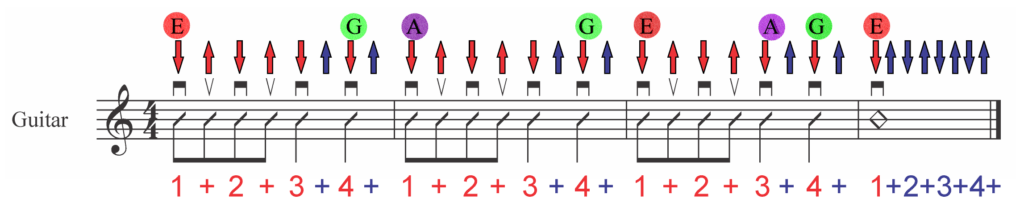
How to Color Code Music to Get LD Students to Perform Accurate Alternate Picking - Color Coded Strum Direction Example

How to Color Code the Alternate Picking

In the example above, I supplemented the traditional symbols for up and down strokes with arrows, because students find the traditional symbols confusing.

Most students think that the symbol for an up stroke looks like it should be a down stroke. Conversely, students think the down stroke looks like a table. The color coded arrows give a guide to strumming the strings. The direction of the up and down arrows indicates the direction of the pick stroke.

In guitar, it is common to have the student swing the pick up and down on every beat and sub-beat. The pick strokes the string when the music indicates a note or chord is to be sounded. The pick “misses” the string on the strokes that make no sound.

A red arrow tells the student to stroke the string, and a blue arrow tells the student to miss the string. As an example, in the first bar the student would say, “Down, up, down, up, down, miss, down, miss” while performing the picking on all of the open strings.

Then, after mastering the strum pattern, the student adds the chord changes. The chords are color coded to help increase reaction time. The color coded alternate picking controls the rhythm.

Without Color Coding, Standard Notation is Counter Intuitive for Beginners

In the study, Beginners’ Intuitions about Musical Notation, Siu-Lan Tan found that a lot of standard notation’s symbols are counterintuitive for beginners. This makes sense of why many students need color coding to ease them into reading sheet music.

Video: How Effective is the Color Coding?

Color Coded Alternate Picking Provides Two Ways to Access the Rhythm

Notice that the color coded arrows have the same pattern of color as the counting numbers. They both reflect the same rhythm, but in different ways. So, the color coded alternate picking gives teachers another way to work on rhythm.

The color coded alternate picking concept can be applied to bowing on the violin, such as detache or spiccato.  Similarly, write in the arrows on percussion scores to indicate right and left hand sticking on drum and mallet instruments.

Multisensory teaching takes the frustration out of alternate picking for both the student and the teacher. It helps students master correct technique who might otherwise fail to do so, especially LD,

ADDASD, and other special needs students.

© 2020 Geoffrey Keith

Newsletter Signup

Join me for in-person or online music lessons!

Back to the Color Coding Blogs Page

Back to the Successful Music Student Blogs Page

Glossary

How Do I Switch from Minor Key Shaped Notes to Standard Notation -Sheet Music

How Do I Switch from Minor Key Shaped Notes to Standard Notation – Part 2

How do I switch from minor key shaped notes to standard notation?” Sight singing minor keys in standard notation can be challenging. Because it can be difficult to figure out if you’re in a major key or the relative minor. Read more to learn how to transition from shaped notes to standard notation for minor keys. Estimated reading time 3 minutes.

Read More
The 5 Best Effortlessly Easy Metronome Practice Tips - Metronome Face - How to Play Musical Tempos from Adagio to Allegro

The 5 Best Effortlessly Easy Metronome Practice Tips

Do you want to know the best way to practice with a metronome? Do you want to know what a metronome even is? A metronome is one of the best practice tools invented for musicians, because it helps you play with a steady beat. Nothing will make you sound like a professional faster than playing with a steady beat, and nothing will make you sound terrible faster than playing with a choppy beat. Keep reading “The 5 Best Effortlessly Easy Metronome Practice Tips" to learn how to play with a steady beat. Estimated reading time 2 minutes.

Read More


Singing with the Kodály Rhythmic Syllables - choir - Question, How Do I Get Better at Sight Singing - Why is it Important to Define the Dynamics to Sing a Piece of Music - How Do I Organize a Recital Concert

Singing with the Kodaly Rhythmic Syllables

Do you struggle with singing accurate rhythm? This post expands your rhythmic flexibility, which makes singing melodies more fun. Click to learn how to sing with the Kodály rhythmic syllables. Estimated reading time 3 minutes.

Read More
What Exactly Is a Ballad and How Do You Write One - Girl Listening to MP3 Player

What Exactly Is a Ballad and How Do You Write One?

“What exactly is a ballad and how do you write one?” Ballads have been around for a long time but remain a popular song form to this day. Keep reading to get the definition and some expert advice for writing your song. Estimated reading time 2 minutes.

Read More