


Estimated reading time 2 minutes
Table of Contents
Introduction
Do you wonder what the word bravo means? You can sometimes hear it shouted at classical music concerts. Keep reading What Does the Exotic Sounding Word Bravo Mean at a Concert? to learn classical concert etiquette.
What Does Bravo Mean: How Do You Define the Term?
“What does the word bravo mean?” According to the Essential Dictionary of Music:
Bravo (It. BRAH-voh): An exclamation of approval. (23)
You mainly hear this shouted at classical music concerts:
- Most musical terms are Italian words, because the Italians were very influential at the height of the Classical period.
- Thus, bravo is also an Italian word.
- In common usage, it is an exclamation of praise for an excellent performance.
It literally means “skillful”:
- The idea being that you are praising a well-executed concert.
- Though these days it could just as easily be thought of as meaning, “Great job!”
- It expresses heartfelt support for an artist or ensemble.
In Italian, bravo is the male form of the word, brava is the female form:
- Thus, technically, bravo would be used for male artists and brava for female artists.
- However, you rarely find English speaking audiences making these fine distinctions.
- Conversely, you might hear the superlative form bravissimo, which basically means, “Really great job!”
What Does Bravo Mean: What Other Classical Concert Etiquette Do I Need to Know?
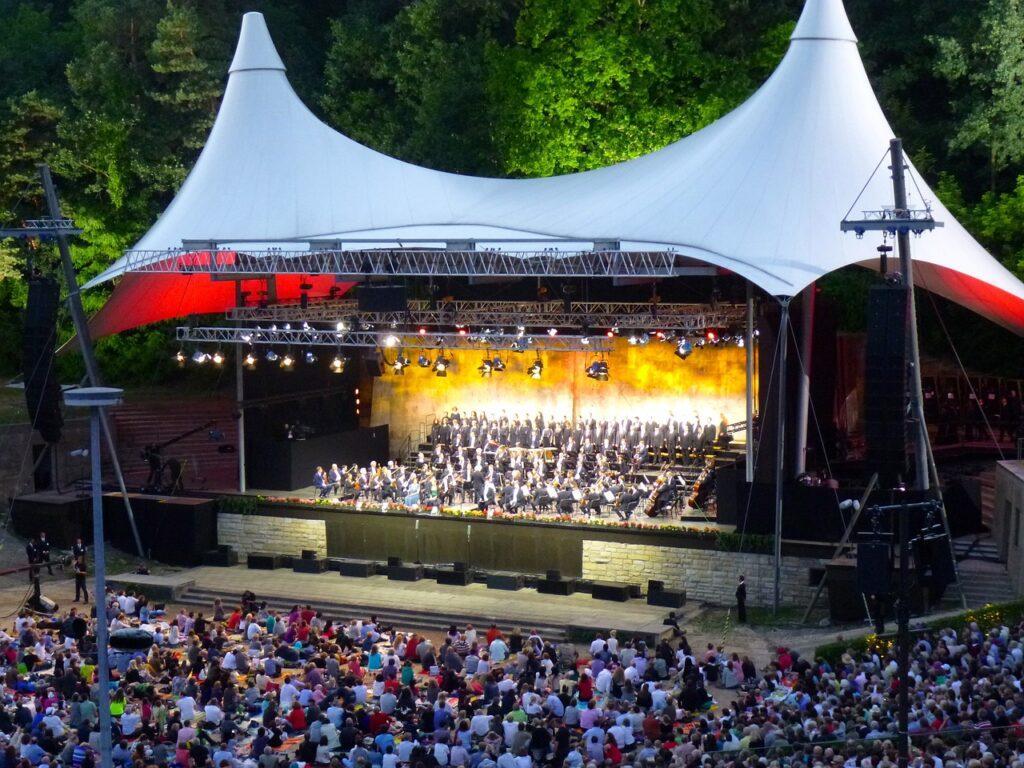
Classical concert etiquette stresses that you must allow the other audience members to hear the performance without interruptions:
- Because classical rarely uses audio equipment for sound reinforcement, you need to stay as quiet as possible during the concert.
- Try to avoid coughing, and always mute your phone so that it vibrates rather than rings.
- Hold your applause until intermission and the end of the concert.
Classical typically has informal wear as its dress code, i.e., a suit for men and a dress, skirt, or pants suit for women. However, formal or semi-formal wear may be needed for more formal settings.
Final Thoughts on “What Does the Exotic Sounding Word Bravo Mean at a Concert?
Takeaway points:
- Bravo is a heartfelt exclamation of praise.
- You use it to applaud an excellent performance.
- You most often hear it shouted at classical music concerts.
Have fun listening!
Related Posts
- Why Do Minor Keys Sound Sad to Me?
- Symphony Meaning: Definition, Videos, and a Quick Guide
- D’you Want Some Music Tips and Tricks I’ve Learned Over the Years?
© 2024 Geoffrey Keith
Join me for in-person or online lessons today!
Back to the All-Purpose Music Tips and Topics category blogs page
How to Tune the Classic Rock Open G Sound Using Harmonics
Frustrated that the guitar sounds out of tune? Learn to tune the classic rock open G tuning using harmonics to be able to play chords in tune. You will also learn the song "Honky Tonk Women." Estimated reading time 3 minutes.
Read MoreAccurately Reading Musical Notes and the Colors of a Rainbow

Do you struggle with reading music notes? Have you always wanted to learn to read music, but found it too hard? Try rainbow colored music notes. This post has stories about musicians who’ve achieved music literacy through color coded music notation. Click to learn about accurately reading musical notes and the colors of a rainbow. Estimated reading time 2 minutes.
Read MoreWhy Doesn’t My Hands-Separate Piano Practice Help with Hands-Together Playing?
Do you get frustrated when your hands-separate playing doesn’t seem to help with playing piano with both hands? Find out what determines how hard it’ll be to play with both hands and what you can do about it. Click to answer the question, “Why doesn’t my hands-separate piano practice help with hands-together playing?” Estimated reading time 4 minutes.
Read MoreWhat’re the Key Differences Between Contralto and Alto Voice?

“What’s the difference between an alto and a true contralto?” While they may seem to be superficially similar, they have their own individual ranges and vocal tone qualities. Keep reading to find out what’re the key differences between contralto and alto voice. Estimated reading time 2 minutes.
Read More