



Success Music Studio

Singing Shape Note Solfege Phrygian Melodies - Chant Manuscript - Discover Early Music Via Beautiful Medieval Gregorian Chants

Discover Early Music Via Beautiful Medieval Gregorian Chants

Facebook
Twitter

Estimated reading time 2 minutes

Table of Contents

Introduction

Do you want to know more about medieval chant? Gregorian chants are essentially medieval church songs that have a mysterious yet serene quality to them. Also, they played a pivotal role in developing modern musical notation. Keep reading to discover early music via beautiful medieval Gregorian chants.

This article uses musical terms. For definitions, see the Glossary at the end of the post.

Discover Early Music Via Beautiful Medieval Gregorian Chants - Monk

Discover Early Music Via Medieval Gregorian Chants: Why Are They Called “Gregorian?”

This type of medieval chant got its name from Pope Gregory I:

  • He is credited with collecting and categorizing Gregorian chants.
  • Plainchant is monophonic, meaning that all the monks sang the same melody in unison.
  • The big, echoey sound of the monasteries and cathedrals combined with the Latin text lends a mystical quality to these simple tunes.

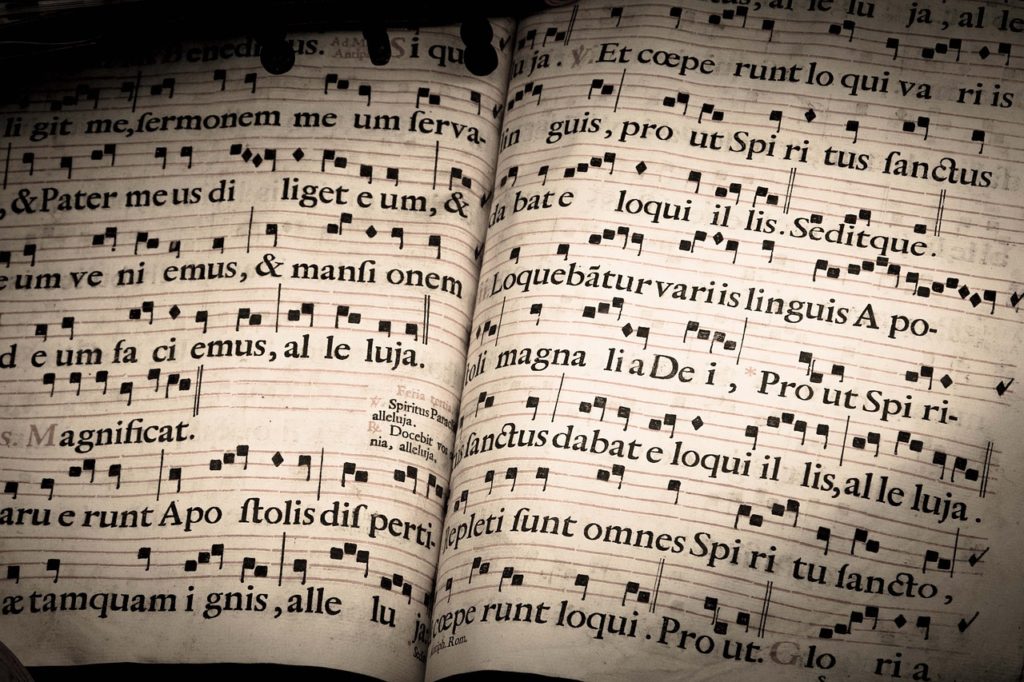
The melodies have a flowing sound because the rhythms are controlled by the poetical meter of the Latin text combined with the melismatic neumes.

Singing Shape Note Solfege Dorian Melodies - Monastery - How Do You Sing Eastern European Vocal Harmony in 2nds by Ear - Discover Early Music Via Beautiful Medieval Gregorian Chants

Discover Early Music Via Medieval Gregorian Chants: How Is it Linked to the Development of Sheet Music?

Plainchant and political ambition lead to the development of Western music notation:

  • In the late first millennium, Charlemagne wanted to unify his empire.
  • He knew that to do this he had to unify the culture of the different people who lived under his rule.
  • Since the church was central to the lives of the people, this meant that the liturgy had to be unified.

However, since the entire mass was sung, Charlemagne’s people had to unify the music in order to unify the liturgy.

Mobile users: for best results reading the examples, rotate your screen 90o to the right.

Singing Shape Note Solfege Dorian Melodies - Chant Manuscript - Singing Shape Note Solfege Aeolian Melodies - Discover Early Music Via Beautiful Medieval Gregorian Chants

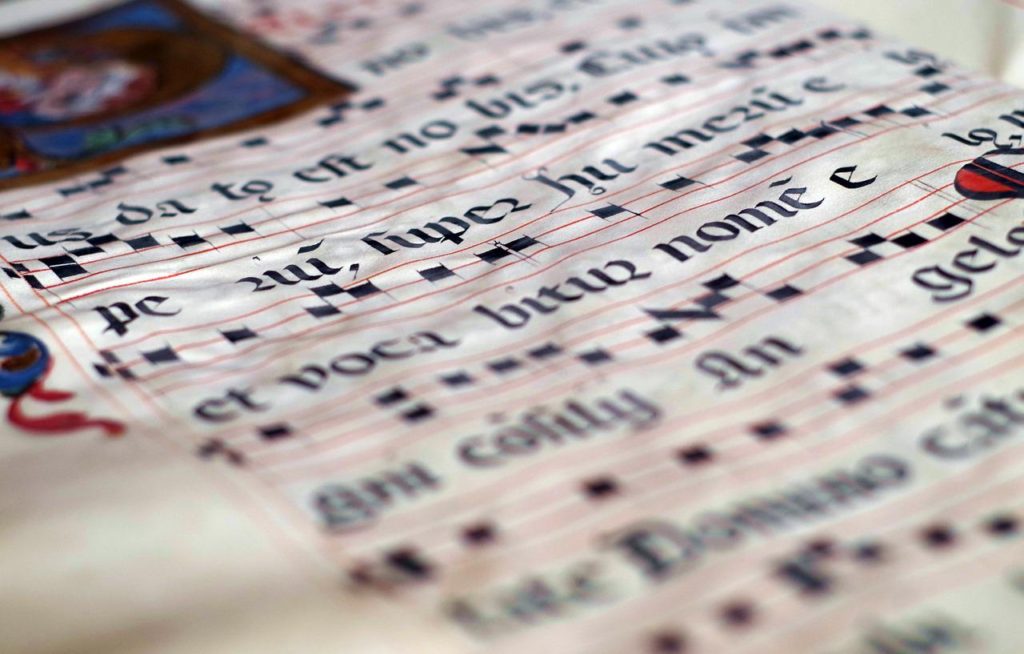
The picture above shows a medieval music manuscript:

  • The four lines and three spaces on the medieval staff allowed the monks to graph out the notes as higher and lower sounds.
  • For the first time, this allowed them to be able to sing melodies they had never heard before.
  • How did they do this? They were able to sing from sheet music using solfege syllables.

The melodies often followed the rhythm of the Latin text:

  • However, in the picture above, when you see the “notes” these are called neumes.
  • Neumes allowed the monks to add melismatic ornaments to the melody.
  • In other words, the neumes made it so they could have more than one note per syllable of text.

Video: Monks of Santo Domingo de Silos

Even though these medieval melodies are hundreds of years old, they became trendy in the 1990s. For example, the video (above) was a top 10 album on the Billboard 200 chart in 1994.

Final Thoughts on “Discover Early Music Via Beautiful Medieval Gregorian Chants”

Takeaway points:

  1. Medieval chants are monophonic, stepwise melodies.
  2. Pope Gregory I is credited with codifying the plainchant repertoire.
  3. Medieval chant played a pivotal role in developing modern musical notation.

Have fun listening!

Related Posts

© 2024 Geoffrey Keith

Newsletter Signup

Join me for in-person or online lessons today!

Back to the All-Purpose Music Tips and Topics category blogs page

Back to the Successful Music Student Blogs page

Glossary

Lyric Writing Tools for You - Sleeping Baby - Lyric Writing Tools for You

15 Fun Lullabies (So Your Children Finally Fall Asleep)

Are you looking for songs to lull your children to sleep? The first, and most important lesson parents learn is – don’t wake the baby! However, despite your best efforts, sometimes your baby wakes up in the middle of the night. This means that your child will need to be lulled back to sleep. Enter the lullaby songs. Keep reading to learn 15 fun lullabies (so your children finally fall asleep). Estimated reading time 3 minutes.

Read More
Singing Rhythmic Syllables in Cut Time - Church Laser Show - Singing Shape Note Solfege Minor Melodies - Singing in Tune with Vowels - Choir Meaning & Examples with Videos, Pictures, & Soundtracks

Singing Rhythm Syllables in Cut Time

Are you confused about how to chant the Kodaly rhythm syllables in cut time? Do you wonder if it’s like chanting 2/4 or 4/4 syllables? Don’t worry, this post has you covered! Read more to learn about singing rhythm syllables in cut time. Estimated reading time 3 minutes.

Read More
singing rhythm syllables in 3/4 time - woman singing.jpg

Singing Rhythm Syllables in 3-4 Time

Have you gotten the hang of reading rhythm in 4-4 time and want to get a handle on 3-4 time too? 3-4 has a much different feel than 4-4 and expands the types of music you can perform. Read more to learn about singing rhythm syllables in 3-4 time. Estimated reading time 3 minutes.

Read More

10 Best Calm Relaxing Music Selections for ADHD Kids

Do you need to find music that will help your student relax and calm down? Do you want to find compositions that will help focus your child’s attention so that homework can get done? Music can be a tremendous help for ADHD children, but not all styles work equally well. Click to find out what genres get the job done and to learn the 10 best calm relaxing music selections for ADHD kids. Estimated reading time 3 minutes.

Read More