


Success Music Studio

How to Play Your $@*% Viola in Tune

Facebook
Pinterest
LinkedIn

Estimated reading time 4 minutes

Table of Contents

Introduction

Do you need advice on how to get your viola to sound good? Traditional strings (e.g., violin, viola, etc.) have an edge on fretted strings (e.g., guitar, banjo, etc.), because they have flexible pitch and so can get their harmonies gorgeously in tune. However, this is only true if you have solid intonation skills. Keep reading to learn how to play your viola in tune.

This article uses musical terms. For definitions, see the Glossary at the end of the post.

What Is Your Definition of a Good Musician - Woman Playing Violin

This post contains affiliate links, which means I may receive a small commission from purchases made through the links. I’ll only recommend products I use, use in lessons, or ones my students or colleagues have recommended.

How to Play Your Viola in Tune: What Is Flexible Intonation?

Unlike piano, organ, or guitar, tuning is an active and important part of playing viola.

In other words, the biggest difference between viola and guitar is the ability to tune your notes as you perform.

Ivan Galamian, in Principles of Violin Playing & Teaching, states:

It is not good advice to interrupt practice every few minutes to retune the violin. One should be able to play in tune on a violin which is out of tune. (22)

So, making a violin, viola, cello, or double bass sound good is more than just tuning your strings. Good intonation happens with every note you play.

In addition, it’s important to understand that melody and harmony don’t tune the same way.

  • Melody is a function of memory. In other words, you compare past notes with the note you’re currently performing. Therefore, you must listen to the distance between notes as you play melodies.
  • Alternatively, you need to listen to the resonance of your ensemble’s harmonies. Particularly, you must listen for the buzz between your ensemble’s instrumental parts.
  • Also, the slower you play, the more time it gives you to tweak the harmonies, because it allows you to hear the beating between the harmonics in a chord.
  • Likewise, vibrato obscures beating, making it harder to have accurate intonation.
  • Therefore, it’s a good idea to devote at least some ensemble practice time to working on harmonic intonation at a slow tempo without vibrato.

Of course, you can always add back in the vibrato for performances.

For more information:

Do professional string players really think about stuff like this?

Yes, they do. For instance, Arnold Steinhardt asserts:

The difficulty in string quartet intonation is to determine the degree of freedom you have at any given moment. Two factors come into play: the linear and the vertical. (qtd. in Duffin 69)

Linear here means the melodic line, and vertical means the harmony that your string ensemble collectively creates.

Later, Steinhardt goes on to discuss what’s involved in balancing the linear and vertical elements of the music.

  • Basically, he says that if you’re a soloist, you can take some liberties with the melody by employing expressive intonation.
  • This is where you push your sharps higher and your flats lower than equal temperament.
  • However, you can’t do this at the expense of your harmony. The harmony needs to be in tune at key points in the harmonic structure.
What Does Intonation Mean and Why Is It Essential in Music - Violin - How to Color Code the Elusive Alto Clef

How to Play Your Viola in Tune: How Do I Successfully Gain Good Intonation Skills?

Does my fingering affect my intonation?

  • You achieve good intonation through a combination of fingering, bowing, and listening skills.
  • George Bornoff felt that the fingers needed to be spaced correctly.
  • For example, if you want to perform a half step, you won’t have a gap between your fingers, but if you want a whole step, you will. This will get you in the ballpark of the notes.
  • Then, you’ll use your ear to fine tune your notes.
  • Be aware that the higher you go on the fingerboard, the smaller the gaps between your fingers become.

Likewise, your bow can affect your intonation.

  • Apply too much pressure with the bow, and it’ll push your note sharp.
  • The more pressure you apply, the faster the bow will have to travel across the string.
  • For example, when performing double stops, you should shoot for medium pressure with a fast bow.
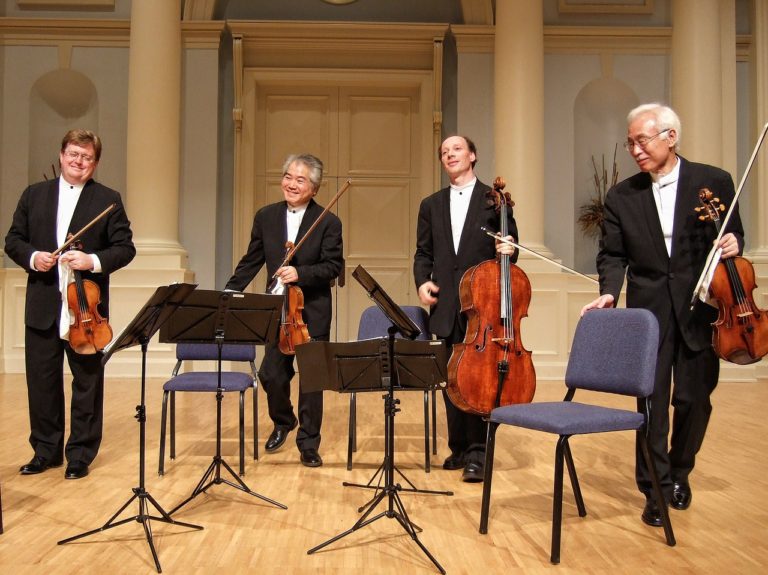
harmony and melody tune differently - string quartet - What's the Meaning of Resonate in the Context of Music - The Top 5 Best Drake Sheet Music Gift Ideas

This book will strengthen your double stop intonation.

How to Play Your Viola in Tune: How Do I Train My Ear?

Since harmony and melody tune differently, you need to take different approaches to each aspect of your ear training.

The following posts have specially tuned soundtracks that’ll help you improve your harmonic intonation.

The tracks were created to help vocalists learn good harmonic intonation skills.

However, they’ll be just as helpful for improving your viola intonation, but you’ll play with the intonation soundtracks instead of singing them.

For melodies, you can use assistive technology to help you achieve accurate intonation.

  • As we talked about in How to Play Your $@#% Trumpet in Tune, Ternstrom and Sundberg’s choir intonation study found that the acceptable tuning range was between +15 and -15 cents of the note’s center-pitch-value.
  • This is why I love the Korg CA-2 Chromatic Tuner.
  • The hollow triangles on the Korg’s display marks the +15 and -15 cent limit, giving you a guide for your melodic intonation. (See the video below.)

Keep in mind that +/-15 cents defines the outside edges of the acceptable range. You should always shoot to get you tuning even closer than that.

Mobile users: for best results viewing the video, rotate your screen 90o to the right.

Video: Korg CA-2 Tuner
1 in 5 students have a learning disability

Final Thoughts

Takeaway points:

  1. The biggest difference between viola and guitar is the ability to tune your notes as you perform.
  2. You achieve good intonation through a combination of fingering, bowing, and listening skills.
  3. String ensembles must learn to balance harmonic and melodic intonation.

Have fun playing!

Glossary

How to Write Music Using Consonance and Dissonance - Piano and Flute

How to Write Music Using Consonance and Dissonance

Do you want to know what consonance and dissonance are? Do you need to know how they work in music? If you want to write incredibly cool music, you need to understand how consonance and dissonance function in melodies and harmonies. Keep reading “How to Write Music Using Consonance and Dissonance” to learn what they are and how they work. Estimated reading time 3 minutes.

Read More
How to Use Hyperbole in Writing, Songwriting, and Poems - Songwriter Typing on a Notebook

How to Use Hyperbole in Writing, Songwriting, and Poems

Do you want to know what the word hyperbole means? Do you need to know how to use it in your writing? Hyperboles can be funny, or they can emphasize powerful emotions. Regardless, when used effectively, they will help you highlight the points in your work that you want to emphasize. Keep reading “How to Use Hyperbole in Writing, Songwriting, and Poems” to learn what it is and how it works. Estimated reading time 2 minutes.

Read More

How Easy Is It to Play Renaissance Lute?

Are you a guitarist who wants to try playing the lute? Do you want to know how difficult it is compared to guitar? The Renaissance lute is a pear-shaped instrument with a swept back headstock that harkens back to another age. Keep reading “How Easy Is It to Play Renaissance Lute?” to learn more. Estimated reading time 3 minutes.

Read More

What Precisely Is Asperger’s and Its Effect on Learning Music?

Do you need to know what Asperger’s is? Do you want to know how it impacts learning music? Asperger syndrome is characterized by difficulties with social situations, because interpreting non-verbal communication is challenging for them. However, people with Asperger’s will otherwise have good facility with language and good cognitive abilities. Keep reading “What Precisely Is Asperger’s and Its Effect on Learning Music?” to find out more about what it is and how it interacts with music lessons. Estimated reading time 3 minutes.

Read More