
Success Music Studio

How to Play Your $@#% Trumpet in Tune - Trumpet and Sheet Music

How to Play Your $@#% Trumpet in Tune

Facebook
Pinterest
LinkedIn

Estimated reading time 5 minutes

Table of Contents

Introduction

Do you have a hard time getting your trumpet to sound right? Do you need help working on your melodic and harmonic intonation? If your ear isn’t fully trained, trying to get your instrument in tune can be frustratingly hard to pin down. Don’t panic! I’ve got you covered. Keep reading to learn how to play your trumpet in tune.

How to Play Your $@#% Trumpet in Tune - Marching Band - How to Play Your $@?% Clarinet in Tune

This post contains affiliate links, which means I may receive a small commission from purchases made through the links. I’ll only recommend products I use, use in lessons, or ones my students or colleagues have recommended.

How to Play Your Trumpet in Tune: Harmonic vs Melodic Intonation

When I first took trumpet in the 1970s, none of my teachers worked on ear training with the goal of achieving good intonation.

  • They focused exclusively on learning to read the notation, which meant you had to learn how to tune up the ensemble’s chords by osmosis.
  • Just as good intonation can be taught in voice, so it can also be taught for brass. Teachers need to make both melodic and harmonic ear training a fundamental part of learning the trumpet.
  • However, in my teachers’ defense, back then there were no assistive technologies that could help you practice your intonation.

Now there are technologies that can help you improve your intonation.

How much intonation flexibility does the trumpet have?

  • James A. Mason, in Comparison of Solo and Ensemble Performances with Reference to Pythagorean, Just, and Equi-Tempered Intonations, found that the instruments in a wind ensemble had a total tuning range of about 50 cents. And they averaged about 23 cents above and 10 cents below the center pitch.
  • Likewise, the YouTuber Ryan Beach has demonstrated that the trumpet’s tuning slide can adjust the notes by 40 cents or so, which gives you a lot of intonational flexibility. (Beach states that you’ll get a much better tone quality using your tuning slide over lipping the note.)
  • In addition, Mason’s study shows that harmony had a beneficial impact on instrumental intonation. (More on harmonic ear training in the next section.)

One of the most important things to know is that harmony and melody tune differently.

  • Harmony: You’ll listen to the tone color. Specifically, you’ll listen for the amount of buzz between the different instrument’s notes while trying to eliminate beating.
  • Melody: With melody you’ll remember the note that you just played and compare it to the note you’re currently playing. Thus, for melodies you need to listen to the distance between notes.

For more information:

What’s Autism Spectrum Disorder and Its Impact on Music - Sheet Music and Yellow Flower

How to Play Your Trumpet in Tune: Harmonic Ear Training

If you want to turbocharge your ear training, start with harmonic intonation.

  1. With harmonic intonation you can directly compare the notes that are played at the same time, leading to immediate feedback.
  2. However, with melodic intonation you must memorize the sound of the melodic relationships, which is a longer process.

Here are some practice tips.

  • Try practicing at a slower tempo. The longer you hold your notes, the better you can tune up the ensemble’s chords.
  • Avoid vibrato because vibrato covers over beating, making it harder to hear if the harmonies are in tune
  • Don’t forget your breath support! You must control the steady flow of air and strategically mark in the score where you’ll breathe.

One common method is to use tuning drones.

  • Most tuning drone websites only let your work on unison notes.
  • The website Tuning Drones is cool because it allows you to practice harmonic intervals. Even cooler, it allows you to compare your notes to just intonation intervals.
  • The big downside to the Tuning Drones website is that the tone color isn’t very good, which limits its effectiveness as an ear training aid.

Alternatively, you can use these online harmonic intonation exercises to help train your ear.

The big advantage to these posts is that the tuning track exercises that you play or sing against will have much better tone color than the tuning drones.

The intonation soundtracks in these posts were designed to help singers learn how to accurately harmonize. However, it’ll work just as well for instrumentalists.

  • You can sing along with the musical exercise tracks, or you can play along on your trumpet.
  • Be aware, if you play along with the tracks using a Bb trumpet, you’ll have to transpose all your notes a major second higher.
  • This will make it so the sound of your instrument agrees with the sound of the tracks.
Video: How to Practice Your Trumpet Intonation

How to Play Your Trumpet in Tune: Melodic Ear Training

Another popular use of assistive technology is to use an electronic tuner to check your pitch.

  • In their intonation study, Ternstrom and Sundberg say this about the acceptable intonation range, “[The chart] shows that the most common [pitch values] lie between -15 and +15 cents” (Precision of Choir Singers 64).
  • In fact, the core pitches were even a little tighter than that with two thirds of the pitches falling within +/-13 cents of the center pitch value. This means that most of the pitches fell within about an eighth of a tone.
  • This could be thought of as the acceptable intonation range.

So, which tuner should I use?

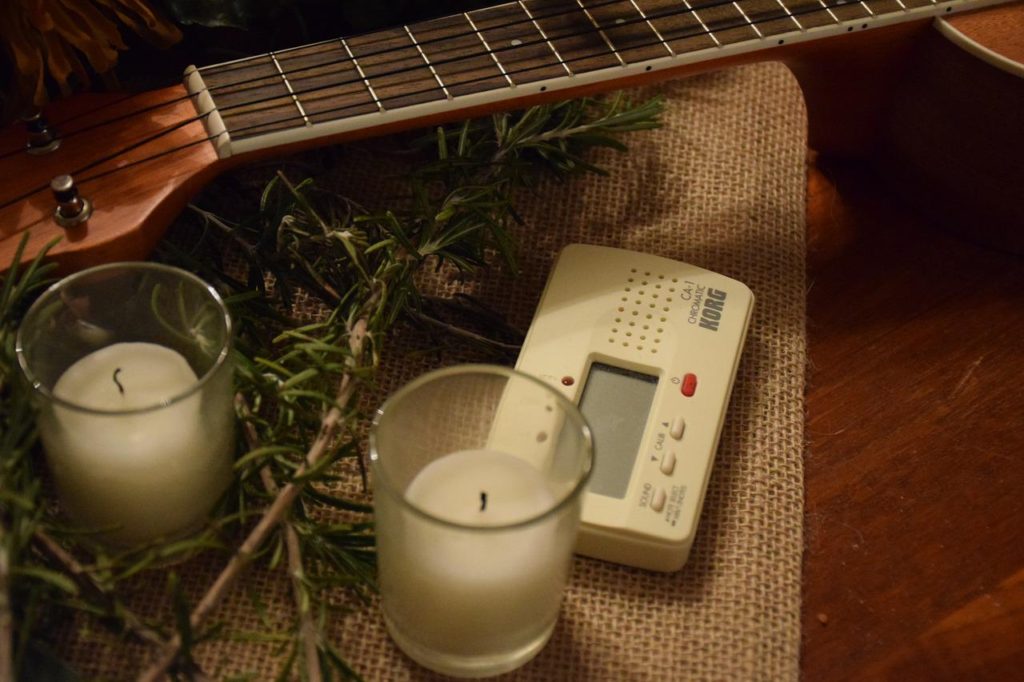
  • I really like the Korg CA-2 Chromatic Tuner.
  • Why? If you keep between the hollow triangles on the display, you’ll be within the acceptable intonation range.
  • Watch the video to see it in action. (You’ll see string players use the Korg tuner, but it works for any instrument.)
  • For example, the Korg tuner’s display has a graduated scale that goes up in 5 cent increments. +20 and -20 cents are shown on the display, and the equal tempered note is indicated by the black triangle.
  • So, why are the hollow triangles important? Because they mark where +15 and -15 cents are on the Korg tuner.

Having said that, +/-15 cents is the maximum acceptable range, but you should try to get your melodic intonation even tighter than that.

Video: Korg CA-2
How to Use an Extremely Accurate Guitar Strobe Tuner to Make Your Guitar Sound Awesome - Korg Tuner and Acoustic Guitar - What Is the Point of Different Alternate Guitar Tunings

Final Thoughts

Takeaway points:

  1. Teachers need to make both melodic and harmonic ear training a fundamental part of learning the trumpet.
  2. Assistive technology such as electronic tuners, tuning drones, and online tuning tracks will all be valuable ear training aids.
  3. +/-15 cents is the maximum acceptable instrumental intonation range, but you should try to get your melodic intonation even tighter than that.

Have fun playing!

Does ADD and ADHD Make People More Creative - Creative

Does ADD and ADHD Make People More Creative?

“Does ADD and ADHD make people more creative?” Yes. Lots of famous people with creative talent have ADD or ADHD. Moreover, creativity and ADD/ADHD are connected in an unexpected way. Keep reading to find out what it is. Estimated reading time 3 minutes.

Read More

Which Notes Are Authentic Blue Notes - Guitarist

Discover Which Notes Are Authentic Blue Notes

“Which notes are authentic blue notes?” The following post clears up the confusion around blue notes and has an example of a popular song that uses them. Keep reading to learn how it works. Estimated reading time 3 minutes.

Read More
Enjoy the Popular Song Oh My Darling Clementine

Do you want to enjoy the popular song “Oh My Darling Clementine?” In this post, you’ll get these three essentials: 1) a sing along song video, 2) the words to the song, and 3) an easy-to-read shape note score with a sing along soundtrack. Keep reading to learn more. Estimated reading time 2 minutes.

Read More
Sing Silent Night with Shape Note Solfege - Sheet Music

The Beautiful Silent Night Carol [Videos]

Do you want to sing Silent Night? In this post, you’ll get the essentials: 1) three videos, 2) the full lyrics, and 3) easy-to-read shape note sheet music with a sing along song track. Keep reading The Beautiful Silent Night Carol [Videos] to learn more. Estimated reading time 3 minutes.

Read More