


Success Music Studio

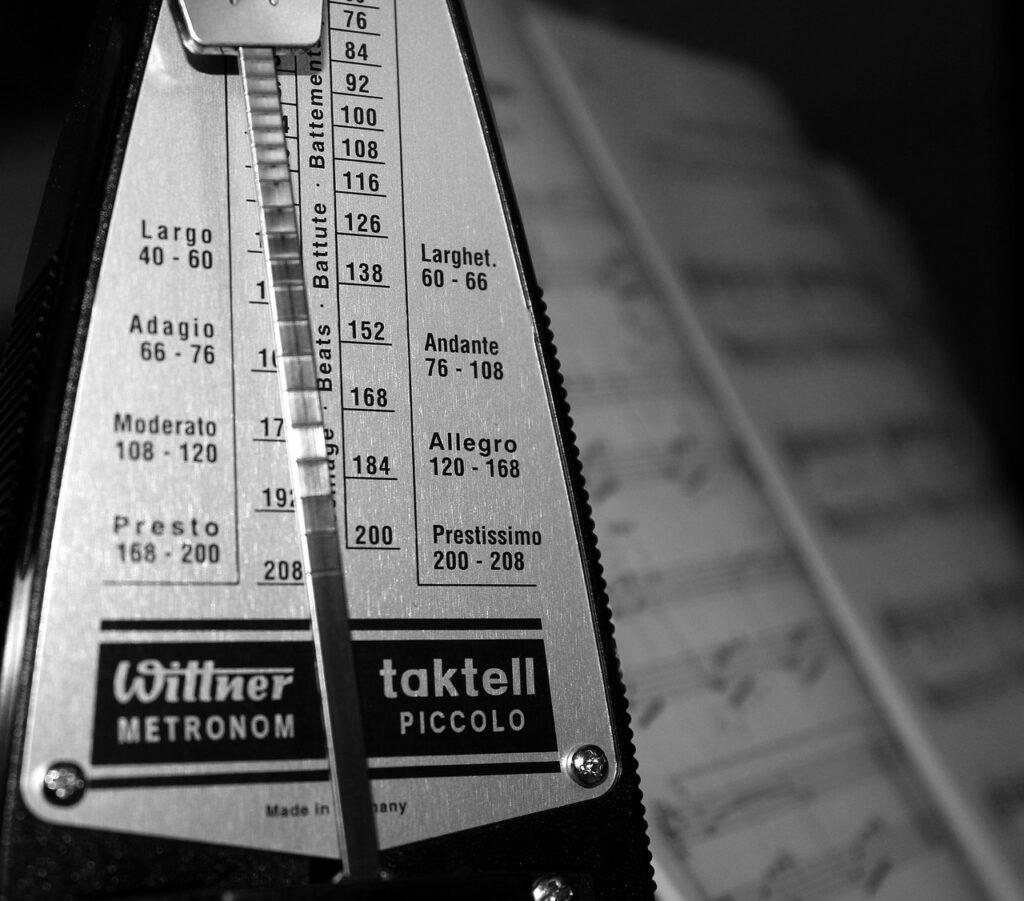
The 5 Best Effortlessly Easy Metronome Practice Tips - Metronome Face - How to Play Musical Tempos from Adagio to Allegro

The 5 Best Effortlessly Easy Metronome Practice Tips

Facebook
Twitter

Estimated reading time 2 minutes

Table of Contents

Introduction

Do you want to know the best way to practice with a metronome? Do you want to know what a metronome even is? A metronome is one of the best practice tools invented for musicians, because it helps you play with a steady beat. Nothing will make you sound like a professional faster than playing with a steady beat, and nothing will make you sound terrible faster than playing with a choppy beat. Keep reading The 5 Best Effortlessly Easy Metronome Practice Tips to learn how to play with a steady beat.

This article uses musical terms. For definitions, see the Glossary at the end of the post.

Color Coded Eighth Note Clapping - Clapping Hands Cartoon - Color Code Rhythm - I’m Having a Hard Time Keeping a Steady Beat - Singing Rhythm - How to Color Code Music to Optimize the Steady Beat - The 5 Best Effortlessly Easy Metronome Practice Tips - How to Teach Music Students with Dyscalculia

Easy Metronome Practice Tips #1: What’s a Metronome?

A metronome is a machine that makes a clicking sound at a regular rate. It’s used as an aid during practice to help you work your songs up to speed while maintaining a constant beat:

  • Originally, the clicking sound was produced by a mechanical device that was first marketed by Johann Maelzel at the beginning of the 19th century.
  • Now, in addition to mechanical versions, they also can be electronic devices or downloadable apps. For an online metronome: click here.
  • The rate of the clicking is adjustable and is measured in beats per minute (bpm), such as 60 bpm which is one beat per second.

Metronomes have a broad range of speeds, in some cases from 25 beats per minute to over 200 beats per minute, for example:

  • 50 bpm (tempo mark = largo) is a slow tempo.
  • 70 bpm (tempo mark = adagio) is medium slow.
  • 100 bpm (tempo mark = andante) is moderately fast.
  • 120 bpm (tempo mark = allegro) is fast.
  • 200+ bpm (tempo mark = presto) is very fast.
Color Coded Eighth Note Clapping - Clapping and Conducting - What’s a Good Alternative to a Metronome for Practice Sessions - I’m Having a Hard Time Keeping a Steady Beat - The 5 Best Effortlessly Easy Metronome Practice Tips

Easy Metronome Practice Tips #2: The Five Best Tips

When practicing with the metronome, you need to prioritize accuracy over speed. The five best metronome practice tips are:

  1. Start slowly, somewhere around 40 to 60 beats per minute.
  2. Gradually increase your tempo in 5 bpm increments until you start making mistakes.
  3. Stop and practice at the tempo 5 bpm below where you stopped.
  4. Once you’ve got it, start increasing the tempo (stopping and correcting mistakes as necessary), until you’ve reached your target tempo.
  5. Pro Tip: Practice 5 to 10 bpm above your target tempo so that you’ll be extra comfortable at your target tempo when you perform.

If you want to play in a band or other ensemble, you must learn how to sync with the beat, and playing with a metronome will help you learn how to do that.

Final Thoughts on “The 5 Best Effortlessly Easy Metronome Practice Tips”

Takeaway points:

  1. Make sure your playing is accurate before you speed up.
  2. Nothing will make you sound like a professional faster than performing with a steady beat, and nothing will make you sound terrible faster than performing with a choppy beat.
  3. Start slowly and work up to your target tempo.

Have fun playing!

Related Posts

© 2024 Geoffrey Keith

Newsletter Signup

Join me for in-person or online lessons today!

Back to the All-Purpose Music Tips and Topics category blogs page

Back to the Successful Music Student Blogs page

Glossary

Learning Differences and Spatial Ability - Dream Big

Learning Differences and Spatial Ability: Part 1

Has your child has been diagnosed with a learning disability? Do you feel confused because your child is so smart, but still struggles to learn? Read more to learn about learning differences and spatial ability. Estimated reading time 6 minutes.

Read More
Singing Shape Notes Solfege Lydian Melodies - Woman Singer

Singing Shape Notes Solfege Lydian Melodies

Do you want to be able to sing advanced modes? Are you confused about how the Lydian mode works? Modes are a feature of folk music around the world but are also both in jazz and 20th/21st century classical. Singing Shape Notes Solfege Lydian Melodies will help you master advanced modes. Keep reading to learn more. Estimated reading time 2 minutes.

Read More
Why is it Important to Define the Dynamics to Sing a Piece of Music - sheet music, cake, and coffee

Why is it Important to Define the Dynamics to Sing a Piece of Music?

Why is it important to sing the dynamics for a piece of music? Dynamics play an important role in notated music, helping bring interest and variety to your songs. If you want help understanding how dynamic signs work, click to answer the question: “Why is it important to define the dynamics to sing a piece of music?” Estimated reading time 3 minutes.

Read More


Basic Arpeggios Explained in Less Than Three Minutes - Harp

Basic Arpeggios Explained in Less Than 3 Minutes

Are you clueless about arpeggios? An arpeggio, or broken chord, is a basic musical figuration that’s used in multiple musical genres and playing styles. It adds grace and elegance to your music, allowing you to achieve a lighter and more sophisticated sound. Keep reading “Basic Arpeggios Explained in Less Than 3 Minutes” to learn what they are and how they work. Estimated reading time 2 minutes.

Read More