



Success Music Studio

A How to Guide to Learning Conducting with Musicality - Conductor

 A How to Guide to Learning Conducting with Musicality

Facebook
Twitter

Estimated reading time 4 minutes

Table of Contents

Introduction

Are you confused about what all the conductor’s hand gestures mean? Do you want to learn how to conduct a musical ensemble? Conducting isn’t just brandishing a stick. The conductor is the coach of an ensemble. Also, they interpret the musical score, making it so that each ensemble has its own unique sound. Keep reading A How to Guide to Learning Conducting with Musicality to learn what it is and how it works.

This article uses musical terms. For definitions, see the Glossary at the end of the post.

Singing in Tune - choir - How Do I Switch from Chromatic Shaped Notes to Standard Notation - What Precisely Is the Purpose of Solfege - A How to Guide to Learning Conducting with Musicality

How to Learn Conducting with Musicality: The Art of Sculpting Sound

Musicality is a sensitivity to musical genres – the ability to know when a style of music sounds right:

  • First, conductors need to know their score intimately, or they won’t be able to bring out the subtle nuances in the music.
  • While keeping time using beat patterns is an important part of the job, the conductor also uses other gestures to convey things like dynamics, entrance cues, and cut offs.
  • Moreover, conductors will use still more gestures that are interpretive in nature. Each conductor’s interpretive gestures are unique to the individual. Often, this is where the true artistry enters the picture.

Video: The Art and Musicality of Conducting

How to Learn Conducting with Musicality: Beat Patterns

Are conducting patterns really necessary? Can’t musicians keep together without you having to wave your arms around?

  • Unless there are tempo changes, the beat patterns aren’t as critical for smaller ensembles such as a church choir.
  • However, in large ensembles (like a major symphony orchestra with upwards of a hundred instruments, plus chorus and soloists, sitting on a 40-foot-wide stage) there can be a noticeable delay in the sound crossing from one side of the stage to the other.
  • In this case, the visual cue of the beat pattern is critical if everyone is to sync up correctly.

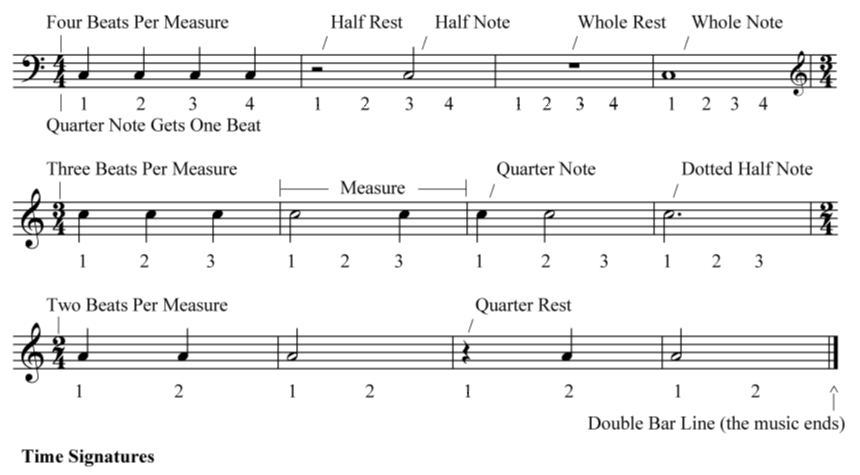
Mobile users: for best results reading the music, rotate your screen 90o to the right.

Reading Music (A Quick Guide to How to Read Music) - Time Signatures - 50 Essential Music Symbols Explained in Less Than 5 Minutes - Basic Music Notation Explained in Less Than 4 Minutes - A How to Guide to Learning Conducting with Musicality

The conducting patterns reflect how many beats are in a measure. Because of this, they are tied to the time signature(s) in the score. Here are the simple meter conducting patterns:

  • 4-4 Time Signature: down-in-out-up
  • 3-4 Time Signature: down-out-up
  • 2-4 Time Signature: down-up

To clearly convey the beat to your ensemble, you need to imagine that each beat bounces off an invisible table.

The following video demonstrates how the patterns work:

Video: Simple Meter Conducting Patterns

Singing Rhythm Syllables in 6-8 Time - Comparison of Compound Meters with 3-8 line 1
Singing Rhythm Syllables in 6-8 Time - Comparison of Compound Meters with 3-8 line 2

Compound meter is more complex:

  • Unlike simple meter, counting numbers and beats aren’t the same thing in compound meter.
  • Why? Because the beats occur at the dotted quarter notes, which means that there are three eighth note counts per beat. You can see this in how the eighth notes are beamed into groups of three notes in the example above.
  • This is why these time signatures are called compound, because the counts and beats are stratified.

Having a stratified time signature means that:

  • 6-8 is like two measures of 3-8 smooshed together, giving you two beats.
  • 9-8 is like three measures if 3-8, giving you three beats.
  • 12-8 is like four measures of 3-8, giving you four beats.

Therefore, at faster tempos you’ll use:

  • The 2-4 beat pattern for the 6-8 time signature
  • The 3-4 beat pattern for the 9-8 time signature
  • The 4-4 beat pattern for the 12-8 time signature

Only at slower tempos will you need special beat patterns for compound meter.

The video below shows you how those special patterns work:

Video: Compound Meter Conducting Patterns

How to Learn Conducting with Musicality: Interpretive Hand Gestures

Ensemble directors use additional hand gestures to convey a wide variety of information to their musicians:

  • Entrances: A conductor will cue a section (such as alto voices in a chorus or violin instruments in an orchestra) on when to start playing.
  • Cut offs: Similarly, players need to be cued when to stop playing. Without a cue each singer or player will stop at slightly different times, making for a sloppy sound. Hand gestures for cut offs can be a circular motion, or a pinching gesture.
  • Dynamics: Ensemble directors usually use a rising hand motion to convey increasing volume. Likewise, a falling hand motion to convey decreasing volume.

There are a whole host of interpretive hand gestures:

  • For example, staccato might be conveyed with sharp, choppy movements, like you’re shaking the staccato out of your tux sleeves.
  • Conversely, legato might be conveyed with smooth and flowing motions, using the whole arm with a rubbery flexibility.
  • Similarly, large bombastic sections will need large sweeping arm movements. Whereas quiet contemplative sections will need small, subdued hand gestures.

One of the best things you can do for yourself is to practice conducting with YouTube videos. Conduct along with your favorite symphonies and choruses while watching what their conductors do.

Video: Conducting Using Hand Gestures

Final Thoughts

Takeaway points:

  1. Conductors are the coaches in ensembles. Also, they interpret the musical score, making it so that each ensemble has its own unique sound.
  2. The conducting patterns reflect how many beats are in a measure.
  3. The conductor uses other gestures to convey dynamics, entrance cues, and cut offs. There are a whole host of interpretive hand gestures, which are unique to each conductor.

Have fun conducting!

Related Posts

© 2025 Geoffrey Keith

Glossary

How Easy Is it to Teach a Down Syndrome Child an Instrument - Man

How Easy Is it to Teach a Down Syndrome Child an Instrument?

Do you need advice on how to teach a music student with Down syndrome? Teaching a Down syndrome (DS) kid an instrument can be a special, heartwarming experience. However, to be truly effective, you need to have effective teaching methods. Keep reading “How Easy Is it to Teach a Down Syndrome Child an Instrument?” to learn how to be effective. Estimated reading time 4 minutes.

Read More
Learn the Secret of How to Play Guitar Trills - Guitarist with Les Paul

Learn the Secret of How to Play Guitar Trills

Do you want to learn the secret of how to play guitar trills? Trills add excitement and flash to your playing. However, if you want to know how to master guitar trills, you must first become proficient at two other guitar techniques. Keep reading to learn what these techniques are and how to best perform them. Estimated reading time 4 minutes.

Read More
brainstorming your song titles - computer with sticky notes attached

Brainstorming Your Song Titles

Are you stuck in a rut like the guy in the picture above? Do you want to know how to come up with vivid and memorable titles? Most of the songwriting experts agree that you should first write your hook, which often ends up being paired with your title. This means you need your title at the beginning of the songwriting process. Read more to learn how to go about brainstorming your song titles. Estimated reading time 4 minutes.

Read More
Joy to the World - Song, Words, and Piano - Gingerbread Man

Joy to the World – A Heavenly Song of Celebration

Do you want to know the words to Joy to the World? Would you like to learn how to sing or play it? In this post, you’ll get the essentials: 1) all the words to the song, 2) two videos (one for the song itself and one for easy piano), and 3) easy-to-read shape note sheet music with a sing along song track. Keep reading Joy to the World - A Heavenly Song of Celebration to learn more. Estimated reading time 2 minutes.

Read More