




Success Music Studio

How to Master Playing Bsus Chords (Guitar and Piano) - Guitar Chord

How to Master Playing Bsus Chords (Guitar and Piano)

Facebook
Pinterest
LinkedIn

Estimated reading time 4 minutes

Table of Contents

Introduction

Do you want to know how to play the Bsus chord on guitar or piano? Bsus has a different construction from your usual triads. Keep reading to learn how to master playing bsus chords on guitar and piano.

This article uses musical terms. For definitions, see the Glossary at the end of the post.

Why Do Minor Keys Sound Sad to Me- Ways Around the Difficulty of Playing the Piano Due to Short Fingers and Small Hands - piano fingers - How Can Legato Notes Be Played Staccato - Do My Hands' Sizes Affect Learning Performance on the Piano - Piano Major Scales (Basic Fingering Concepts)

This post contains affiliate links, which means I may receive a small commission from purchases made through the links. I’ll only recommend products I use, use in lessons, or ones my students or colleagues have recommended.

How to Master Playing Bsus Chords on Guitar and Piano: What Is It?

What is Bsus?

  • Bsus is short for B suspended. Why suspended? Because it has a restless quality that needs to be resolved.
  • Basically, the 3rd (D#) gets substituted by either the 2nd (C#) or the 4th (E), and it has B as its root.

There are two types of sus chords.

  • Bsus defaults to the Bsus4 chord, meaning that the 3rd (D#) is replaced by the 4th (E). Therefore, this chord can be labeled either Bsus or Bsus4.
  • However, there’s also the Bsus2 chord, meaning that the 3rd (D#) is replaced by the 2nd (C#). This chord will always be labeled Bsus2.
Chord - Picture of a Guitarist Playing a Barre Chord - How Common are Mistakes While Practicing and Playing Guitar- Guitar Tuner Online (Standard Guitar Tuning)

How to Master Playing Bsus Chords (Guitar and Piano): How it Works on Guitar

How to Play the Easy Beginner Guitar F Chord Without a Barre - Easy G Chord - Hand Icon LH (guitar) - What Are the Best Easy Guitar Chords for Beginners to Learn?

Hand Icon (churien.deviantart.com/art/hand-template-blank-272630198) by Unknown Author is licensed under CC BY (creativecommons.org/licenses/by/3.0). Modified by Geoffrey Keith.

How to Master Playing Bsus Chords (Guitar and Piano) - Bsus4 Alt Chord Root 5

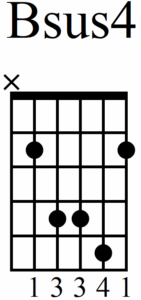
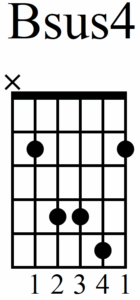
Bsus4 is tricky to play, because it uses two barres.

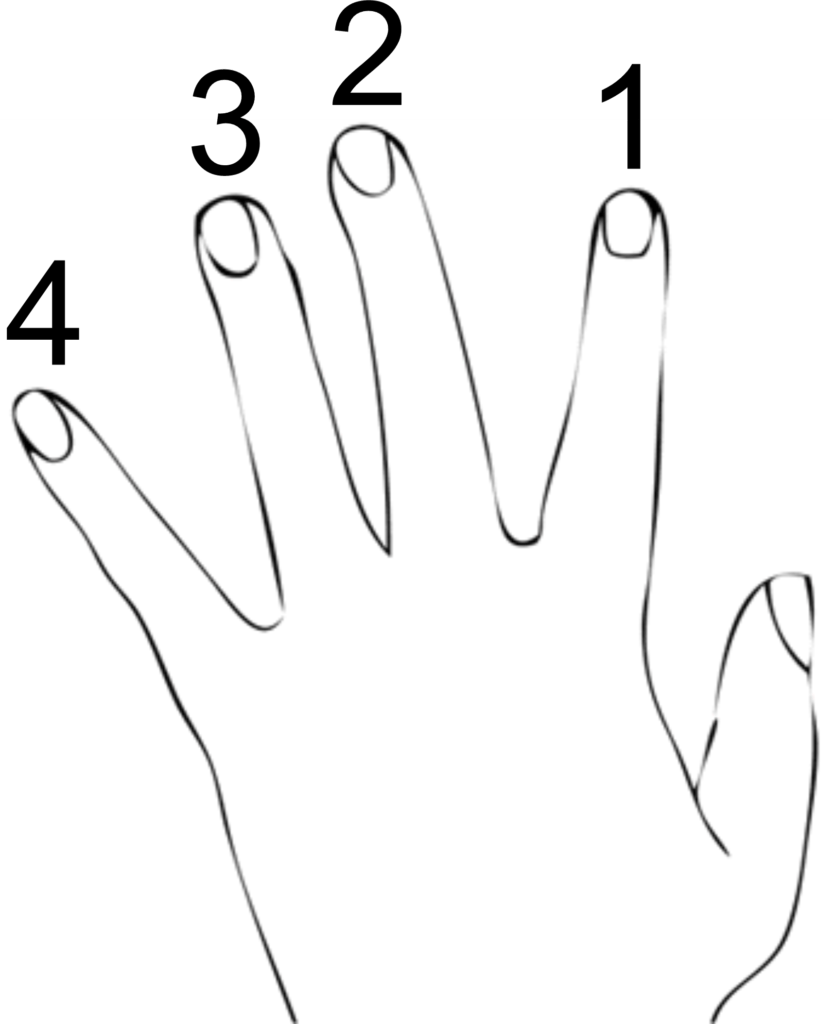
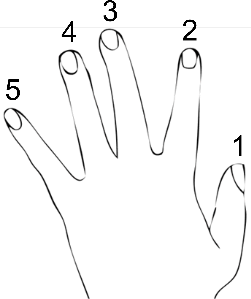
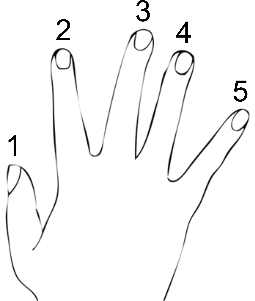
  • Barre this chord by pressing your index finger (finger #1 – see the hand icon above) across the five thinnest strings at the second fret.
  • Then, barre the two middle strings using finger #3.
  • Lastly, press your finger #4 down onto the second string at the fourth fret.

However, this fingering can be difficult to play on the acoustic guitar.

  • It’s difficult for everyone to play, but particularly for women and children, because it’s a hand strength issue.
  • You can partially get around this by playing on an electric, which normally has lighter gage strings with a lower string action.
  • However, you can also make it easier to play this chord by using the alternate fingering that substitutes fingers 2 and 3 for the third finger barre.
  • You can make it even easier by releasing the first finger barre.
  • Press finger #1 onto the fifth string, second fret and mute the first string with your pinky (finger #4).
  • The first fingering is quicker to play but requires more hand strength.
  • The second fingering uses more fingers, which makes it more complex to play. However, it helps with the hand strength issue, because you have more fingers pressing down, which evens out the load.
How to Master Playing Bsus Chords (Guitar and Piano) - B Chord Root 5
How to Master Playing Bsus Chords (Guitar and Piano) - Bsus2 Chord Root 5

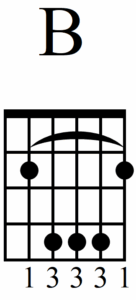
The next diagram shows you a regular B major chord.

  • This is often paired with sus chords, because the sus chord resolves to the major chord.
  • Notice that B major also uses a #1 and #3 finger barre.
  • If you use the alternate fingering of Bsus4, you’ll also need to use the same fingering for B major.
  • However, finger #4 will play one fret lower (i.e., one fret closer to the head of the guitar).
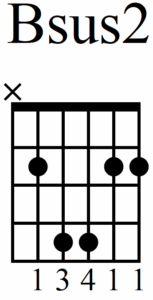
  • The last diagram shows you the Bsus2 chord.
How Do Guitar Harmonics Work - Guitarists Playing - after they can sight-read what’s left for musicians to learn - Improvising vs Composing Music -How Do I Find the Key of a Song with Accidentals - Discover Which Notes Are Authentic Blue Notes - 10 Amazing Elite Virtuoso Guitarists

How to Master Playing Bsus Chords on Guitar and Piano: How it Works on Piano

color coding fingers for music - LH piano hand icon with finger numbers
color coding fingers for music - RH piano hand icon with finger numbers

Hand Icon (churien.deviantart.com/art/hand-template-blank-272630198) by Unknown Author is licensed under CC BY (creativecommons.org/licenses/by/3.0). Modified by Geoffrey Keith.

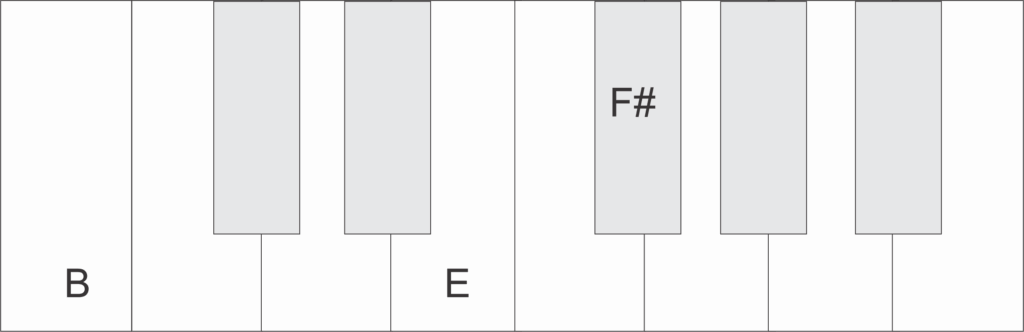
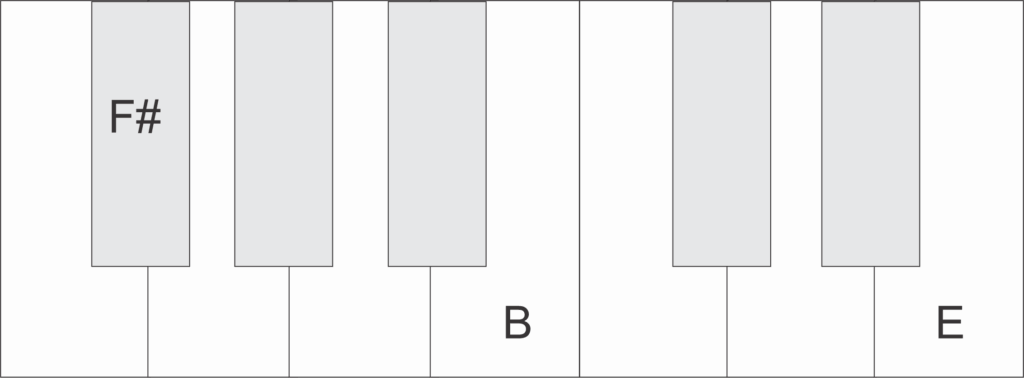
Piano Bsus4

Mobile users: for best results reading the examples, rotate your screen 90o to the right.

How to Master Playing Bsus Chords (Guitar and Piano) - Keyboard Bsus4 Root
How to Master Playing Bsus Chords (Guitar and Piano) - Keyboard Bsus4 1st inversion
How to Master Playing Bsus Chords (Guitar and Piano) - Keyboard Bsus4 2nd Inversion

How you’ll finger the above triads will depend on the context of the music.

  • Therefore, the first Bsus4 triad above is in root position so it would most likely be in B position.
  • This means you’ll use finger numbers 1, 4, and 5 on the right hand, and 5, 2, and 1 on the left hand.
  • The second triad is in first inversion.
  • This means that it’ll be in E position with right hand fingers 1, 2, and 5, and left hand fingers 5, 4, and 1.
  • The third triad is in second inversion.
  • A possible fingering choice would be 1, 2, and 5 on the right hand, and 5, 2, and 1 on the left hand.
  • However, the fingering ultimately depends on what other triads and scales you’re playing with it.

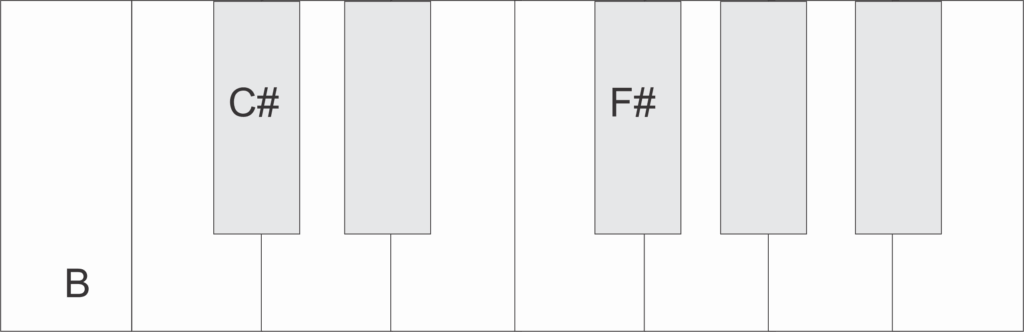
Piano Bsus2

How to Master Playing Bsus Chords (Guitar and Piano) - Keyboard Bsus2 Root
How to Master Playing Bsus Chords (Guitar and Piano) - Keyboard Bsus2 1st inversion
How to Master Playing Bsus Chords (Guitar and Piano) - Keyboard Bsus2 2nd Inversion

The same fingering principle goes for these triads as well.

  • For example, the first Bsus2 triad above is in root position so it would most likely be in B position.
  • This means you’ll use finger numbers 1, 2, and 5 on the right hand, and 5, 4, and 1 on the left hand.
  • The second triad is in first inversion.
  • This means that it’ll be in E position with right hand fingers 1, 2, and 5, and C position with left hand fingers 5, 2, and 1.
  • The third triad is in second inversion.
  • This means that it’ll be in F position with 1, 4, and 5 on the right hand, and 5, 2, and 1 on the left hand.
  • You’ll need to experiment with these triads to see which fingering works best for the music you’re playing.

Here are some resources that’ll help you learn these and other chords.

Guitar
Piano/Keyboard
Guitar Tuner Online (Standard Guitar Tuning) - Acoustic Guitar

Final Thoughts

Takeaway points:

  1. Bsus is short for B suspended, because it has a restless quality that needs to be resolved.
  2. There are two types of Bsus: Bsus4 and Bsus2.
  3. On guitar, your fingering decisions will be based on your hand strength, while on piano it will be hand position based.

Have fun playing!

Glossary

How Can I Write a Song Without an Instrument - Music Laptop - The 5 Best Free Music Notation Apps

How Can I Write a Song Without an Instrument?

“Can I write a song if I don’t play an instrument? If I have a melody and lyrics in my head, how can I create backing tracks for my song?” Good news! You too can write songs, even if you can’t play an instrument. Click to read, “How can I write a song without an instrument?” Estimated reading time 2 minutes.

Read More

Intonation and the Supplemented Equal Temperament Chart 2 - how to change keys in supplemented equal temperament

How to Change Keys in Supplemented Equal Temperament

Have you tried retuning your synth, but gotten frustrated by the limited number of keys? Do you want your keyboard’s chords to sound stronger when playing brass, string, and organ sounds? Supplemented Equal Temperament (SET) is a new and powerful tuning system that allows your chords to sound stronger and more in tune. Kurzweil’s PC3K synth also makes it a breeze to switch keys while using SET. Read more to learn how to change keys in Supplemented Equal Temperament. Estimated reading time 7 minutes.

Read More
Can I Learn Sight-Singing if I Haven’t Learned an Instrument? - How Intervals Affect Singing in Tune - Female Singer with mic - Sing Perfectly in Tune All the Time with Touchstone - How Can I Tell When I’m Singing in Key

How Can I Tell When I’m Singing in Key?

Do you ever ask yourself, “How can I tell when I’m singing in key?” or “How do I know if I’m singing in tune?” If you happen to be one of those people who has an innate sense of pitch, count yourself lucky. For everybody else, take heart! Performing in key is a skill that you can learn, and the sing-along soundtracks will help. Read more to learn what you need to listen for to be able to sing in key. Estimated reading time 3 minutes.

Read More

Singing Shape Note Solfege Flats - Choir - Singing Vocal Exercises - Choir Meaning & Examples with Videos, Pictures, & Soundtracks

Singing Shape Note Solfege Flats

Have you gotten basic sight singing down, but want to expand beyond seven notes? Look no further. In this post you will sing both sharp and flat solfege notes with an emphasis on the flats. Read more to understand singing shape note solfege flats. Estimated reading time 3 minutes.

Read More