



Success Music Studio

How to Build Mysterious Minor Chords - Sheet Music & Leaves

How to Build Mysterious Minor Chords

Facebook
Pinterest
LinkedIn

Estimated reading time 2 minutes

Table of Contents

Introduction

What is a minor triad? Minor chords have a dark, mysterious quality. Keep reading to learn how to build mysterious minor chords.

Why Do Pianists Occasionally Play Their Hands at Different Times as They Perform - The 2022 Success Music Studio Student Showcase - Why Doesn’t My Hands-Separate Piano Practice Help with Hands-Together Playing

This post contains affiliate links, which means I may receive a small commission from purchases made through the links. I’ll only recommend products I use, use in lessons, or ones my students or colleagues have recommended.

How to Build Minor Chords: Definitions

Mobile users: for best results reading the examples, rotate your screen 90o to the right.

Can Someone Explain Roman Numeral Analysis in Layman's Terms for Me - Triads Key of C - Tonic vs. Root in Music Theory - The C Major Scale (Including the C Major Chord Scale) - Whats the Secret of Practicing Arpeggios

A minor triad is a group of three pitches that’s typically played simultaneously.

  • Triads have three notes: root, third, and fifth.
  • The minor triad is named for the root note. For instance, Am has A as its root note.
  • Likewise, the notes C and E are the third and fifth of the chord – so named because of their distance from the root note.

Moreover, minor triads have a dark or “sad” quality, which contrasts with the major triad.

How to Build Minor Chords: How Do You Construct Them?

The C Major Scale (Including the C Major Chord Scale) - Keyboard - Piano Major Scales (Basic Fingering Concepts)

You build minor triads using intervals.

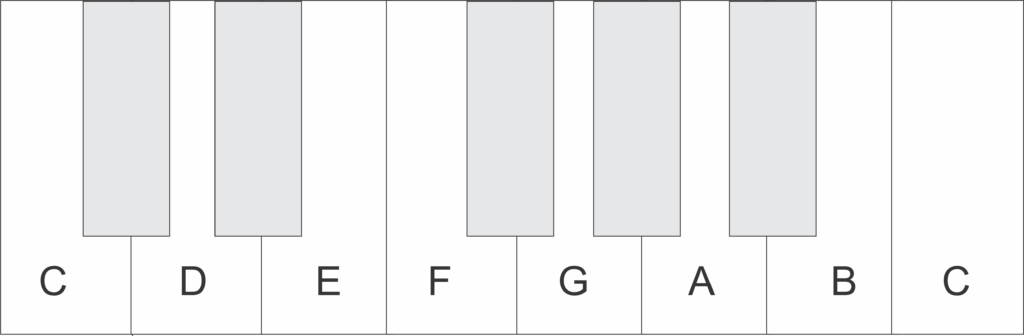
  • A basic interval (e.g., 2nd, 3rd, 4th, etc.) is when you count white keys on the keyboard.
  • For example, when building a triad in thirds, you’ll skip every other white key.
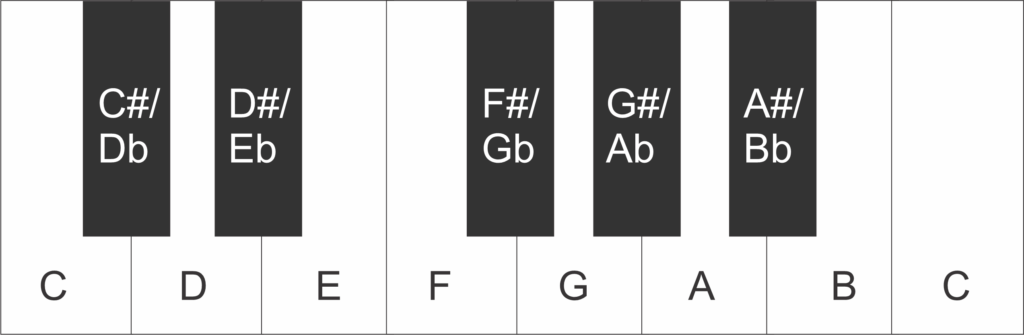
  • Though if you want to include black keys in your triads, semitones (a.k.a., half-steps) will give you a more precise measure for the triad’s internal structure.
  • A semitone measures the span from one key to the next key up or down whether the key is black or white.

Use the piano diagram above to find the notes of an A minor (Am) chord.

  • If you count the half-steps between the A and C of the Am triad, you’ll see that this third had three semitones between the notes. This is called a minor third (minor means “small”).
  • Alternatively, C and E has four semitones and is called a major third (major means “big”).
  • In the same way, the A and E have seven semitones and is called a perfect fifth.

You can build any minor chord using this pattern of semitones. In addition, you can invert the triad – essentially rearranging the order of the notes of the harmony.

How to Build Minor Chords: Directory of Triads

Do I Really Have to Learn Music Theory to Learn How to Play Piano - Why Do Minor Keys Sound Sad to Me - Color Code Key Signatures - Keyboard Accidentals - What is a Parallel Mode and How Does it Work - What Purpose Do Accidentals Serve in Reading Sheet Music - Reading Music (A Quick Guide to How to Read Music) - How Can I Learn the Basics of Music Theory - What Exactly Do I Do with the Circle of Fifths - An Easy How to Guide to Understanding Triads - 50 Essential Music Symbols Explained in Less Than 5 Minutes - What Exactly Do I Do with The Circle of Fifths - Circle of Fifths - How to Learn Music Theory with a Learning Disability - How to Effectively Use Music Theory to Transpose Music

There are 12 minor triads. I’ve only included the spellings for the versions that exclude double sharps, double flats, or white key sharps or flats.

  • Am = A C E
  • Bbm = Bb Db F
  • Bm = B D F#
  • Cm = C Eb G
  • C#m = C# E G#
  • Dm = D F A
  • D#m = D# F# A#
  • Ebm = Eb Gb Bb (plays the same keys as D#m)
  • Em = E G B
  • Fm = F Ab C
  • F#m = F# A C#
  • Gm = G Bb D
  • G#m = G# B D#
  • Am = A C E

Look at the piano diagram, all the triads shown above are built from the same intervals as the A minor chord in the preceding section.

For more info on chords:

Chord - Picture of a Guitarist Playing a Barre Chord - How Common are Mistakes While Practicing and Playing Guitar- Guitar Tuner Online (Standard Guitar Tuning)

Final Thoughts

Takeaway points:

  1. A basic interval (e.g., 2nd, 3rd, 4th, etc.) is when you count white keys on the keyboard.
  2. Though if you want to include black keys in your chords, semitones (a.k.a., half-steps) will give you a more precise measure for the triad’s internal structure.
  3. A semitone measures the span from one key to the next key up or down whether the key is black or white.
How to Extract a Melody from Your Lyrics - vintage-typewriter-on-desk - The Narrator’s Point of View in Your Songwriting.jpg

How to Extract a Melody from Your Lyrics

Do you have lyrics but need a melody? Starting with the text’s rhythm helps you create the melody you need. Read more to learn how to extract a melody from your lyrics. Estimated reading time 3 minutes.

Read More


How to Write a Song with a Catchy Chorus (Including Lyrics) - Singer-Songwriter with Guitar

How to Write a Song with a Catchy Chorus (Including Lyrics)

Do you want to learn how to make your own songs? Do you need help with your lyrics? There are many different song forms, and not all of them use a chorus. However, the verse/chorus form is one of the most popular. Songwriters and lyric writers both will find this post helpful. Keep reading to learn how to write a song with a catchy chorus. Estimated reading time 3 minutes.

Read More

How to Explain an Octave to an Absolute Beginner Musician - Man Playing Piano

How to Explain an Octave to an Absolute Beginner Musician

Are you confused about what an octave is? Or are you a music teacher with a student that doesn’t understand how they work? Octaves are one of the most fundamental music theory concepts. When teaching music students, it helps to demonstrate them on a keyboard instrument, so I’ve created a keyboard diagram you can reference. Keep reading “How to Explain an Octave to an Absolute Beginner Musician?” to dive into the theory. Estimated reading time 2 minutes.

Read More

How to Harmonize in Minor Keys - female singer.jpg

How to Harmonize in Minor Keys

Do you have a hard time singing minor keys in tune? According to Hagerman and Sundberg, minor thirds are almost as hard to tune by ear as major seconds, and much harder than major thirds. However, sing-along song tracks can help! Read more to learn how to harmonize in minor keys. Estimated reading time 3 minutes.

Read More

Leave a Comment

Your email address will not be published. Required fields are marked *