




Success Music Studio

How to Build Cool Major Chords - Piano

How to Build Happy Major Chords

Facebook
Pinterest
LinkedIn

Estimated reading time 3 minutes

Table of Contents

Introduction

What’s a major chord? It’s a fundamental harmony that’s at the core of Western music theory. Keep reading to learn how to build happy major chords.

Should I Learn to Play the Piano One Hand at a Time or Simultaneously - Concert Pianist - Why Can I Play Piano Hands Together but not Separately - Can I Learn Singing on the Piano - Musical Talent and Giftedness - What Does the Exotic Sounding Word Bravo Mean at a Concert?

This post contains affiliate links, which means I may receive a small commission from purchases made through the links. I’ll only recommend products I use, use in lessons, or ones my students or colleagues have recommended.

How to Build Major Chords: What Is It?

Mobile users: for best results reading the examples, rotate your screen 90o to the right.

Can Someone Explain Roman Numeral Analysis in Layman's Terms for Me - Triads Key of C - Tonic vs. Root in Music Theory - The C Major Scale (Including the C Major Chord Scale) - Whats the Secret of Practicing Arpeggios

A major chord is a collection of notes that is usually played altogether at the same time.

There are many types of chords, but specifically, the major chord is a triad, which means that it has three-notes.

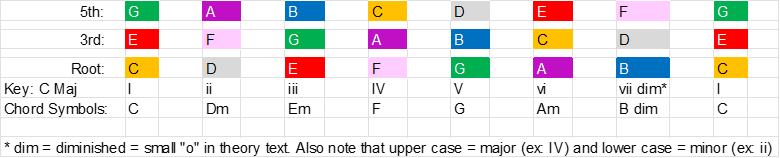
  • The notes of the triad are the root, the third, and the fifth.
  • The root is the note for which the chord is named. For example, the root of a C major triad is C.
  • The third is three notes above the root (e.g., E in a C triad), and the fifth is five notes above the root (e.g., G in a C triad).

In addition, the major triad has a bright quality, which is interpreted to be “happy” in Western music. This is typically contrasted with minor triads, which have a dark, “sad” sound.

How to Build Major Chords: How Is It Constructed?

The major chord is built using intervals.

  • An interval is a distance in music, and each interval is built with half-steps.
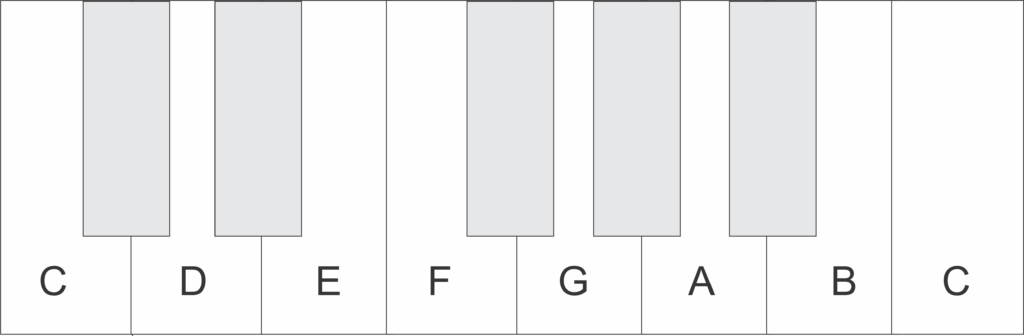
  • If you were to look only at the white keys on the piano, chords are built three notes apart (called thirds) so that you skip every other white key.
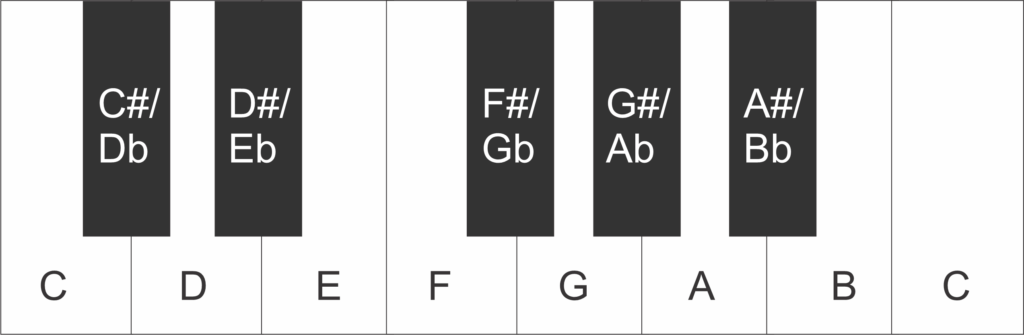
  • However, if you add in the black keys, you’d need to start measuring the triads using half-steps. A half-step is the distance from any key to the very next key moving up (to the right on the keyboard) or down (moving to the left on the keyboard) regardless of whether the key is black or white.

For example, the C major triad contains the notes C E G (see the keyboard below).

  • As I said above, the third (E) of the triad is called that because you’d count up three white keys from the root note (C). However, if you count all the half-steps between the root and the third of the chord, you’d find that the third is four half-steps above the root. This is called a major (or big) third.
  • Alternatively, the interval of a third between E and G is called a minor third (minor means small) because it only has three half-steps.
  • Similarly, the perfect fifth in the triad has seven half-steps (on the keyboard diagram you’d count seven half-steps between the C and G).

All major triads are constructed using this pattern of intervals. In addition, we can mix up the order of the notes by inverting the chord.

The C Major Scale (Including the C Major Chord Scale) - Keyboard - Piano Major Scales (Basic Fingering Concepts)

How to Build Major Chords: List of Major Chords

There’re twelve major chords (listed using versions that don’t have double flats, double sharps, or white key flats or sharps):

  • C = C E G
  • Db = Db F Ab
  • D = D F# A
  • Eb = Eb G Bb
  • E = E G# B
  • F = F A C
  • F# = F# A# C#
  • Gb = Gb Bb Db (contains the same keys as F#)
  • G = G B D
  • Ab = Ab C Eb
  • A = A C# E
  • Bb = Bb D F
  • B = B D# F#
  • C = C E G

Looking at the keyboard below, you’ll see that all the triads listed above have the same interval structure as the C major triad in the previous section.

Do I Really Have to Learn Music Theory to Learn How to Play Piano - Why Do Minor Keys Sound Sad to Me - Color Code Key Signatures - Keyboard Accidentals - What is a Parallel Mode and How Does it Work - What Purpose Do Accidentals Serve in Reading Sheet Music - Reading Music (A Quick Guide to How to Read Music) - How Can I Learn the Basics of Music Theory - What Exactly Do I Do with the Circle of Fifths - An Easy How to Guide to Understanding Triads - 50 Essential Music Symbols Explained in Less Than 5 Minutes - What Exactly Do I Do with The Circle of Fifths - Circle of Fifths - How to Learn Music Theory with a Learning Disability - How to Effectively Use Music Theory to Transpose Music

For more information on chords:

How to Master Playing Bsus Chords (Guitar and Piano) - Guitar Chord

Final Thoughts

Takeaway points:

  1. The major chord is a triad, which means that it’s a three-note chord.
  2. In addition, it has a bright quality, which is interpreted to be “happy” in Western music.
  3. This is typically contrasted with minor triads, which have a dark, “sad” sound.
How to Play Your $@!% Cello in Tune - Cellist

How to Play Your $@!% Cello in Tune

Do you want to be able to play your cello or double bass in tune? Do you need help learning the necessary skills for accurate string intonation? The following post will give you bowing, fingering, and ear training tips that will help you master your instrument’s intonation. Click to learn how to play your cello in tune. Estimated reading time 4 minutes.

Read More


Do I Really Have to Learn Music Theory to Learn How to Play Piano - Learn the Elements of Songwriting Construction - Songwriter at a Computer - after they can sight-read what’s left for musicians to learn - What is a Parallel Mode and How Does it Work - How Can I Learn the Basics of Music Theory - The Top 5 Best Drake Sheet Music Gift Ideas

Learn the Elements of Songwriting Construction

Not sure about how to write a pre-chorus or a bridge? Are you confused about how to shape the form of your song? Look no further! Read more to learn the elements of songwriting construction. Estimated reading time 5 minutes.

Read More

sound like a rock star with open G tuning - keith richards

Sound Like a Rock Star with Open G Tuning

Do you want to capture the sound of 70s rock guitar? Amp settings, effects, pickups, and strings all play a role in crafting your guitar sound. Nevertheless, the tuning you choose remains an important factor in your guitar sound that you might have overlooked. You will also learn the song “Brown Sugar.” Read more to learn how to sound like a rock star with open G tuning. Estimated reading time 3 minutes.

Read More

The Special Needs and Learning Disability Label Dilemma - Label

The Special Needs and Learning Disability Label Dilemma

Do you feel uncomfortable with special needs labels? Do you like one label but hate another? Terms like special needs and learning disabilities are critical for gaining access to support services. However, they can come with some big downsides. Click to learn about the special needs and learning disability label dilemma. Estimated reading time 4 minutes.

Read More

Leave a Comment

Your email address will not be published. Required fields are marked *