


Success Music Studio

How to Write Quartertone Music that Sounds Amazing - Keyboard Player

How to Write Quartertone Music that Sounds Amazing

Facebook
Twitter

Estimated reading time 4 minutes

Table of Contents

Introduction

Are you frustrated that you can’t make your quartertone music sound good? It’s notoriously hard to write music for this scale. However, How to Write Quartertone Music that Sounds Amazing can show you how to make it work.

In other words, if you want your music to sound like this:

Oh, My Love

Rather than this:

You need to keep reading.

This article uses musical terms. For definitions, see the Glossary at the end of the post. The glossary also includes terms for the supplementary PDFs.

Question - How Do I Get Better at Sight Singing - Male Singer - What Exactly Is a Ballad and How Do You Write One? - How to Have Fun Singing Karaoke Songs

How to Write Quartertone Music: How the Notation Works

About the accidentals used in the "Oh, My Love" score.

  • When I first started working with quartertones, I looked at a few different notation systems.
  • Finally, I settled on Krzystof Penderecki’s microtonal accidentals because I liked the look of them, and they made sense to me. This is what you’ll find in today’s example song Oh, My Love, which is an early copy of the score that I made, and which you’ll be able to download as a PDF.
  • However, it seems that his notation isn’t popular, because I don’t have a font that I can use as I write about the quartertones. Therefore, I found substitutions that were as close an approximation to the original as I could get.

About the accidentals in the supplementary theory PDFs.

  • The following PDF (at the link below) shows you the accidentals I used in the PDFs “Oh, My Love Scales” and “Oh, My Love Analysis.”
  • The accidentals in the PDFs are slightly different from the example song’s score.
  • Be sure to check the PDFs against the chart on the Oh, My Love score title page.

Click to Download the PDF file:

How to Write Quartertone Music: How to Write Good Sounding Music

The Concept

Quartertones consist of two twelve note chromatic scales a quartertone apart:

The idea is to modulate across the microtonal barrier from one set of twelve keys to the other:

  • However, because of the aural mismatch between the two sets of chromatic notes, there can be no common tones at all across the barrier.
  • Nevertheless, the voice leading stays the same as found in your standard harmony textbook.
  • When I tested the music on volunteers, I found that the essential element for achieving good transitions across the microtonal barrier was the resolving tritone

The Scales

Unfortunately, the fonts for the quartertone accidentals don’t work in my posting software. So, instead I have created a downloadable PDF that discusses the scales used in Oh, My Love:

Analyzing the Song "Oh, My Love"

Oh, My Love

Next, click on the downloadable analysis PDF:

Then, listen to the soundtrack while following along with the score pages. Use the analysis PDF to better under the Roman numeral analysis in the score.

How to Write Quartertone Music: The Difference Between Dissonance and Microtonal Tuning Effects

Listen to these three soundtracks, and to "Oh, My Love" again.

Oh, My Love

So, what am I doing differently from the other composers?

  • All three composers treat the quartertones like normal chromatic notes. In fact, Haba seems to be really embracing incidental chromaticism, which won’t work at all with quartertones.
  • Harmonic dissonance happens when harmonic overtones fall within the critical bands. (If you don’t understand what that means, read: Harmony is Tone Color.)
  • However, the quartertone’s sound comes from a tuning effect rather than just dissonance.

Mobile users: for best results reading the example, rotate your screen 90o to the right.

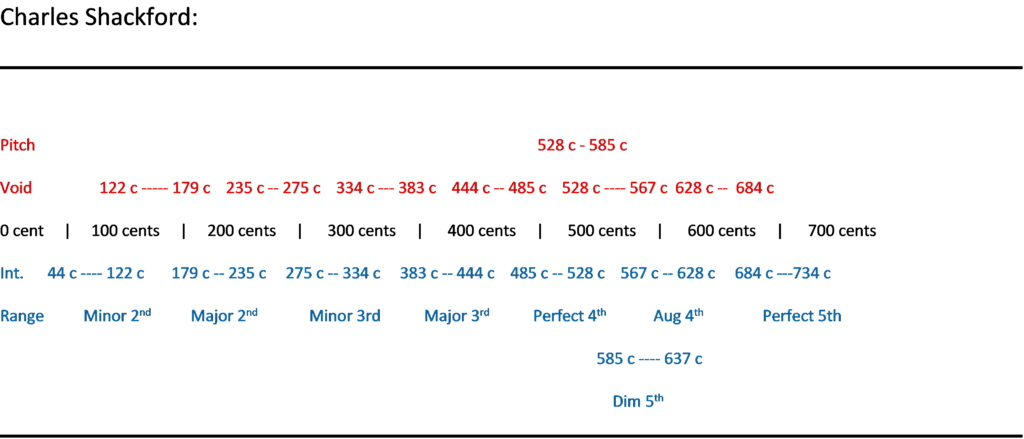
A Note Contains Many Pitches - Charles Shackford Pitch Cluster

Charles Shackford studied violin intonation and found that scale tunings fell into patterns.

  • The chart shows the interval cent ranges for the notes (color coded blue).
  • The pitch void (color coded red) shows the gap where notes are out of tune.
  • If notes stray into the pitch void, your inner ear says, “Hey, this sounds strange, I must have eaten something bad. Okay, it’s time to throw up now.”
  • In other words, if your tuning systems strays into the pitch void, it can make your audience queasy (at least for Western listeners).
  • This can make it challenging to write quartertone music.

However, the resolving tritone tricks the ear into thinking it knows where it is even when it doesn’t.

  • Experience has shown that some people will still hear it as being out of tune.
  • Others, especially experienced musicians, will think it’s really interesting.
  • Still others won’t be able to hear anything unusual at all.

How is it useful for composing?

  • Quartertones works best when you carefully prepare your modulations rather than improvise your compositions.
  • Also, it works well when you do programmatic music – music that tells a story.
  • Some programmatic subjects that might be appropriate: death, insanity, traumatic loss, transformations (e.g., werewolves or supervillains), disquieting subjects (e.g., Lovecraft or pogroms).

As long as you use it to tell the right kind of story, you can justify almost anything in music.

Final Thoughts

The takeaway points:

  1. Quartertones consist of two twelve note chromatic scales a quartertone apart. So, you need to modulate across the microtonal barrier from one set of twelve keys to the other.
  2. The essential element for the smoothest possible transition across the microtonal barrier is the resolving tritone.
  3. In addition, if you use your music to tell the right kind of story, you can justify almost anything in music.

Have fun composing!

Related Posts

© 2025 Geoffrey Keith

Glossary

Learning Differences and Spatial Ability - Dream Big

Learning Differences and Spatial Ability: Part 1

Has your child has been diagnosed with a learning disability? Do you feel confused because your child is so smart, but still struggles to learn? Read more to learn about learning differences and spatial ability. Estimated reading time 6 minutes.

Read More
How Do Musicians Find Enough Time to Practice Their Instruments - Musicians Practicing Outside

How Do Musicians Find Enough Time to Practice Their Instruments?

“How do musicians find enough time to practice their instruments?” It can be challenging. Adults live busy lives, and kids have tons of homework, sports, and afterschool activities. However, it’s not hopeless. You just have to learn how to best structure the time you have. Keep reading to find out how it works. Estimated reading time 2 minutes.

Read More
How to Play Musical Tempos from Adagio to Allegro - Metronome and Recorder

How to Play Musical Tempos from Adagio to Allegro

Do you want to know what the word tempo means? Do you need to understand how tempos work? Understanding how tempos work in music is a critical skill, because picking the right speed can breathe life into your music. Click to learn how to play musical tempos from adagio to allegro. Estimated reading time 3 minutes.

Read More


Geoffrey Keith Owner of Success Music Studio - Who's Who - About

Who’s Who Biographies Adds Geoffrey Keith

I’m honored to announce that I’ve been included in the Marquis Who's Who biographies. While the biography briefly covers all of my music career, my work with LD and special needs students caught their attention. This led them to decide to include me in their listing. Read more. Estimated reading time 1 minutes.

Read More