
Success Music Studio

What Precisely Is the Purpose of a Clef - Clef Cookies

What Precisely Is the Purpose of a Clef?

Facebook
Twitter

Estimated reading time 2 minutes

Table of Contents

Introduction

What precisely is the purpose of a clef? It’s the symbol to the left side of the staff that helps you know how to play the sheet music’s notes. The three most common are: treble, alto, and bass. Keep reading to learn what they are and how they work.

This article uses musical terms. For definitions, see the Glossary at the end of the post.

How to Graduate from the Color Coded Sheet Music - Part II - Girl Playing Flute - after they can sight-read what’s left for musicians to learn - What Does it Mean for Me to Interpret a Piece of Music - Music Therapy vs Music Lessons - BPM (Using the Metronome to Get the Music Beat) - What Does Intonation Mean and Why Is It Essential in Music

What Is the Purpose of a Clef: Treble Clef

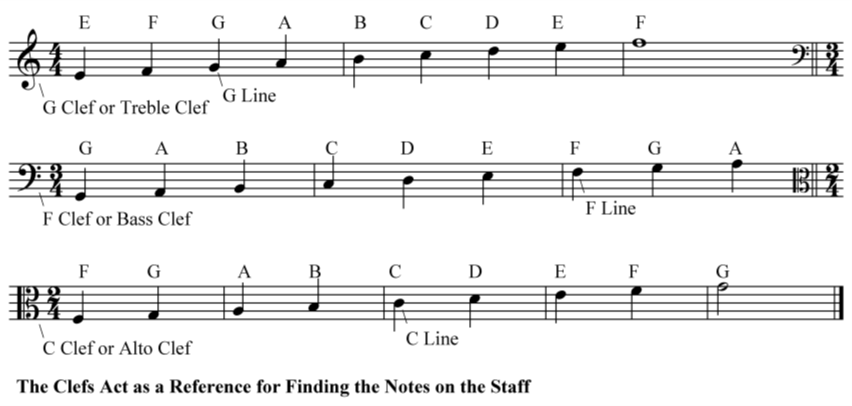
The treble clef is recognized by its distinctive swirly form:

  • It’s a stylized G, curving around the second line of the staff.
  • It indicates that any note on this line will be a G on your instrument.
  • Therefore, if you can remember that the treble clef is a fancy G, you’ll have a reference note from which you can find all the other notes on the staff.

Which instruments read the treble clef? Here’s a quick list of high instruments:

  • Piccolo
  • Flute
  • Oboe
  • English horn
  • Clarinet
  • Saxophone
  • Trumpet
  • French horn
  • Violin
  • Mallet percussion
  • Piano (right hand)
  • Guitar
  • Ukulele
  • Mandolin
  • Banjo

Also, these voices:

Mobile users: for best results reading the music, tilt your screen 90o to the right.

Reading Music (A Quick Guide to How to Read Music) - Clefs - Making Sense of Why Treble and Bass Clef Are So Different - How to Color Code the Elusive Alto Clef - 50 Essential Music Symbols Explained in Less Than 5 Minutes - Basic Music Notation Explained in Less Than 4 Minutes

What Is the Purpose of a Clef: Bass Clef

The bass clef is a loose spiral that points to the F line:

  • Also, it’s a stylized F. Because the F line goes between the two dots on the bass clef, this line can be a reference which tells you what line has the F note.
  • From there you can find any note on the staff just by going forward in the musical alphabet as you go higher on the page.
  • Likewise, as you go lower on the page, you’ll go backward in the musical alphabet.

Which instruments read the bass staff? Here’s a short list of low instruments:

  • Bassoon
  • French horn (sometimes)
  • Trombone
  • Tuba
  • Cello
  • Double bass
  • Bass guitar
  • Piano (left hand)

Also, these voices:

What Does Dissonance Mean for Basic Seventh Chords - Sheet Music - How to Play Musical Tempos from Adagio to Allegro

What Is the Purpose of a Clef: Alto Clef

The alto clef isn’t widely used:

  • It’s a stylized C that points to the center line on the staff, which is middle C.
  • From this note you can find the other notes just by going up and down the staff.
  • As you go higher on the staff, you’ll go higher in sound, and vice versa.

Which instrument reads the alto clef?

  • Viola

Because of the range of the instrument, the viola needs a special staff that sits in between the treble and bass staves. The viola is the only instrument that regularly uses the C staff.

Final Thoughts

Takeaway points:

  • The clef is the symbol to the left side of the staff. It’s a reference from which you can find all the other notes on the staff.
  • The treble staff covers the high notes, the alto covers the middle notes, and the bass covers the low notes.
  • The viola is the only instrument that regularly uses the C staff.

Related Posts:

© 2025 Geoffrey Keith

Glossary

singing chromatic solfege using shape notes - sheet music and red rose - Where Do I Start if I Want to Be Able to Sing A Cappella

Singing Chromatic Solfege Using Shape Notes: Moveable vs Fixed Do

Do you get confused about the different types of solfege? Which is better for sight singing music? Fixed or moveable Do solfege? Read “Singing Chromatic Solfege Using Shapes Notes” for practical suggestions on how to sing music with lots of sharp and flats. Estimated reading time 4 minutes.

Read More
The Top Ten Best Enchanting Chopin Masterpieces - Chopin Statue

The Top 10 Best Enchanting Chopin Masterpieces

Curious to learn about Chopin’s music? Frederic Chopin (1810 – 1849) was a classical composer who wrote during the Romantic period (1820 - 1910). He’s best known for his hypnotic piano music. Keep reading to learn about and listen to the top 10 best enchanting Chopin masterpieces. Estimated reading time 4 minutes.

Read More
Success Music Studio Has Been Blogging for 600 Days - Balloons - Hail the New Year with the Popular Old Lang Syne Song - Milestone 300 Posts of Thought-Provoking Musical Advice

Success Music Studio Has Been Blogging for 600 Days

Today marks a milestone for me: 600 days of blogging “The Successful Music Student!” If you want to read or sight sing music, sing in tune, write better songs, or finally get your guitar or keyboard in tune, the blog has just what you need. Estimated reading time 1 minute.

Read More
Learn How To Get A Killer Sound For Your Band - supplemented equal temperament minor keys - synth, guitar, and lead singer - Is Playing the Piano a Suitable Activity for Autistic People

Learn How to Get a Killer Sound for Your Band

Do you want your band to sound better? Have you ever been frustrated that your guitar or keyboard sounds out of tune when you play chords? Learn how to get a killer sound for your band by retuning your keyboards and guitars using Supplemented Equal Temperament. Supplemented Equal Temperament works with equal tempered instruments. It also works with variable pitch instruments such as voices, violins, and winds. Estimated reading time 5 minutes.

Read More