


Estimated reading time 3 minutes
Table of Contents
Introduction
Do you want to know how easy it is to play accordion? The accordion is a versatile instrument that’s a dominant force in folk and ethnic music around the world. However, the playing difficulty depends on which type of instrument you’re talking about. Keep reading How Easy (or Difficult) Is it to Play Accordion? to learn more.
This article uses musical terms. For definitions, see the Glossary at the end of the post.
How Easy Is it to Play Accordion: What Are Diatonic Buttons?
How easy is it to play accordion? It depends on the type of instrument you’re talking about:
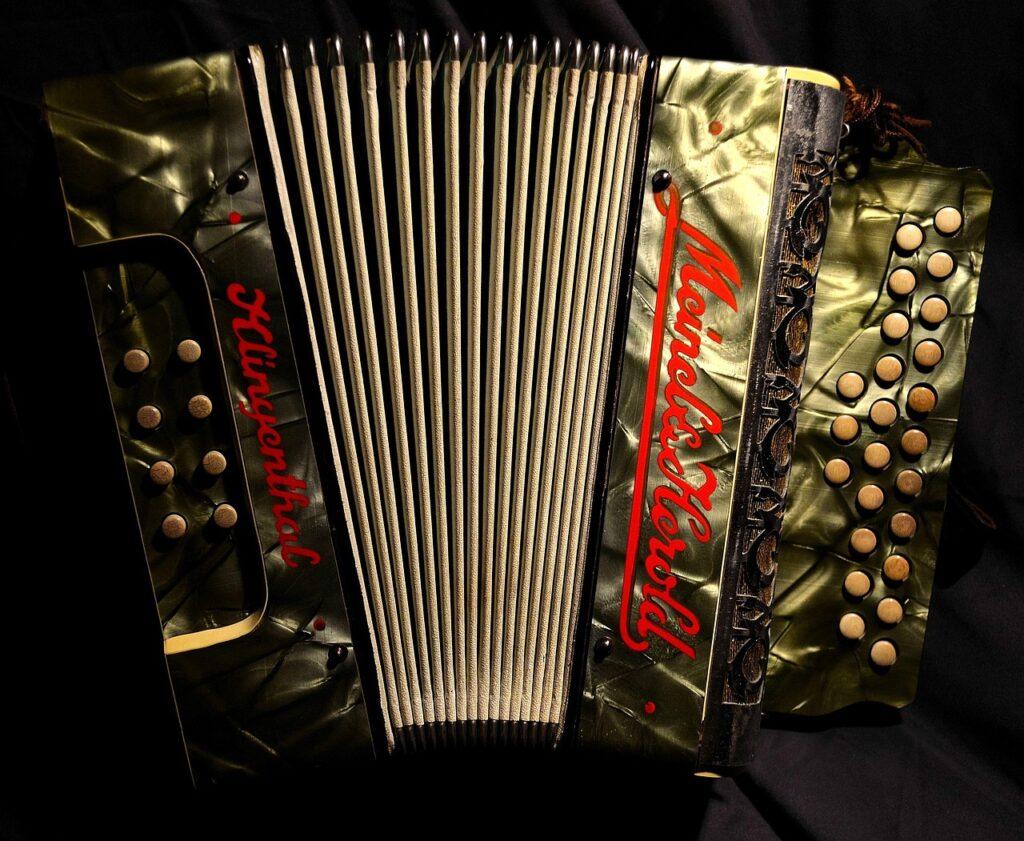
- For instance, I have a diatonic button accordion that my students love.
- Dia-what? Diatonic means that it’s limited to the seven “white key” notes from the piano. (Also, instead of keys it has buttons.)
- This means that none of the note combinations will sound too horrible, making it fairly easy to noodle around on.
In addition, it’s single-action, meaning that when you change directions on the bellows you get different notes:
…the earliest ones, are “single-action,” in which the paired reeds sound adjacent notes of the diatonic (seven-note) scale, so that a button will give, for instance, G on the press and A on the draw. (Britannica)
This makes press and draw bellows phrasing more challenging. However, on the plus side, these instruments are lighter and easier to handle.
Even among diatonic button accordions, there’s going to be a range of difficulty:
- For example, one instrument I have at my lesson studio is from the Schylling Kid series, and my young students have a ball improvising on it. Why is it good for kids? Because it has small buttonboards with less buttons for both right and left hands.
- Obviously, a serious adult diatonic button accordion will have more buttons and therefore will be more challenging to play than the kid’s version.
- Nevertheless, the adult version of the instrument will still be a good option for people who love the sound of the instrument, but don’t want too much complexity.
How Difficult Is it to Play Accordion: What Is a Chromatic Piano Accordion?
The piano accordion is a much more complex instrument than the diatonic button version:
- The “piano” moniker comes from the fact that this type of instrument has a piano style keyboard for the right hand instead of a buttonboard.
- However, the left hand usually uses a buttonboard.
- Depending on the buttonboard system, the left hand will be able to play a combination of bass notes and/or chords.
Also, it’s much larger and heavier, because it’s double-action:
In “double-action” accordions, the two reeds of each pair are tuned to the same note, thus making each treble or bass note available from the same key or button with both directions of bellows movement. (Britannica)
Having twice the number of reeds accounts for its larger size and for the bulk of the extra weight. This makes it a handful to play.
In addition, the piano style right hand keyboard is chromatic:
- Chromatic means that it has twelve keys (seven white and five black) per octave, allowing you to play a larger repertoire with a greater range of musical styles.
- The downside is that it makes for a much steeper learning curve for beginners.
- However, if you have a piano background, it’ll give you a boost toward mastering the right hand. On the other hand (pun intended), the bass buttons for the left hand take some getting used to.
There are other variations of these instruments. However, this gives you some of the basics to consider when choosing which way you want to go.
Final Thoughts on “How Easy (or Difficult) Is it to Play Accordion?”
Takeaway points:
- The diatonic button accordion is a good option for people who love the sound of the instrument, but don’t want too much complexity.
- Also, it’s lighter and easier to handle.
- Conversely, the piano accordion is much more complex but is also a much more versatile instrument.
Have fun playing!
Related Posts
- Basic Arpeggios Explained in Less Than 3 Minutes
- Reading Music (A Quick Guide to How to Read Music)
- D’you Want Some Music Tips and Tricks I’ve Learned Over the Years?
© 2025 Geoffrey Keith
Glossary
What Does Intonation Mean and Why Is It Essential in Music?
Have you ever wondered what the word intonation means? In music, it’s an important part of performance for many instruments, and it impacts all instruments to one degree of another. Keep reading “What Does Intonation Mean and Why Is It Essential in Music?” to learn more. Estimated reading time 4 minutes.
Read MoreLearn the Secret of How to Play Guitar Trills

Do you want to learn the secret of how to play guitar trills? Trills add excitement and flash to your playing. However, if you want to know how to master guitar trills, you must first become proficient at two other guitar techniques. Keep reading to learn what these techniques are and how to best perform them. Estimated reading time 4 minutes.
Read MoreHow Can I Tell When I’m Singing in Key?

Do you ever ask yourself, “How can I tell when I’m singing in key?” or “How do I know if I’m singing in tune?” If you happen to be one of those people who has an innate sense of pitch, count yourself lucky. For everybody else, take heart! Performing in key is a skill that you can learn, and the sing-along soundtracks will help. Read more to learn what you need to listen for to be able to sing in key. Estimated reading time 3 minutes.
Read MoreDo I Really Have to Learn Music Theory to Learn How to Play Piano?
Do you want to give up on learning music theory? Does it seem pointless to you? Music theory can help with sight reading skills on the piano. It’ll be useful for improvisation and composition. It even helps with performance practice. If you still have an open mind, read “Do I Really Have to Learn Music Theory to Learn How to Play Piano?” to understand the ways it can help you to better play the instrument. Estimated reading time 4 minutes.
Read More