

Success Music Studio

Art vs Commerce in Songwriting - whitney houston singing - I'm Confused About These Stupid Vocal Ranges

I’m Confused About These Stupid Vocal Ranges

Facebook
Twitter

Estimated reading time 3 minutes

Table of Contents

Introduction

“I’m confused about these stupid vocal ranges, because it seems like I can sing way more notes than I’ve been finding listed online.” It’s critical for singers and composers alike to be familiar with singer classifications. I can help. Keep reading to learn more – including vocal range charts.

This article uses musical terms. For definitions, see the Glossary at the end of the post.

harmony and melody tune differently - pianist singing - I'm Confused About These Stupid Vocal Ranges

I'm Confused About These Stupid Vocal Ranges: Clearing Up the Confusion

“I’m confused about these stupid vocal ranges, because it seems like I can sing way more notes than I’ve been finding listed online.” The reason for this is that most of the vocal range charts you’ve found were probably intended for composers and songwriters.

For example, the vocal range charts below give a conservative tessitura for each voice type:

  • These are the singer tessituras I got in music theory class at UMass Lowell in the ‘90s.
  • They’re intended to help composers to know what notes will work for almost every singer within a particular voice type.
  • Nevertheless, individual singers will often be able to sing more than that.
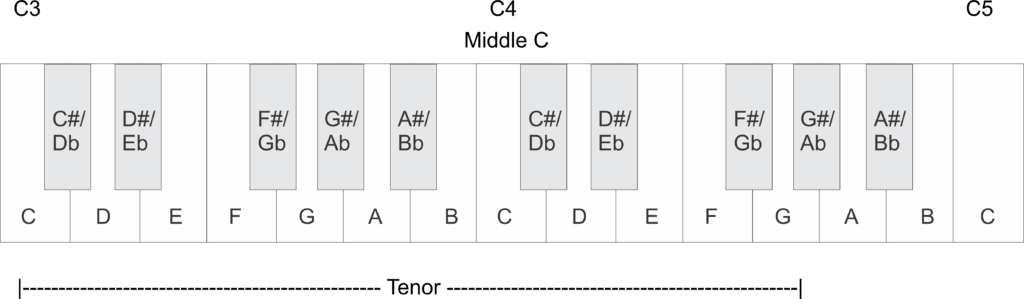
  • For instance, the tenor tessitura chart shown below is an octave and a half.
  • Yet, my personal tessitura is about two and a half octaves, meaning that I can comfortably sing any note on the chart… and many people have even greater note spans.

However, you can use the vocal range charts to find your tessitura (and therefore get a hint at your voice type) on a keyboard or piano.

Measuring a Song’s Success - Recording Sign - I'm Confused About These Stupid Vocal Ranges - How to Employ Effective Equalization on Your Song

I'm Confused About These Stupid Vocal Ranges: What Are Voice Types?

Voice types (such as soprano, alto, tenor, and bass, among others) help us group singers by tessituras:

  • In other words, they’re sorted by what notes each voice type is going to be able to comfortably sing. Also, it implies the general tone quality of the singer in question.
  • Singers can be further sorted by the ability to sing gender-relative high notes (sopranos and tenors) and low notes (altos and basses).
  • Also, they can be sorted by gender itself (e.g., sopranos and altos are women while tenors and basses are men).

These are the basic categories, with further subcategories such as: coloratura, lyric soprano, mezzo soprano, contralto, countertenor, and baritone, all of which we’ll leave for other posts.

How Do I Switch from Chromatic Shaped Notes to Standard Notation - Choral Music - Choir Meaning & Examples with Videos, Pictures, & Soundtracks - I'm Confused About These Stupid Vocal Ranges

I'm Confused About These Stupid Vocal Ranges: Vocal Range Charts

The following vocal range charts are for the basic voice types:

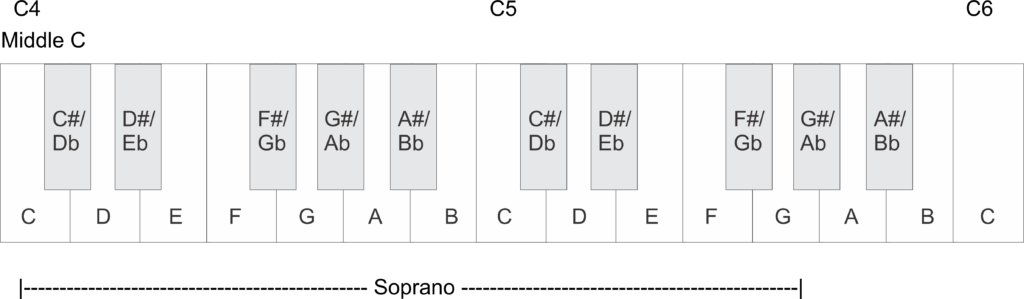
Sopranos: They have a conservative tessitura of C4 to G5. (C4, also called middle C, is the fourth C from the left on the piano.) These women have a higher, lighter tone, even when singing with intensity. They usually take the main melody in showtunes, pop songs, opera, and choral arrangements.

Famous Sopranos:

  • Celine Dion
  • Diana Ross
  • Whitney Houston

Mobile users: for best results reading the examples, tilt your screen 90o to the right.

Soprano Tessitura Chart:

I'm Confused About These Stupid Vocal Ranges - Conservative Vocal Ranges - Soprano

Video: Soprano Celine Dion

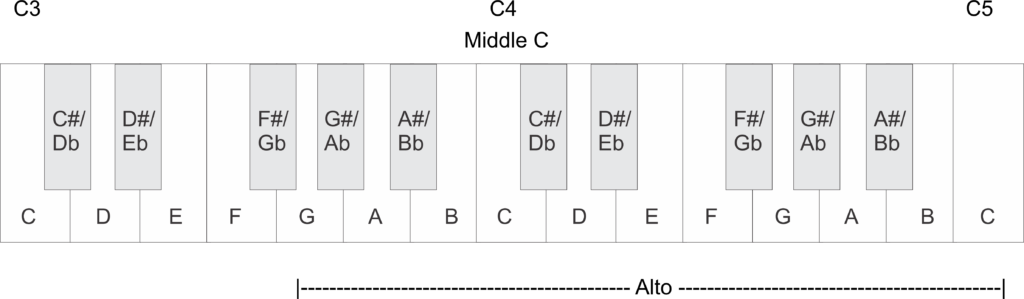
Altos: They have a conservative tessitura of G3 to C5. These women have a warmer tone than sopranos and will often play more of a supporting role in choir and Broadway arrangements.

Famous Altos:

  • Bonnie Raitt
  • Gladys Knight
  • Norah Jones

Alto Tessitura Chart:

I'm Confused About These Stupid Vocal Ranges - Conservative Vocal Ranges - Alto

Video: Alto Norah Jones

Tenors: They have a conservative tessitura of C3 to G4. These men can, at times, have either a bold and bright tone or a light and airy sound. They’ll often take the lead parts in pop/rock groups, musical theatre, and opera.

Famous Tenors:

  • Art Garfunkel
  • Justin Timberlake
  • Luciano Pavarotti

Tenor Tessitura Chart:

I'm Confused About These Stupid Vocal Ranges - Conservative Vocal Ranges - Tenor

Video: Tenor Art Garfunkel

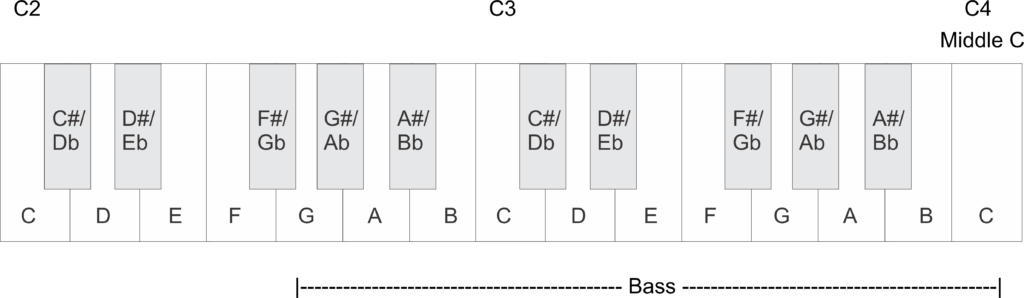
Basses: They have a conservative tessitura of G2 to C4. These men possess a rich, low tone and often supply the bottom end in chorus and other ensembles.

Famous Basses:

  • Barry White
  • Geddy Lee
  • Johnny Cash

Bass Tessitura Chart:

I'm Confused About These Stupid Vocal Ranges - Conservative Vocal Ranges - Bass

Video: Bass Johnny Cash

Final Thoughts

To summarize:

  • We can define vocal range as all the notes that a person can produce, and the tessitura for a singer grouping as being what they can comfortably produce. (Shown on the charts above).
  • The basic groups are soprano, alto, tenor, and bass, which also includes the tone quality of each group as part of the definition. (See the videos for examples of how they sound.)
  • Other subgroupings exist such as: coloratura, lyric soprano, mezzo soprano, contralto, countertenor (i.e., male soprano), and baritone.

Have fun singing!

Related Posts:

© 2024 Geoffrey Keith

Newsletter Signup

Join me for in-person or online lessons today!

Back to the Singing in Tune category blogs page

Back to the Successful Music Student Blogs page

Glossary

Why Does My Guitar Sound Off Tune - Fender Strat - What Are the Best Easy Guitar Chords for Beginners to Learn?

Why Does My Guitar Sound Off Tune?

Have you ever tuned your guitar, using the frets or an electronic tuner, only to find that it still sounds off when you start strumming? Many guitarists have noticed this problem. However, you can learn how to make your guitar sound better! Read more to find out, “Why does my guitar sound off tune?” Estimated reading time 2 minutes.

Read More
Prodigy Meaning (Examples of Special Talent in Music) [Video] - Children Playing Music - Sing the Charming Song London Bridge Is Falling Down

What Does Prodigy Mean and Do They Have Elite Musical Talent?

Do you have a musical prodigy on your hands? Do you need information about how your musical child or student learns? Musical giftedness can emerge as early as one to two years old and usually appears before age six. It’s characterized by a rage to learn. Keep reading “What Does Prodigy Mean and Do They Have Elite Musical Talent?” to get examples of this shocking musical ability. Estimated reading time 5 minutes.

Read More
supplemented equal temperament minor keys - two curved keyboards.jpg

How Supplemented Equal Temperament Minor Keys Work

Frustrated with your out of tune synth chords? Do you want your brass, woodwind, and string programs to sound better? It’s not only the program you select which controls how your synth sounds, the tuning has an impact as well. I created Supplemented Equal Temperament (SET) to produce chords that sound better in tune than equal temperament (the piano’s tuning). Read more to learn how SET minor keys work. Estimated reading time 5 minutes.

Read More
What Should I Look for in a “Piano Teacher Near Me” – Woman at Piano

What Should I Look for in a “Piano Teacher Near Me”?

“What should I look for in a ‘piano teacher near me’?” Most parents start by doing a web search for a “piano teacher near me” or for “piano lessons near me.” But how do you choose a teacher? Piano lessons cost a lot of money, so finding the right teacher is important. Getting it right can mean the difference between getting a good lesson experience and wasting your money. Read more to learn what you should look for in a “piano teacher near me.” Estimated reading time 4 minutes.

Read More