



Success Music Studio

I’m Confused About What Precisely D.S. al Coda Means - Rose and Sheet Music

I’m Confused About What Precisely D.S. al Coda Means

Facebook
Pinterest
LinkedIn

Estimated reading time 2 minutes

Table of Contents

Introduction

“I’m confused about what precisely D.S. al Coda means.” This marking is part of a class of music notation called “signs of repetition.” Some of the more advanced signs of repetition can be confusing, including this one. Keep reading to find out how it works.

singing dotted eighth note rhythm - sheet music pattern - Singing Shape Notes Solfege Ionian Melodies - I’m Confused About What Precisely D.S. al Coda Means

This post contains affiliate links, which means I may receive a small commission from purchases made through the links. I’ll only recommend products I use, use in lessons, or ones my students or colleagues have recommended.

I’m Confused About What Precisely D.S. al Coda Means: Let’s Define It

“I’m confused about what precisely D.S. al Coda means.” D.S. al Coda is used to help musicians move around the score and repeat sections of the sheet music:

  • D.S. is an abbreviation for “dal segno” (SANE-yoe), which means “to the sign” and al coda means “to the final section.”
  • A coda (COE-dah) is a section of the arrangement that concludes the piece of music. For example, in the song Hey Jude, it ends with the “Nah, Nah” section. This section’s purpose is to wind the song down.
  • These ending sections can vary in how complex they are. The one in this song is relatively simple, but Beethoven’s codas were long and complex (e.g., Symphony No. 8).

To see an example showing how D.C. al fine works:

Video: Hey Jude

I’m Confused About What Precisely D.S. al Coda Means: How Does It Work in Sheet Music?

Now let’s look at how you do it in a score.

The Symbols:

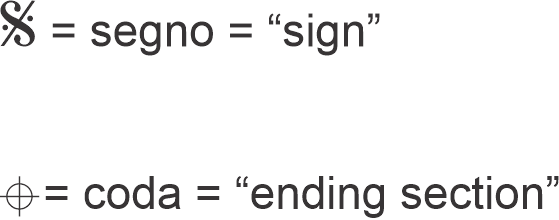
I’m Confused About What Precisely D.S. al Coda Means - Segno and Coda Symbols

How do you interpret D.S. al Coda?

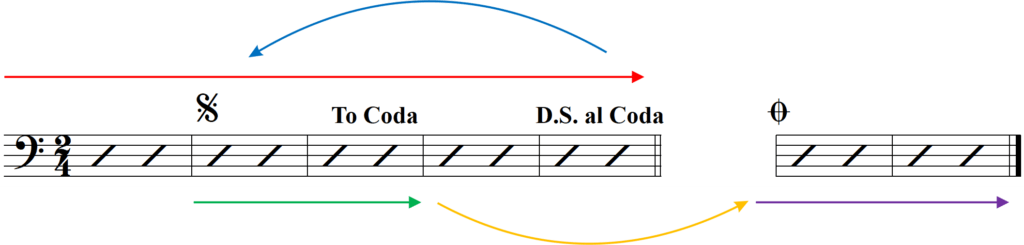
“I’m confused about what precisely D.S. al Coda means.” Let’s look at the music example below:

  1. Start at bar 1 and play through bar 5.
  2. The words “D.S. al Coda” tells you to jump back to the weird, dollar-like sign in bar 2.
  3. Play until you reach the words “to coda” in bar 3. This tells you to jump to the symbol that looks like a hunter’s scope.
  4. Finish by playing to the end.

To help you, I’ve added some color coded arrows:

  • Follow the red arrow first
  • The blue line second
  • Then, the green line third
  • The orange line fourth
  • Finally, follow the purple line to the end

Mobile users: for best results reading the music, rotate your screen 90o to the right.

I’m Confused About What Precisely D.S. al Coda Means - Coda Example
How to Graduate from the Color Coded Sheet Music - Part II - Girl Playing Flute - after they can sight-read what’s left for musicians to learn - What Does it Mean for Me to Interpret a Piece of Music - Music Therapy vs Music Lessons - BPM (Using the Metronome to Get the Music Beat) - What Does Intonation Mean and Why Is It Essential in Music

More Information About Reading Music

Final Thoughts on “I’m Confused About What Precisely D.S. al Coda Means”

What’s the purpose of a D.S. al Coda in the score?

  • Originally, it was to save copying costs, because music was copied by hand and thus was very expensive.
  • Even today, it saves on the cost of paper and ink, saving you money.
  • In addition, it saves you effort, because you won’t need to do as many page turns.

Have fun playing!

Related Posts

© 2024 Geoffrey Keith

Newsletter Signup

Join me for in-person or online lessons today!

Back to the All-Purpose Music Tips and Topics category blogs page

Back to the Successful Music Student Blogs page

Tonic vs. Root in Music Theory: Are They the Same Thing? (Part 2) - Sheet Music and Pencil - How to Graduate from Color Coded Music Symbols - Musical Talent and Giftedness

Tonic vs. Root in Music Theory: Are They the Same Thing? (Part 2)

Are you confused about the difference between the root and the tonic in music theory? Some musicians treat the terms root and tonic as if they were interchangeable. However, they have different, but equally important roles in music theory. Click to learn the difference between the tonic vs. root in music theory. Estimated reading time 3 minutes.

Read More


Enjoy the Charming Hymn What a Friend We Have in Jesus - Jesus

Enjoy the Heavenly Hymn What a Friend We Have in Jesus

Do you want to enjoy the heavenly hymn “What a Friend We Have in Jesus?” In this post, you’ll get three essentials: 1) a sing along video of the song featuring Alan Jackson, 2) the complete lyrics to the hymn, and 3) easy-to-read free sheet music using shape notes including a sing along soundtrack. Keep reading to learn more. Estimated reading time 2 minutes.

Read More

What Are the Advantages of Dyslexia - Episodic Memory (Woman Remembering)

What are the advantages of dyslexia? Episodic Memory

Do you want to know what the advantages of dyslexia are? How can people with dyslexia seem to have terrible memories sometimes, but not others? “He could remember events perfectly, even those that happened when he was an infant” (The Gift of Dyslexia 96). Episodic memory has a central role in the thinking process of many dyslexics which helps explain this puzzling fact. Also, it’s one of the four benefits to dyslexia. Keep reading to learn what the advantages of dyslexia are and how episodic memory plays a part in that. Estimated reading time 3 minutes.

Read More
Color Coded Eighth Note Clapping - Clapping Hands Cartoon - Color Code Rhythm - I’m Having a Hard Time Keeping a Steady Beat - Singing Rhythm - How to Color Code Music to Optimize the Steady Beat - The 5 Best Effortlessly Easy Metronome Practice Tips - How to Teach Music Students with Dyscalculia

Color Coded Eighth Note Clapping

Does reading eighth note rhythm notation give you fits? (Or do your students struggle with eighth notes?) Many musicians have trouble reading rhythm, especially ADD, ASD, LD, and special needs students. Read more to learn color coded eighth note clapping. Estimated reading time 3 minutes.

Read More