

Estimated reading time 3 minutes
Table of Contents
Introduction
Does your child have dyspraxia and wants to learn to play piano? Are you a music teacher of a “clumsy” student? Because dyspraxia affects motor skills, it can have a huge impact on music lessons. However, with the correct teaching strategies, students with dyspraxia can successfully learn to play the piano. Keep reading What Exactly Is Dyspraxia and Its Impact on Learning Piano? to find out what it is and how to deal with it.
This article uses musical terms and other technical words. For definitions, see the Glossary at the end of the post.
What Is Dyspraxia: Understanding Dyspraxia
What is Dyspraxia? Dyspraxia, or Developmental Coordination Disorder (DCD), affects a student’s coordination:
- These students are the type of people who will often be labeled as clumsy or accident prone.
- It can impact music, sports, handwriting, etc.
- Despite this, it does not affect a student’s general intelligence.
In addition, dyspraxia can coincide with ASD, ADHD, and dyslexia.
Ronald Davis, in The Gift of Dyslexia, talks about the relationship between dyspraxia and dyslexia:
All dyslexics will, from time to time, experience some degree of dyspraxia because of disorientations [more on disorientation in the next section].
It shows up as a chronic condition in only 10 to 15 percent of dyslexic children. Like other aspects of dyslexia, it varies in severity. (61)
Dyspraxia’s impact on learning piano can include:
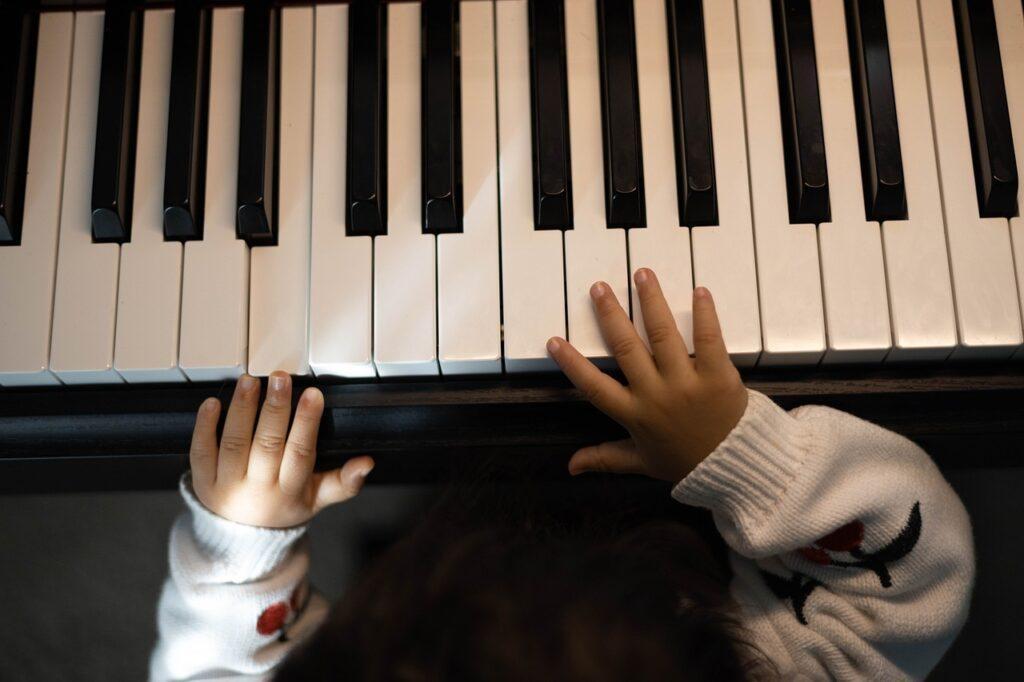
- Problems with fine motor skills such as executing accurate finger movements on the piano keys.
- Challenges with hand-eye coordination, e.g., when students do hands together work.
- Difficulties with posture and balance such as falling off the piano bench (yes, I have seen that happen with students three times in the last year).
What Is Dyspraxia: Understanding Disorientation (Plus Multisensory Resources)
So, what causes dyspraxia? Davis says that:
Dyspraxia has two causes. First, the senses of balance and movement are distorted by disorientation. (The Gift of Dyslexia 59)
“What’s disorientation” you ask? Davis uses the term to describe how people with strong spatial ability can have problems with accurately perceiving their surroundings. He states:
[Disorientation] occurs when we are overwhelmed by stimuli or thought. It also occurs when the brain receives conflicting information from the different senses and attempts to correlate the information. (The Gift of Dyslexia 15)
For more information on disorientation (including visual aids):
Essentially, people with strong visual abilities can see their imaginations as if they were real. This can interfere with reading music notation, fingering, and even correctly seeing the notes on the piano.
So, how do you deal with disorientation?
- Davis has created a simple mental exercise that helps students to clearly perceive their surroundings.
- He calls this mental exercise the Alignment Procedure.
- You can find out how to do the Alignment Procedure in chapter 12 in the book The Gift of Learning.
In addition, color coding the score will help struggling students to learn how to read music notation:
- Playing the Piano with Color Coded Notes
- Kid’s Color Coded Piano Hand Placement
- How Does Your Brain Learn to Play the Piano with Two Hands?
- How to Color Code Music Notes
- How to Color Code Rhythm
This link talks about the science behind color coding:
What Is Dyspraxia: Final Thoughts
Takeaway points:
- Dyspraxia affects a student’s coordination.
- The impact on learning piano can often be seen in fingering, coordinating hands, and the student’s piano posture.
- Multisensory teaching methods combined with Davis’s Alignment Procedure will help these students to effectively learn piano.
Related Posts:
- Lego Rhythm Manipulatives
- How to Color Code Music to Optimize the Steady Beat
- 50 Essential Music Symbols Explained in Less Than 5 Minutes
© 2024 Geoffrey Keith
Join me for in-person or online lessons today!
Glossary
How Long Do You Take to Memorize a Piece of Piano Music?
“How long do you take to memorize a piece of piano music?” It’ll vary from person to person how long it’ll take. I’ve known musicians who can memorize a piece of music after just one listening. For most of my students, it takes a half-dozen to a dozen listenings to just start learning a piece, much less memorize it. This means that for most musicians, memorizing a piece of music will be a process. Keep reading to get tips to help you memorize your music better and more quickly. Estimated reading time 2 minutes.
Read MoreThe Beautiful Silent Night Carol [Videos]
Do you want to sing Silent Night? In this post, you’ll get the essentials: 1) three videos, 2) the full lyrics, and 3) easy-to-read shape note sheet music with a sing along song track. Keep reading The Beautiful Silent Night Carol [Videos] to learn more. Estimated reading time 3 minutes.
Read MoreSuccess Music Studio Blog Anniversary

Find out more about Success Music Studio’s “Successful Music Student” blog and what it covers as you read the blog anniversary article. Click to learn how the Successful Music Student blog helps you grow in your music.
Read MoreHow Chords in Supplemented Equal Temperament Work
Are you frustrated that your synth chords sound out of tune? Supplemented Equal Temperament is designed to play chords that sound more in tune than the regular piano tuning: equal temperament. Learn how to better tune your chords in Supplemented Equal Temperament tuning. Estimated reading time 3 minutes.
Read More