Success Music Studio

How to Sing Key Changes in Tune - Choir - Sight Singing with Solfege - Can Singers Sing in Tune Even if They Do Not Hear Their Voice - Requiem Meaning: Music, Memorial, and Mourning [Video]

How to Sing Key Changes in Tune

Facebook
Twitter

Estimated reading time 4 minutes

Table of Contents

Introduction

Do you find key changes tricky to sing in tune? The sing-along song tracks will help! Read more to learn about how to sing key changes in tune.

  • Performing key changes for vocalists can be difficult, because the ear has to reorient to the new key. The song tracks function as a flight simulator for vocalists. This allows you to have focused, effective practice.
  • When a song moves from one key to another, we call that a modulation. For more info on how key changes work: Changing Keys in Your Songwriting
  • Songs can change keys in different ways. However, one of the most common modulations – pivot modulation – gets used extensively in pop, rock, jazz, and classical. Because of this, today you will sing an example of a commonly used pivot modulation.
  • The sing-along tracks use synth voices rather than actual voices. Science has shown that this helps you, the vocalist, to identify and perform absolute pitch information. For more info, see Why Use a Synth Voice Instead of Real Voices.

This article uses musical terms. For definitions, see the Glossary at the end of the post.

Choir Sound Model:

How to Sing Key Changes in Tune - Vocalist

How to Sing Key Changes in Tune: The Basics of Singing (Review)

Let’s review some basic elements of singing before we start learning how to sing key changes in tune.

See these posts for:

  1. Power in Singing: Sight Singing with Solfege
  2. Vowel Production: Singing Lips Vowels
  3. A Free and Open Tone: Ear Training Exercises for Harmonizing in Tune
  4. Breath Phrasing: Shape Note Singing Lesson

For more tips:

Begin by practicing with the synth voice parts using the vowel ah. When you’ve got that down, practice the tracks with the other vowels: ay, oh, ee, and oo one by one.

Sopranos and kids will go an octave higher when practicing with the soundtracks. After you’ve gotten each part solid, practice the example to the solo organ soundtrack.

Takes breaths before each change of pitch even though there is no break in the synth parts. You don’t want to run out of air as this will make your note sink, making you go out of tune.

The Vocal Parts for Singing Key Changes in Tune

The song tracks below act as harmonic sound models that show how to sing key changes in tune. That is, the specially tuned sing-along tracks train your ear to recognize how modulations should sound.

  1. The first track shows the soprano accompanied by the organ. Practice the track with the ah vowel. When tuning up chords, listen to how the tone color of your voice mixes with the synth parts.
  2. Listen for:
  3. Don’t use vibrato when performing the examples, especially when practicing the parts with the organ.
  4. Each part has a small range, so each voice type (soprano, alto, tenor, and bass) can sing more than one part.
  5. Once you’ve gotten comfortable with a part, try practicing it with the solo organ track. After that, try singing with the choir track in the next section.
  6. For a review of shape notes: Shape Note Sight Singing Success

Mobile users: for best results reading the music, tilt your screen 90o to the right.

How to Sing Key Changes in Tune - Soprano line 1
How to Sing Key Changes in Tune - Soprano line 2

Soprano:

How to Sing Key Changes in Tune - Alto line 1
How to Sing Key Changes in Tune - Alto line 2

Alto:

How to Sing Key Changes in Tune - Tenor line 1
How to Sing Key Changes in Tune - Tenor line 2

Tenor:

How to Sing Key Changes in Tune - Bass line 1
How to Sing Key Changes in Tune - Bass line 2

Bass:

Solo Organ:

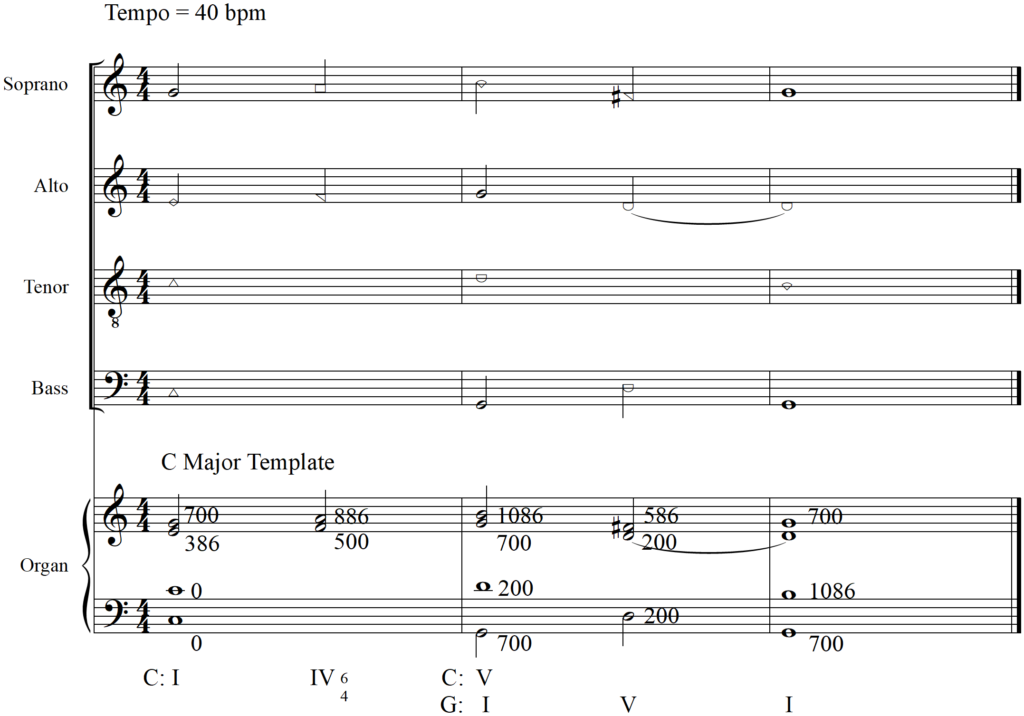
The Ensemble Score for Singing Key Changes in Tune

How to Sing Key Changes in Tune - SATB - Choir Meaning & Examples with Videos, Pictures, & Soundtracks

The ensemble track for How to Sing Key Changes in Tune:

How to Sing Key Changes in Tune - SATB Score

Concluding Thoughts for Singing Key Changes in Tune

The above examples show you how well-tuned chords should sound when singing key changes in tune. Develop your listening skills, and you’re halfway there.

Practice daily with the soundtracks. This will help train your brain’s mental pitch template, allowing you to sing better in tune. Have fun!

© 2022 Geoffrey Keith

Newsletter Signup

Join me for in-person or online lessons today!

Back to the Singing in Tune category blogs page

Back to the Successful Music Student Blogs page

Glossary

What is Required of Me to Write a Good Song if I Have no Experience with Songwriting - Girl Playing Guitar on Beach - Positives to Dyslexia - Everything is Connected to Everything - How to Write a Song with a Catchy Chorus (Including Lyrics)

What is Required of Me to Write a Good Song if I Have No Experience with Songwriting?

Do you want to write songs, but don’t know where to start? To write a song, you need both imagination and the skill to put your imagination to work. If you see pictures in the clouds and have words and melodies pop into your head, songwriting will be well suited to your abilities. Click to answer the question, “What is required of me to write a good song if I have no experience with songwriting?” Estimated reading time 3 minutes.

Read More
Singing Shape Note Solfege Phrygian Melodies - Chant Manuscript - Discover Early Music Via Beautiful Medieval Gregorian Chants

Discover Early Music Via Beautiful Medieval Gregorian Chants

Do you want to know more about medieval chant? Gregorian chants are essentially medieval church songs that have a mysterious yet serene quality to them. Also, they played a pivotal role in developing modern musical notation. Keep reading to discover early music via beautiful medieval Gregorian chants. Estimated reading time 2 minutes.

Read More

How to Graduate from Color Coded Music Symbols - Certificate of Graduation

How to Graduate from Color Coded Music Symbols – Part 5

“How do I finally get my students to be able to read music without color coding?” In today’s post, we’ll look at the last stage of graduating from the colors: flashcards. Keeping reading to learn how to graduate from color coded music symbols. Estimated reading time 3 minutes.

Read More