


Success Music Studio

How to Play Wheels on the Bus Easy Piano - School Bus

How to Play Wheels on the Bus – Easy Piano

Facebook
Pinterest
LinkedIn

Estimated reading time 3 minutes

Table of Contents

Introduction

Are you new to playing piano? Do you want (or do you want your child) to learn an easy version of the song? Written in 1939, The Wheels on the Bus is a beloved children’s standard that’s had popular staying power. Keep reading to learn how to play The Wheels on the Bus – easy piano version.

Why Doesnt My Hands-Separate Piano Practice Help with Hands-Together Playing - Grand Piano - Help Me! How Do I Improve My Touch on Piano?

This post contains affiliate links, which means I may receive a small commission from purchases made through the links. I’ll only recommend products I use, use in lessons, or ones my students or colleagues have recommended.

How to Play The Wheels on the Bus – Easy Piano Version: The Video

To help you, I’ve included a play-along video.

  • When you watch the video, you’ll notice that colored shapes descend from the top of the screen down to the bottom where the video keyboard sits.
  • This’ll help you anticipate when to play the notes.
  • If the shape is longer, you’ll hold the notes for longer and vice versa.
  • Notice that the colored shapes have note labels on them. This’ll help you learn the names of the piano keys.
  • Click on the gear icon (settings) to change the playback speed if you need to follow along with the video at a slower tempo.

If you already know how to read music because you play another instrument, this easy sheet music book will help you learn the song.

How to Play The Wheels on the Bus – Easy Piano Version: How Do I Play the Rhythm Accurately?

Usually, you’d learn the rhythm from your sheet music.

  • However, if you don’t know how to read music at all, you can grease the wheels (pun intended) by singing the song as you play.
  • If you can sing the words in time, this’ll help you play in time.
  • In fact, many ear-oriented players just follow along with the music playing inside their heads.

Click this link to view The Wheels on the Bus lyrics.

The following posts show you how to count rhythm.

How to Play The Wheels on the Bus – Easy Piano Version: Which Fingers Should I Use?

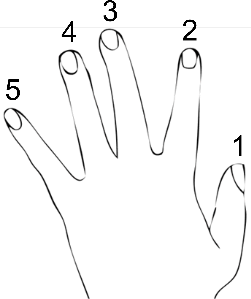
color coding fingers for music - LH piano hand icon with finger numbers
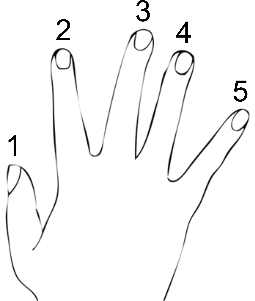
color coding fingers for music - RH piano hand icon with finger numbers

Organizing Your Fingers

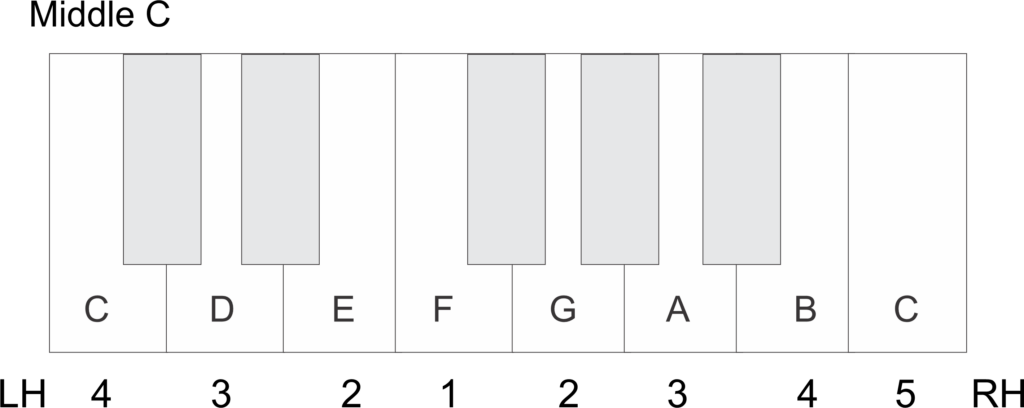
  • The song The Wheels on the Bus spans an octave from C to C.
  • If you place both thumbs on the central F, the other fingers on your right hand (RH) and left hand (LH) will cover the notes you’ll need.
  • See the hand icons above and cross reference them with the piano keyboard diagram below.

Mobile users: for best results reading the example, rotate your screen 90o to the right.

How to Play Wheels on the Bus – Easy Piano - Middle F Position

Fingering on the Right Hand

  • Thumb (#1) on F
  • Pointer (#2) on G
  • Middle (#3) on A
  • Ring (#4) on B
  • Pinky (#5) on C

Fingering on the Left Hand

  • Thumb (#1) on F
  • Pointer (#2) on E
  • Middle (#3) on D
  • Ring (#4) on middle C

Once you get your hands in position, you’re ready to play along with the video.

Video: The Wheels on the Bus

If you’re interested in learning how to play piano, the following links show you the piano books that I use when I teach piano lessons (sorted by age).

Ages 4-6

Ages 5-7

Ages 8-10

Ages 10-12

Teens and Adults

playing the piano with color coded notes - girl playing piano - 12 Easy Piano Songs (Including Twinkle Twinkle Little Star) - How to Play Piano (Kid’s Color Coded Piano Hand Placement) - What Is the Precise Meaning of Scaffolding in Teaching - How to Teach Music Students with Dyscalculia - What’s Pervasive Developmental Disorder and Its Impact on Music?

Final Thoughts

Takeaway points:

  1. In the video, the colored shapes descend from the top of the screen down to the bottom where the video keyboard sits. This will help you anticipate when to play the notes.
  2. If you place both thumbs on the central F, the other fingers on your right hand (RH) and left hand (LH) will cover the notes you’ll need.
  3. Once you’ve got your hands in position, you can play along with the video.

Have fun playing!

Learn the Secret Relationship of Timbre and Harmony - Orchestra - Beethoven (Why Did He Keep Composing After Deafness)

Learn the Secret Relationship of Timbre and Harmony

Have you ever wondered why a chord works with one instrument’s tone color (or a particular timbre of voice) but not another? Do you want to know what to listen for when tuning up your chords? Timbre and harmony are intimately related and understanding that relationship will deepen a composer’s knowledge of music. Also, it’ll help vocals, woodwinds, brass, and violins to know what to listen for when tuning up chords. Keep reading to learn the secret relationship of timbre and harmony. Estimated reading time 3 minutes.

Read More

Singing Rhythmic Syllables in Cut Time - Church Laser Show - Singing Shape Note Solfege Minor Melodies - Singing in Tune with Vowels - Choir Meaning & Examples with Videos, Pictures, & Soundtracks

Singing Rhythm Syllables in Cut Time

Are you confused about how to chant the Kodaly rhythm syllables in cut time? Do you wonder if it’s like chanting 2/4 or 4/4 syllables? Don’t worry, this post has you covered! Read more to learn about singing rhythm syllables in cut time. Estimated reading time 3 minutes.

Read More
hear the notes when harmonizing - harmony and melody tune differently - barbershop quartet - Singing Shape Note Solfege Mixolydian Melodies - Do You Need Help Learning How to Harmonize - Sing Silent Night with Shape Note Solfege - Learn the Secret Relationship of Timbre and Harmony - What Makes a Barbershop Quartet a Special A Cappella Group?

How to Hear the Notes When Harmonizing

Have you ever listened to a chord and couldn’t pick out the notes? Or maybe you’ve tried to hear the inner parts, but couldn’t? If you want to harmonize in tune, you need to be able to hear the parts. Read more to learn how to hear the notes when harmonizing. Estimated reading time 6 minutes.

Read More
The Top 10 Best Captivating Vivaldi Masterpieces - Violin

The Top 10 Best Captivating Vivaldi Masterpieces

Do you want to explore Antonio Vivaldi’s music? Vivaldi (1678 – 1741) is best known for his violin concertos. His music is celebrated for its infectious melodies combined with its impressive technical demands. Keep reading to learn about and listen to the top 10 best captivating Vivaldi masterpieces. Estimated reading time 3 minutes.

Read More