
Success Music Studio

What Makes a Barbershop Quartet a Special A Cappella Group - Barbershop Window

What Makes a Barbershop Quartet a Special A Cappella Group?

Facebook
Twitter

Estimated reading time 2 minutes

Table of Contents

Introduction

“What makes a barbershop quartet a special a cappella group?” It’s more than just the fun and camaraderie of four guys singing together. There are a number of stylistic elements that contribute to this music’s special, distinctive sound. Keep reading to learn more.

This article uses musical terms. For definitions, see the Glossary at the end of the post.

hear the notes when harmonizing - harmony and melody tune differently - barbershop quartet - Singing Shape Note Solfege Mixolydian Melodies - Do You Need Help Learning How to Harmonize - Sing Silent Night with Shape Note Solfege - Learn the Secret Relationship of Timbre and Harmony - What Makes a Barbershop Quartet a Special A Cappella Group?

What Makes a Barbershop Quartet a Special A Cappella Group #1: What Do the Words “A Cappella” and “Barbershop” Mean?

 “What does the word a cappella mean?”

  • These types of singing ensembles perform harmonies without instrumental accompaniment.
  • Singing without instrumental accompaniment allows the vocalists to really tune up their harmonies.
  • This in turn makes their ensemble’s tone sound stronger and more vivid.

Barbershop music constitutes one of many styles you see a cappella groups sing.

Why are they called barbershop quartets?

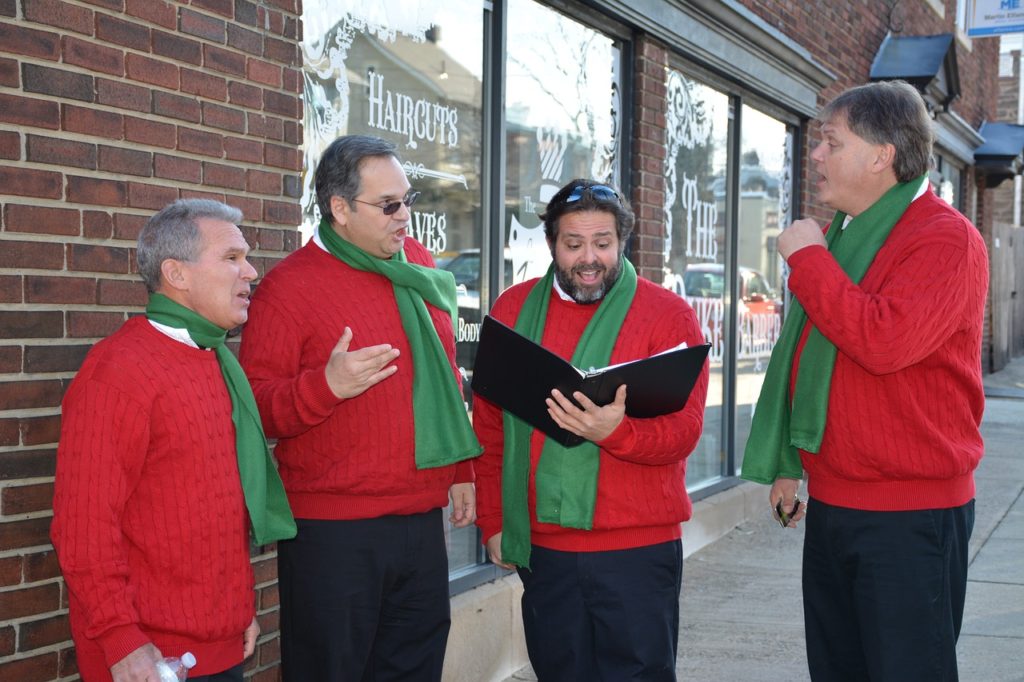
  • As you might guess, they got their start in barbershops.
  • Back in the 1800s, these shops functioned as community centers.
  • Besides getting haircuts, people would play games (i.e., checkers) and sing songs.

Thus, a style of chromatic four-part singing blossomed among these amateur groups.

According to The New Grove Dictionary of Music and Musicians:

The melody is carried by the “lead” (second) tenor, while the first tenor harmonizes above; the bass provides the foundation, and the baritone completes the harmony, frequently crossing above the melody. (2:697

Requiem Meaning - Music, Memorial, and Mourning [Video] - Mozart Choral Music - Perfect Pitch: Discover the Truth [Plus Absolute Pitch Test] - Explore Mozart's Enchanting Music in Less Than Four Minutes - What Makes a Barbershop Quartet a Special A Cappella Group?

What Makes a Barbershop Quartet a Special A Cappella Group #2: Close Harmonies

“What makes a barbershop quartet a special a cappella group?” The New Harvard Dictionary of Music states:

The melody is… harmonized in characteristically “close” part writing… (77)

What does “close part writing” mean? This is when all the voice parts’ intervals are spaced very closely together, contributing to the music’s special, distinctive sound.

How Do I Write a Song That Actually Sounds Good - mic - What Makes a Barbershop Quartet a Special A Cappella Group?

What Makes a Barbershop Quartet a Special A Cappella Group #3: Distinctive Chord Progressions

“What makes a barbershop quartet a special a cappella group?” They have distinctive chord progressions:

…triads and seventh chords predominate, with frequent chromatic passing tones. (77)

What does this mean?

  • The seventh chords help the music to change keys.
  • Likewise, the chromatic passing tones also help with the key changes, making this a very chromatic style of music.
  • In addition, the chromatic passing tones will have melodic implications as well.

What Makes a Barbershop Quartet a Special A Cappella Group #4: Precision Vocal Intonation

“What makes a barbershop quartet a special a cappella group?” Like all a cappella groups, barbershop music focuses on precise vocal intonation:

Performers attempt to cause individual chords to “ring” by singing acoustically pure rather than tempered intervals. (77)

Making the chords “ring” is a combination of the vocalists adjusting their pitch and their vowels coupled with breath control.

For more information on singing in tune and good vowel production:

For more information on just intonation vs equal temperament:

Video: Demo of Barbershop and Other A Cappella Styles

The above video shows several vocal styles with the barbershop music style being demonstrated at the beginning and end of the video.

Final Thoughts on “What Makes a Barbershop Quartet a Special A Cappella Group?”

Takeaway points:

  1. Making the chords “ring” is a combination of the vocalists adjusting their pitch and their vowels coupled with breath control.
  2. Triads and seventh chords predominate with frequent chromatic passing tones.
  3. Close harmony is when all the voice parts are spaced very closely together, contributing to barbershop music’s special, distinctive sound.

Have fun singing!

Related Posts:

© 2024 Geoffrey Keith

Newsletter Signup

Join me for in-person or online lessons today!

Back to the Singing in Tune category blogs page

Back to the Successful Music Student Blogs page

Glossary

How to Sing Elegant Opera Arias - Opera Stage

How to Sing Elegant Opera Arias

Do you want to sing opera arias? Do you need help with your vocal technique and diction? To be an opera singer, you’ll need a blend of talent and technical skill. Click to learn how to sing elegant opera arias. Estimated reading time 4 minutes.

Read More


Shatter the Perfectionism Chains in Music Lessons - Blue Abstract Sheet Music

Shatter the Perfectionism Chains in Music Lessons

Are you a music teacher? Do you have a student who struggles with obsessive perfectionism? While having a high standard is a good thing, obsessive perfectionism can be debilitating. Keep reading to learn how to shatter the perfectionism chains in music lessons. Estimated reading time 3 minutes.

Read More

How to Teach Music Students with Dyscalculia - Numbers

How to Teach Music Students with Dyscalculia

Does your child or student have dyscalculia? Do you need help getting them to play rhythm accurately? Children with dyscalculia have struggles with math, and math and music have a lot in common. So, it makes sense that students with dyscalculia can have problems learning music. However, this post is stuffed with teaching tips that will help students learn. Keep reading “How to Teach Music Students with Dyscalculia” to learn multisensory strategies that will help kids of all abilities have fun playing and singing. Estimated reading time 4 minutes.

Read More