




Estimated reading time 4 minutes
Table of Contents
Introduction
“What advice do you have for a pianist in jazz band?” Piano in middle school and high school jazz band can be challenging. Jazz is chromatic and modulates often. This means that piano teachers will have to have a plan of attack. Keep reading if you need advice for teaching a first year high school jazz pianist.
This post uses musical terms. For definitions, see the Glossary at the end of the article.
Advice for Teaching a First Year High School Jazz Pianist #1: Think Long Term
Need advice for teaching a first year high school jazz pianist? First, think long term. Your student will be in jazz band for years, you can build his (or her) skills up over time.
- Can your student read in multiple keys? Many young pianists can’t.
- If your student can’t read in every key, you’ll need to simplify the score.
- However, you should also work to expand his skill set every semester.
- What you start working on first and how fast you go depends a lot on both the music and the student.
Advice for Teaching a First Year High School Jazz Pianist #2: Comping Chords
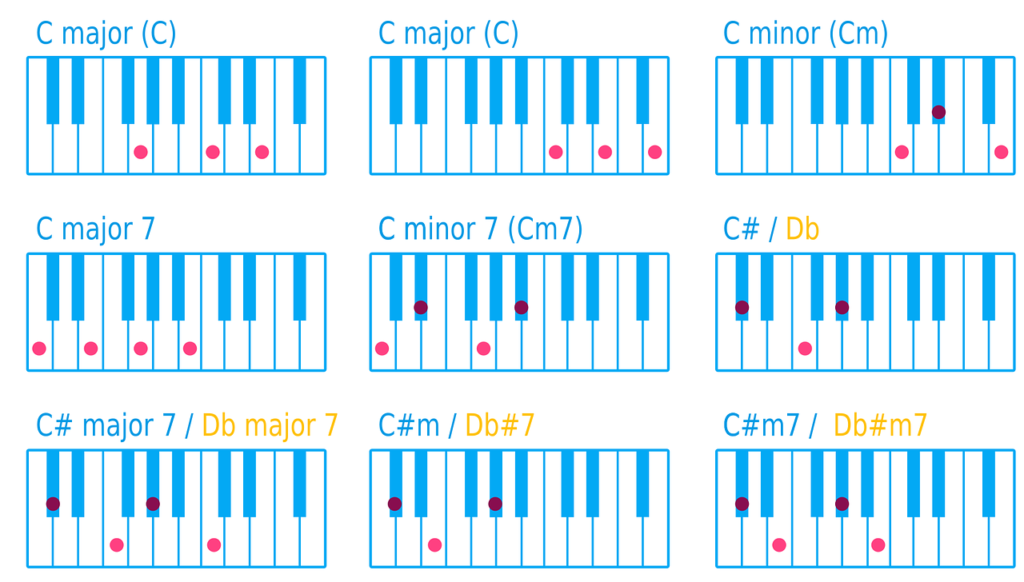
Need advice for teaching a first year high school jazz pianist? Second, if the score has him comping chords, simplify them to triads. Even if there is a part written out, you may want to make a comping arrangement if the original part is too difficult.
You’ll need to teach each chord separately.
- For example, if you have an arrangement around the 12 bar blues in Bb, you’ll need to teach at least the Bb, Eb, and F major triads.
- However, since it’s jazz band, there may be other chromatic passing triads as well.
After you’ve reduced the chords to triads, create voicings that stay, as much as possible, within one hand position.
- Or at least limit the number of hand positions as much as you can.
- The next semester, or even next year, you can start working on seventh chords.
- Extensions (such as nineth, eleventh, and thirteenth chords) will probably have to wait a year or two down the road.
- If there are single note (i.e., melodic) passages, limit them to one hand to begin with. You can work on hands combined playing in later semesters.
When you’ve created your arrangement, print it out and give it to your student. Color coding the music will help your ADHD and dyslexic students. The following link talks about music notation software that can color code the notes for you:
Advice for Teaching a First Year High School Jazz Pianist #3: Make a Recording
Need advice for teaching a first year high school jazz pianist? The third piece of advice is critical:
- Play your arrangement into your phone and send the video to the student to listen to.
- Record it at slow, medium, and fast speeds.
- Your main goal isn’t sight reading but performance, so you’ll use the video to “grease the wheels.”
Advice for Teaching a First Year High School Jazz Pianist #4: Rhythm
Need advice for teaching a first year high school jazz pianist? Fourth, there’s a long tradition in big band jazz of playing steady quarter notes in the rhythm section:
- You may need to do that because you’ll have enough work to do with the chord voicings.
- Plus, your student may need time to adjust to playing swing eighth notes.
- Nevertheless, if he plays swing rhythms for, say, an RH single note passage, you might want to consider color coding the rhythm.
- This will speed up his reaction time, making it easier for him to pick up the rhythm more quickly.
I developed the system of color coded rhythms to help special needs students, but it works well with any student:
Advice for Teaching a First Year High School Jazz Pianist #5: Talk to the Band Director
Need advice for teaching a first year high school jazz pianist? The last piece of advice: make sure the band director is onboard with what you plan to do.
- Get in contact with your student’s jazz band director to get your plan okayed.
- If the jazz band director doesn’t like your plan, see if they have an electronic keyboard.
- Maybe your student can play another part (such as a trombone bassline), using the keyboard’s sounds.
- This is how many of my piano students have played in both concert band and jazz band.
Good luck!
Related Posts
- How to Overcome the Fear of Performing in Front of an Audience
- D’you Want Some Music Tips and Tricks I’ve Learned Over the Years?
- Ways Around the Difficulty of Playing the Piano Due to Short Fingers and Small Hands
© 2023 Geoffrey Keith
Join me for in-person or online lessons today!
Back to the All-Purpose Music Tips and Topics category blogs page
Glossary
How to Sound Like a Pro Disc Jockey (DJ)
Do you want to be a disc jockey? Do you need to know how to get a professional sound? The term disc jockey comes from the early days of radio when on air personalities used to play disc-shaped records. However, it’s come to mean a whole lot more. If you want to be a DJ, you’ll need a pro sound, and to get that you’ll need the right gear. Click to learn how to sound like a pro disc jockey. Estimated reading time 4 minutes.
Read MoreWhat Is the Point of Different Alternate Guitar Tunings?
“What is the point of different alternate guitar tunings?” Alternate tunings change both how the instrument sounds and how it feels as you play it. They say that cloths make the man. Likewise, how the guitar gets tuned can make the guitarist. Read more to find out some of the advantages of alternate tunings. Estimated reading time 3 minutes.
Read MoreJoy to the World – A Heavenly Song of Celebration

Do you want to know the words to Joy to the World? Would you like to learn how to sing or play it? In this post, you’ll get the essentials: 1) all the words to the song, 2) two videos (one for the song itself and one for easy piano), and 3) easy-to-read shape note sheet music with a sing along song track. Keep reading Joy to the World - A Heavenly Song of Celebration to learn more. Estimated reading time 2 minutes.
Read MoreSinging Shape Note Solfege Mixolydian Melodies
Do you want to sing blues, gospel, or even mediaeval melodies? Are you confused about how modes work? Modes have the exotic feel of world music and music from ancient times. "Singing Shape Note Solfege Mixolydian Melodies" helps you discover the sound of the modes. Estimated reading time 4 minutes.
Read More