Success Music Studio

Amnesia, Alzheimer’s, Stroke, and Color Coding Music - Elderly Accordion Player - Perfect Pitch: Discover the Truth [Plus Absolute Pitch Test]

Amnesia, Alzheimer’s, Stroke, and Color Coding Music

Facebook
Twitter

Estimated reading time 4 minutes

Table of Contents

Amnesia, Alzheimer’s, Stroke, and Color Coding Music #1: Color Coding Helps Students Learn

Are you a music teacher who has a student with amnesia, Alzheimer’s, or stroke? All three conditions can have a profound effect on a person’s life. If we do our jobs well, we can help them improve their quality of life. Read more to learn how color coding music can help students with amnesia, Alzheimer’s, and strokes.

This article uses musical terms. For definitions, see the Glossary at the end of the post.

Amnesia, Alzheimer’s, Stroke, and Color Coding Music - Piano Art - BPM (Using the Metronome to Get the Music Beat)

Amnesia, Alzheimer’s, Stroke, and Color Coding Music #2: Specializing in Special Needs

I specialize in special needs students (as in 8,000 hours’ worth of experience). I’ve adapted a lot of music for students with dyslexia, ADHD, and autism, including students with low expressive language.

For these students, color coding had been my go-to strategy. For information on the science behind color coded music:

Occasionally, I get students who have other issues, such as:

  • Agenesis of the corpus callosum
  • Amnesia
  • Down syndrome
  • Microcephaly
  • Mitochondrial myopathy
  • Stroke
  • Twice exceptional

Color coding has been effective for these students as well.

  • Therefore, in this post I’ll do a couple of “case studies” showing how color coding has helped with both amnesia and stroke students.
  • How does color coding help? It makes it easier to interact with the score.
  • This in turn will help students retain as much quality of life through music as possible.

Read the next section for information about amnesia and Alzheimer’s students.


Mobile users: for best results reading the examples, tilt your screen 90o to the right.

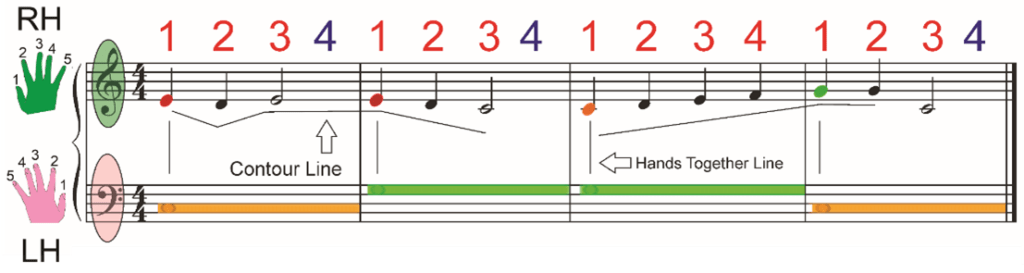
Color Coding Hand Icons for Music - score - Amnesia, Alzheimer’s, Stroke, and Color Coding Music

Amnesia, Alzheimer’s, Stroke, and Color Coding Music #3: the Amnesia Case Study

Full disclosure time, I haven’t had an Alzheimer’s student yet. However, since memory difficulties are a feature of both amnesia and Alzheimer’s, this information will most likely be relevant for teachers of Alzheimer’s students.

I had a piano student with recuring amnesia.

  • She’d been in a car accident and had significant brain damage. This meant that she would literally forget everything we had worked on from the week before.
  • In fact, she would forget who I was. If I acted as if I knew her, this would upset her. So, I had to introduce myself like it was the first lesson each and every week.
  • Music lessons are based on the idea of learning something one week and building upon it the next week. With this student that wasn’t possible.

I quickly realized that the goal of teaching her un-adapted standard notation was out of reach.

  • This meant I needed to color code the notes and rhythms in the score.
  • In addition, I color coded the instrument and her fingers.
  • Each week I’d quickly teach her how the color coding worked, and then I’d teach her a new song. Her parents were there to observe so they could support her during practice at home.

Here are the teaching strategies:

Keep reading for the stroke case study.

Amnesia, Alzheimer’s, Stroke, and Color Coding Music - Pianist - Shatter the Perfectionism Chains in Music Lessons - Making Sense of Why Treble and Bass Clef Are So Different

Amnesia, Alzheimer’s, Stroke, and Color Coding Music #4: the Stroke Case Study

Another student was a guitarist who’d had a stroke.

  • Unlike the amnesia student, he didn’t have issues with his memory.
  • However, the stroke had paralyzed his left hand, so that he only had one hand he could play with.
  • This meant I needed to work out how to teach a guitarist to play one-handed.

I tried a few things to figure out how to teach a one-handed guitarist:

  1. I tried putting a Chord Buddy on his guitar, but he didn’t have enough hand strength or coordination to press the buttons.
  2. I hoped to have him be able to use his left arm enough to play with a slide. However, he hadn’t retained enough control to make that work either.
  3. Finally, I had him play the slide with his right hand, which I put on his thumb. Then, he’d alternately pluck the strings using his index and middle fingers like on bass guitar, which he used to play. This worked.

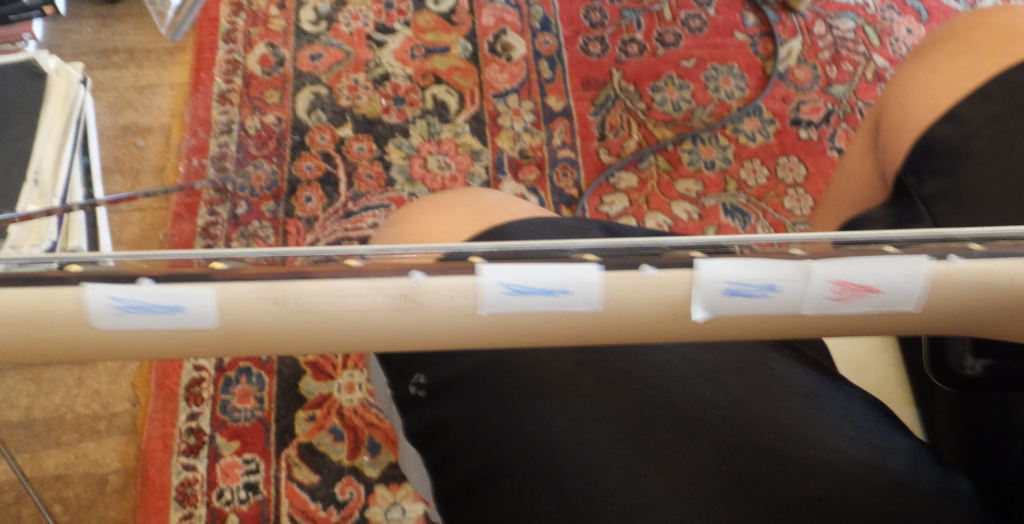
Then, because he had cognitive issues from the stroke, I color coded the chords in his music and the frets on his instrument. Here are the teaching strategies:

How to Color Code Guitar Tab to Empower LD Achievement - Color Coded Fret Example - Amnesia, Alzheimer’s, Stroke, and Color Coding Music

Amnesia, Alzheimer’s, Stroke, and Color Coding Music #5: Final Thoughts

Here’s a summary of Amnesia, Alzheimer’s, Stroke, and Color Coding Music.

  1. Even though both students had physical and cognitive complications, color coding helped them each to learn music in their own way.
  2. I found the strategies that worked best were the ones that worked with the skills the musicians already had before their health problems occurred. For example, both the amnesia and stroke students had muscle memory from prior music lessons that lent to learning in specific ways.
  3. Patience and compassion will be two of your greatest assets in a situation like this. If you stick with it, you can make a real difference in your student’s life.

Related Posts:

© 2024 Geoffrey Keith

Newsletter Signup

Join me for in-person or online lessons today!

Back to the Color Coding category blogs page

Back to the Successful Music Student blogs page

Glossary

How to Effectively Use Music Theory to Transpose Music - Sheet Music

How to Effectively Use Music Theory to Transpose Music

Want to know what the word transpose means in music? Do you need to know how to change the key of a song? There are a bunch of reasons you might need to change the music’s key: 1) it’s the wrong range for your voice, 2) you need to make it fit your instrument’s range, 3) or you may play a transposing instrument (such as Bb trumpet) but need to read some music written at concert pitch. Keep reading “How to Effectively Use Music Theory to Transpose Music” to learn how to do it. Estimated reading time 4 minutes.

Read More
What Exactly Is Attenuation for Home Recording Studios - Sound Studio

What Exactly Is Attenuation for Home Recording Studios

Do you want to know what the word attenuation means? Do you need to know what the attenuation control on your soundboard does? If you want the songs and demos you produce in your home recording studio to sound good, you need to understand how your gear works. This includes volume-related equipment such as limiters, compressors, and your soundboard’s various gain and attenuation controls. Keep reading “What Exactly Is Attenuation for Home Recording Studios” to find out what attenuation is and how it works in sound recording. Estimated reading time 4 minutes.

Read More
Active Versus Passive Voice How to Write Them - Man Typing on Phone

Active Versus Passive Voice: How to Write Them

Are you confused about what’s the difference between active and passive voice? Do you need help writing them? You need to understand their advantages and disadvantages if you want your prose, poems, and songs to sound tight and be easy to listen to and read. Click “Active Versus Passive Voice: How to Write Them” to learn what they are and how they work. Estimated reading time 3 minutes.

Read More

50 Essential Music Symbols Explained in Less Than 5 Minutes - Sheet Music and Rose

50 Essential Music Symbols Explained in Less Than 5 Minutes

Do you get confused when you look at sheet music? Do you want to know what the music symbols mean? The visual-score-guides paired with quick explanations will help you understand the music notation. Keep reading “50 Essential Music Symbols Explained in Less Than 5 Minutes” to find the symbols listed by notation category. Estimated reading time 4 minutes.

Read More