



Estimated reading time 3 minutes
Table of Contents
Introduction
“What do you think of the Chord Buddy for special needs guitarists?” I first heard about using the Chord Buddy for special needs students from Sarah Fard at the 2019 Able Assembly. However, I’ve found it works better for some students than for others. Read more to find out who benefits.
Before we go any further, I need to mention that I didn’t receive any compensation to write this post. It contains my unpaid observations.
This article uses musical terms. For definitions, see the Glossary at the end of the post.
What Do You Think of the Chord Buddy for Special Needs Guitarists #1: How It’s Designed
“What do you think of the Chord Buddy for special needs guitarists?” Before we discuss special needs students let’s talk typical learners.
How it’s supposed to work:
- The Chord Buddy was designed as an educational device to help beginners learn the G, C, D, and E minor chords.
- It has a framework of plastic tabs with buttons that you attach to the guitar neck.
- The buttons have been color coded and work with the color coded songbook that comes with the Chord Buddy.
- This allows the beginner to focus on strum patterns before worrying about left hand chord fingering.
- Eventually, the students will remove the tabs, one at a time, so that they can learn how to finger the chords.
- Chord Buddy’s introductory video shows you how this process works.
Video: How the Chord Buddy Works
What Do You Think of the Chord Buddy for Special Needs Guitarists #2: Special Needs Student Success
“What do you think of the Chord Buddy for special needs guitarists?” Because the Chord Buddy has been color coded, it generally works well for special needs students.
How do you use it with special needs students?
- Special needs students can improvise using the Chord Buddy. This allows for self-expression and supported creativity.
- Students can strum a steady quarter note pattern and follow along with the color coded chord symbols while someone sings the melody. This can be a fun bonding time for the guitarist and singer.
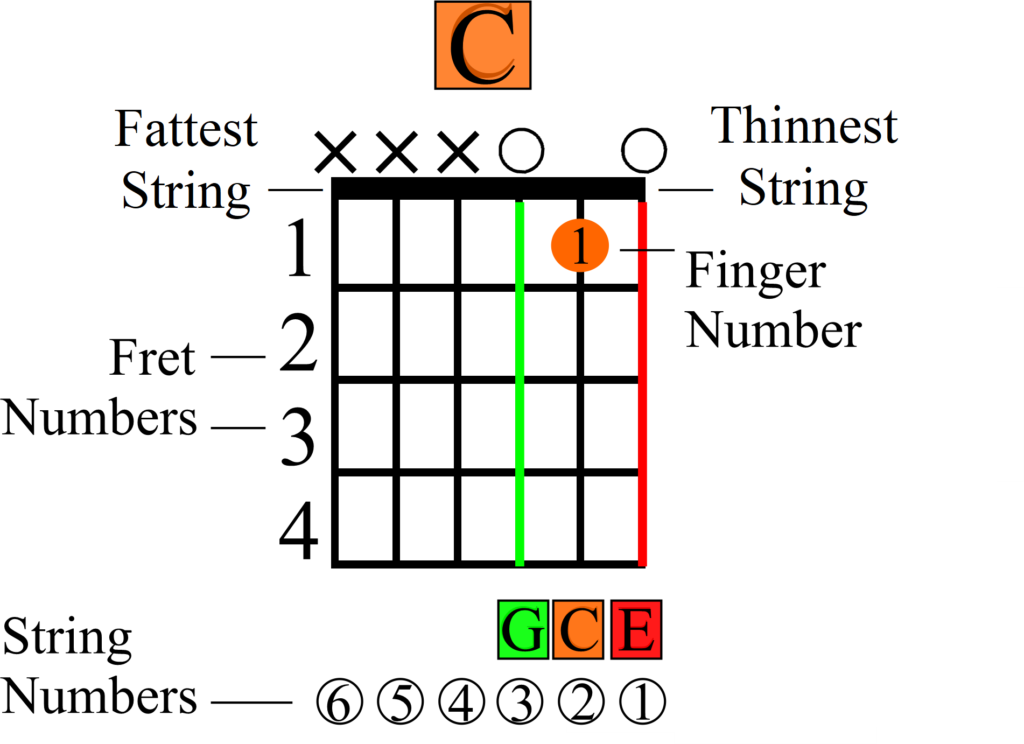
- Some students won’t progress beyond this point. However, if the student seems ready, you can color code the chord frames to help the student learn chords without the aid of the Chord Buddy. Using this method helps students learn chords beyond the four that the Chord Buddy teaches.
How to color code guitar chord frames:
What Do You Think of the Chord Buddy for Special Needs Guitarists #3: Issues with the Chord Buddy
“What do you think of the Chord Buddy for special needs guitarists?” The Chord Buddy does come with some drawbacks:
- First the obvious one, the Chord Buddy only has four chords. However, these four chords unlock the ability to accompany lots of songs, and many special needs students will eventually graduate from the Chord Buddy anyway.
- The songbook doesn’t teach the strum patterns or how to read rhythm. However, both can be color coded by the teacher.
- Pressing down the Chord Buddy’s buttons takes some hand strength if fitted to an acoustic guitar. This makes it a poor fit for young students and students with hypotonia. Fitting it to an electric guitar may help, but it depends on the guitar’s action and string gauge. This is a problem you may not be able to work around.
Learn how to color code rhythm and strum patterns:
Summary of “What Do You Think of the Chord Buddy for Special Needs Guitarists?”
Here’s some final thoughts on, “What do you think of the Chord Buddy for special needs guitarists?”
- The Chord Buddy will be a good option for many special needs students.
- Why? Because the color coded buttons and score work well with the students’ learning style.
- Additional color coding will be necessary for strumming and reading rhythms.
- The Chord Buddy won’t be a good option for people with low hand strength.
While the Chord Buddy won’t work for everyone, it provides an option that will be worth checking out.
Related Posts
- How to Color Code Music Notes for LD & Special Needs Distance Learning
- How to Color Code Guitar Tab for LD Achievement
- Color Coded Eighth Note Clapping
- Color Coded Quarter Rest Clapping
© 2023 Geoffrey Keith
Join me for in-person or online lessons today!
Glossary
What Does the Exotic Sounding Word Bravo Mean at a Concert?
Do you wonder what the word bravo means? You can sometimes hear it shouted at classical music concerts. Keep reading “What Does the Exotic Sounding Word Bravo Mean at a Concert?” to learn classical concert etiquette. Estimated reading time 2 minutes.
Read MoreHarmony Singing Examples for Children

Don’t you think kids need to develop harmonizing skills too? Yes! Does "Harmony Singing Examples for Children" have to be limited to children only? No! However, children especially need good harmonic sound models to train their ears to hear how well-tuned harmony should sound. The post’s sound tracks contain specially tuned sing-along songs that balance harmonic and melodic tuning. Thus, they help develop a cappella level intonation. Estimated reading time 2 minutes.
Read MoreHow to Write Songs About Friendship
Do you want to write heartfelt songs about friendship? Do you need tips on how to write your lyrics? Songs about friendship can be deeply moving, nostalgic, or even lighthearted and fun, giving you free reign to explore the full emotional songwriting pallet. Click to learn how to write songs about friendship. Estimated reading time 3 minutes.
Read MoreHow to Color Code Music to Get LD Students to Perform Accurate Alternate Picking
Even among typical learners, students find alternate picking and strumming challenging. It is one of the few color-coding strategies I use with every student. Using color-coded arrows as a guide to alternate picking effectively shows students how to accurately execute the picking patterns. Estimated reading time 2 minutes.
Read More