


Success Music Studio

Tonic vs. Root in Music Theory: Are They the Same Thing? (Part 2) - Sheet Music and Pencil - How to Graduate from Color Coded Music Symbols - Musical Talent and Giftedness

Tonic vs. Root in Music Theory: Are They the Same Thing? (Part 2)

Facebook
Twitter

Estimated reading time 3 minutes

Table of Contents

Introduction

Are you confused about the difference between the root and the tonic in music theory? Some musicians treat the terms root and tonic as if they were interchangeable. However, they have different, but equally important roles in music theory. Keep reading to learn the difference between the tonic vs. root in music theory.

For a review of Roman numeral analysis:

This article uses musical terms. For definitions, see the Glossary at the end of the post.

Do You Want Cool Chords for Your Song - Sheet Music with Chords - after they can sight-read what’s left for musicians to learn - Can I Become a Music Teacher if I Have Special Needs - Need Advice for Teaching a First Year High School Jazz Pianist - Tonic vs. Root in Music Theory - What Exactly Does I7-vi7-V7, I-iii-IV-I, and IV-V-I-V Mean - Chord Progression (Including the 12 Bar Blues) - What Is the Precise Meaning of Scaffolding in Teaching - An Easy How to Guide to Understanding Triads - Why Is EADGBE the Unquestioned Standard Guitar Tuning?

Tonic vs. Root in Music Theory #1: Scale Degrees and Root Note Defined

Mobile users: for best results reading the examples, tilt your screen 90o to the right.

Can Someone Explain Roman Numeral Analysis in Layman's Terms for Me - Triads Key of C - Tonic vs. Root in Music Theory - The C Major Scale (Including the C Major Chord Scale) - Whats the Secret of Practicing Arpeggios

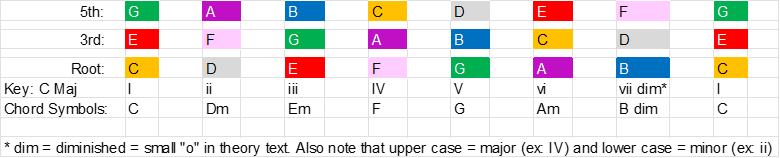
Diatonic Chords in C Major:

Before we talk about the tonic vs. the root in music theory, we need to discuss the names for the scale degrees and define the word “root.”

We call the notes in a scale the scale degrees. Each scale degree gets named and numbered. For instance, in C major we have:

  • Tonic = 1st scale degree = C (tonic = root of I chord)
  • Supertonic = 2nd scale degree = D (supertonic = root of ii chord)
  • Mediant = 3rd scale degree = E (mediant = root of iii chord)
  • Subdominant = 4th scale degree = F (subdominant = root of IV chord)
  • Dominant = 5th scale degree = G (dominant = root of V chord)
  • Submediant = 6th scale degree = A (submediant = root of vi chord)
  • Leading tone = 7th scale degree = B (leading tone = root of viio chord)

The root note will provide the letter that names the chord. Thus, the note C will be the root of the C major chord.

Tonic vs. Root in Music Theory #2: Why Did They Choose These Names for the Scale Degrees?

Why did they use names like tonic or dominant vs. root in music theory for the scale degrees? The names for the scale degrees describe either their position or their function within the scale.

  • Tonic: We call the first scale degree the tonic, because the I chord acts as our relaxing “home” chord.
  • Dominant: We call the fifth scale degree the dominant because the V chord strongly leads back to the tonic chord. So, it “dominates” the chord progression.
  • Subdominant: The dominant sits five notes above the tonic. Likewise, the subdominant sits five notes below the tonic. Thus, the subdominant is the dominant below.
  • Mediant: The word mediant means “middle.” Therefore, the mediant is the “middle note” between the tonic and dominant.
  • Submediant: Just as the subdominant is the dominant below the tonic, so the submediant is the mediant below the tonic.
  • Leading Tone: The leading tone strongly leads up to the tonic.
  • Supertonic: Just as superman is above your average man, so the supertonic sits above the tonic note.

The Roman Numeral Analysis Centurion

Can Someone Explain Roman Numeral Analysis in Layman's Terms for Me - Lego Roman - Tonic vs. Root in Music Theory - What’s the Deal with These i-VII-VI-V and iv-V-VII Chords and Stuff

Tonic vs. Root in Music Theory #3: How Do We Use Scale Degree Names vs. Root Note Names?

To understand the difference between the tonic and root in music theory, you must understand how the role of the scale degree names differs from the role of root notes.

The name root describes a note’s position within a chord.

  • If you look at the chart above, we have one chord built on each note of the scale.
  • The lowest note of each chord on the chart we call the root of that chord.
  • In any key, we have seven roots, one for each chord.
  • However, in each key, you’ll only have one tonic note.

Why do they give the scale degrees names?

  • It allows you to abstract from the specific notes of a key and talk about the larger patterns… sort of like in math. (4 apples + 3 oranges = 7 pieces of fruit vs. a + b = c)
  • For example, in the keys D and A major, the tonic notes will be different (D vs. A). However, they’ll still behave like the tonic regardless of the key.
  • So, the scale degree names allow us to talk about how the notes of the major scale behave in any key.

Plus, you can track notes in chords and chord progressions with them. For example, the tonic note will be the root of the I chord, the fifth of the IV chord, and the third of the vi chord.

So, in each key you have seven roots, but only one tonic, because they have different roles in analyzing music.

Related posts:

© 2023 Geoffrey Keith

Newsletter Signup

Join me for online or in-person lessons today!

Back to The Craft of Songwriting Category Blogs page

Back to the Successful Music Student Blogs page

Glossary

How to Record a Professional Quality Podcast - Podcasters

How to Record a Professional Quality Podcast

Do you want to start your own podcast? Do you need to know what stuff to get and how to use it? Podcasting is hot right now. I mean, I recently walked into Target, and they had podcasting pro audio gear on display – in Target! That means there are lots of people out there who want to share their views with the world. If you’re one of them, click “How to Record a Professional Quality Podcast” to learn how to get a professional sound. Estimated reading time 5 minutes.

Read More

What Does Decibel Mean (In Less than 3 Minutes) - Audio Meter

What Does Decibel Mean? (In Less than 3 Minutes)

Do you need to know what the word decibel (dB) means? Do you want a decibel chart so that you can know what noise levels are safe? Decibels are used in sound recording, radio, and live concert reinforcement. Keep reading “What Does Decibel Mean? (In Less than 3 Minutes)” to learn what it is and how it works. Estimated reading time 2 minutes.

Read More

What Common Mistakes Do People Make When Tuning Their Guitars - Tuning Without Fret References - Yes it is Possible to Tune a Guitar Perfectly - What Is the Point of Different Alternate Guitar Tunings - Guitar Tuner Online (Standard Guitar Tuning) - Why Is EADGBE the Unquestioned Standard Guitar Tuning?

Yes, it is Possible to Tune a Guitar Perfectly

“Why does my guitar sound out of tune even after I’ve tuned it? Is it possible to tune a guitar perfectly?” Yes, it is possible to tune a guitar perfectly, and it’ll give your sound a boost! Click to find out how it works. Estimated reading time 3 minutes.

Read More

shape note sight singing - Is There a Better Way to Learn Sight Singing - chorus - Is Singing Solfege Helpful for Learning to Hear Intervals by Ear - Singing Shape Notes Solfege Lydian Melodies

Shape Note Sight Singing Success

Have you always wanted to sight sing music, but found it too hard? Shape notes can help. Also, last post centered on singing melodies with a specially tuned synth-organ sound. Namely, we focused on harmonic tuning. This week we will look at the same melodies, but from the angle of melodic tuning. Most of the examples have sing-along sound tracks, but the last example is a shape note sight singing quiz. Read more to experience shape note sight singing success. Estimated reading time 6 minutes.

Read More