




Success Music Studio

Do visual spatial thinkers and other neurodivergent musicians need to have sheet music tailored to how they learn - The Successful Music Student Celebrates 100 Blog Posts - color coded quarter rest clapping - Best Music Program for Three-Year-Olds

Do visual spatial thinkers and other neurodivergent musicians need to have sheet music tailored to how they learn?

Facebook
Twitter

Estimated reading time 3 minutes

Table of Contents

Introduction

Do visual spatial thinkers (and other neurodivergent) musicians need to have sheet music tailored to how they learn? Neurodivergent musicians learn in fundamentally different ways from typical leaners. This means that students with learning differences (LD) can greatly benefit from adapted scores. Read more to find out how it works.

This post uses some technical and musical terms. See the Glossary below for definitions.

How to Color Code Music Notes for LD Students - Note Collage - Need Advice for Teaching a First Year High School Jazz Pianist - How Do I Make ANY Progress and Have Fun in Music Lessons Again

Answering the Question, “Do Visual Spatial Thinkers and Other Neurodivergent Musicians Need to Have Sheet Music Tailored to How They Learn?”

Mobile users: tilt your phones 90o to the right to better read the music.

How to Graduate from Color Coded Notes - Part I - Grand Staff - Accurately Reading Musical Notes and the Colors of a Rainbow

Visual spatial thinkers and other neurodivergent musicians do need to have sheet music tailored to how they learn. This is because the notation itself can be an issue. Siu-Lan Tan studied how non-musicians perceived the score and discovered that they found it to be counter intuitive.

In other words, almost everyone found standard notation to be confusing. If you factor in learning issues, things get even more confusing.

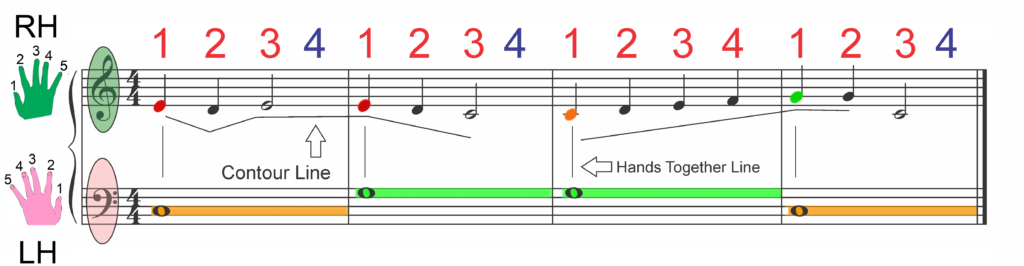
What’s the solution? Answer: we adapt the score. For instrumentalists, I suggest you color code the music. For vocalists, I recommend your use shape notes.

Adapted scores have been proven to be effective for helping students with LD read music. George L. Rogers found that musicians overwhelmingly preferred reading a color coded score. This was especially true for LD and special needs students. With color they read as well as typical learners. Without it, they couldn’t read at all.

Likewise, George H. Kyme found vocalists sight sang more effectively with shape notes than with standard notation.

These two studies show that visual spatial thinkers and other neurodivergent musicians need to have sheet music tailored to how they learn. For more information on the studies read:

How exactly does the adapted score work? I’ll give you the resource links for that in the next section.

Sight Singing with Solfege - Merrily We Roll Along in C Major

How Do Visual Spatial Thinkers and Other Neurodivergent Musicians Need to Have Sheet Music Tailored to How They Learn?

Teaching how to adapt the score is beyond the scope of this post. So, for examples of color coding for instrumentalists, click on the following links:

For examples of shape notes and Kodaly rhythm syllables for vocalists read:

shape note sight singing - Is There a Better Way to Learn Sight Singing - chorus - Is Singing Solfege Helpful for Learning to Hear Intervals by Ear - Singing Shape Notes Solfege Lydian Melodies

Video: How Effective is the Color Coding

Concluding Thoughts to “Do Visual Spatial Thinkers and Other Neurodivergent Musicians Need to Have Sheet Music Tailored to How They Learn?”

Why do visual spatial thinkers and other neurodivergent musicians need to have sheet music tailored to how they learn? Visual spatial learners need information to be presented visually and concretely. Both the color coding and shape note multisensory strategies play into this strength that LD students have.

Even for students who don’t possess strong visual spatial abilities, both color coding and shape notes have been scientifically proven to be effective. Really, the approach will help any beginning musician, but especially LD, ADD, ASD, and other special needs students.

© 2022 Geoffrey Keith

Newsletter Signup

Join me for in-person or online lessons today!

Back to the Color Coding category blogs page

Back to the Successful Music Student blogs page

Glossary

Piano Major Scales (Basic Fingering Concepts) - Woman at Piano

Piano Major Scales (Basic Fingering Concepts)

Do you want to understand piano scale fingering concepts better? At their core, all piano scales are based upon a central concept that helps simplify the fingering. Keep reading for piano major scales - basic fingering concepts. Estimated reading time 2 minutes.

Read More
Is Just Intonation Impractical - Tuning the Grand Piano - What’s the Difference Between Just Intonation and Equal Temperament

Is Just Intonation Impractical?

Are you thinking about composing in just intonation? Do you worry that just intonation is impractical? As with any tuning system, just intonation has its strengths and weaknesses. We’ll look at the pros and cons, and when you’ve gone through the post, you can make up your own mind. Read more to help you answer the question, “Is just intonation impractical?” Estimated reading time 4 minutes.

Read More
How Easy (or Difficult) Is it to Play Accordion - Piano Accordion

How Easy (or Difficult) Is it to Play Accordion?

Do you want to know how easy it is to play accordion? The accordion is a versatile instrument that’s a dominant force in folk and ethnic music around the world. However, the playing difficulty depends on which type of instrument you’re talking about. Keep reading “How Easy (or Difficult) Is it to Play Accordion?” to learn more. Estimated reading time 3 minutes.

Read More