
Success Music Studio

How to Color the Music Score to Successfully Focus Special Needs and LD Students on Features of the Sheet Music - Colorful Highlighter Pens

How to Color the Music Score to Successfully Focus Special Needs and LD Students on Features of the Sheet Music

Facebook
Twitter

Estimated reading time 2 minutes

Table of Contents

Introduction

Have you ever had a really distractable student who keeps missing features of the score? I know I have. Luckily, color does not need to be limited to color coding. Read more to learn how to color the music score to bring staccato, legato, pedal, dynamics, and accents to the foreground by using a highlighter and red pen.

Is There a Better Way to Learn Sight Singing - Snowy Sheet Music - How To Color The Music Score - Singing Intervals

How to Color the Music Score to Focus on Legato and Staccato

Mobile users: for best results reading the music, tilt your screen 90o to the right.

How to Color the Music Score to Successfully Focus Special Needs and LD Students on Features of the Sheet Music - example of legato and staccato with highlighter and red pen applied

Apply color to the music score by highlighting the slurs in the score so that they pop off the page. Next, circle the staccato dots in red pen to bring them forward. I used to circle the slurs, crescendo, and decrescendo symbols in red as well. However, this cluttered the score, so I switched to yellow highlighter.

How to Color the Music Score to Focus on Dynamics and Pedal

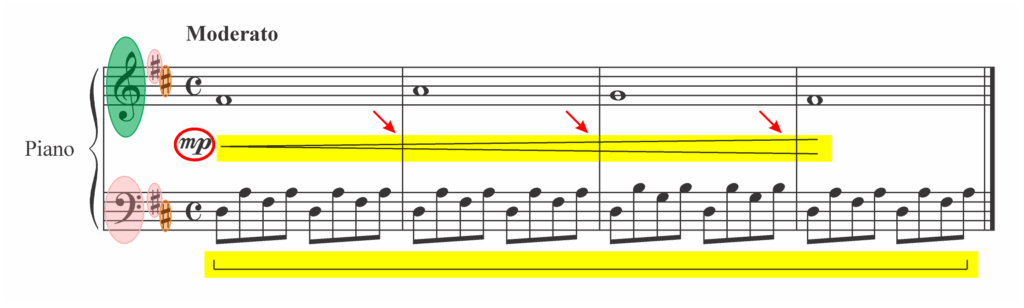
How to Color the Music Score to Successfully Focus Special Needs and LD Students on Features of the Sheet Music - example of applying highlighter to pedal and dyanimcs - What Purpose Do Accidentals Serve in Reading Sheet Music -
  • When applying color to the music score, circle all the dynamics in red, except for the crescendo and decrescendo symbols. Highlight them instead. If the words crescendo or decrescendo/diminuendo are instead printed in the score, use the red pen for the words. However, still use the yellow highlighter for the dashed line.
  • Notice how I use red arrows to point out where a student needs to get louder when performing the crescendo. This makes sure the student does not get loud too quickly or too slowly.
  • One of my students on the autistic spectrum had a problem with pedaling. I found it difficult to get him to press down the piano’s pedal when I pointed at the score. When I started highlighting the pedal symbol, he no longer had any problems seeing when he needed to press down.

Many Highlighter Colors and How to Color the Music

There are many highlighter colors, but I stick with yellow. It seems to be the best for focusing the student’s attention on the highlighted notation.

  • I have known other music teachers, including one who works with ADD, LD, ASD, and special needs students, who used a variety of highlighter colors to differentiate various features of the score. So far, I have not needed that much variety. If you wish for more options, you can use any highlighter color you want, giving the score a stratified effect.
  • Effective use of multisensory teaching can make the difference between success and failure, especially for special needs and LD students. Color the music score and watch your students achieve the next level of playing beyond notes and rhythms.

Accents have a slightly different treatment and will be dealt with in the next post.

© 2020 Geoffrey Keith

Newsletter Signup

Join me for in-person or online music lessons!

Back to the Color Coding Blogs Page

Back to the Successful Music Student Blogs Page

Glossary

Whats a Good Alternative to a Metronome for Practice Sessions - Metronome - I’m Having a Hard Time Keeping a Steady Beat - Singing Rhythm - BPM (Using the Metronome to Get the Music Beat) - - How to Learn Music Theory with a Learning Disability

What’s a Good Alternative to a Metronome for Practice Sessions?

Teachers, do you have students who can’t use a metronome and can’t keep a steady beat? We all know how valuable metronome practice can be. However, it can be tricky for students to sync with a metronome, and many students flat out refuse to work with them. Click to answer the question, “What’s a good alternative to a metronome for practice sessions?” Estimated reading time 2 minutes.

Read More

https://successmusicstudio.com/17-songwriting-ideas-to-get-you-unstuck/

17 Songwriting Ideas to Get You Unstuck

“Do you have tips on what to do when you get stuck?” We’ve all been there. You stare at a blank page and can’t come up with any ideas. To help you I’ve compiled a list of 17 songwriting ideas to get you unstuck. Each songwriting idea has a link that leads to an example showing how it works in a real song. Keep reading to get the 17 songwriting ideas. Estimated reading time 2 minutes.

Read More

Anyone Can Learn to Sing, Including You - Woman Singing into a Firey Mic - What's The Basic Difference Between Falsetto and Chest Voice

Anyone Can Learn to Sing, Including You

Anyone can learn to sing, including you. An old Zimbabwe proverb says, “If you can walk, you can dance. If you can talk, you can sing.” So, if you can talk, why don’t you give singing a try? Read more to find out how it works. Estimated reading time 3 minutes.

Read More

singing major and minor harmonies in tune -singer

Singing Major and Minor Harmonies in Tune

Do you find minor harmonies harder to tune than major? Frustrated that you don’t sound as good as other singers? How well you tune impacts how good you sound, including the strength of your vocal tone. Read more to learn about singing major and minor harmonies in tune. Estimated reading time 5 minutes.

Read More